Image
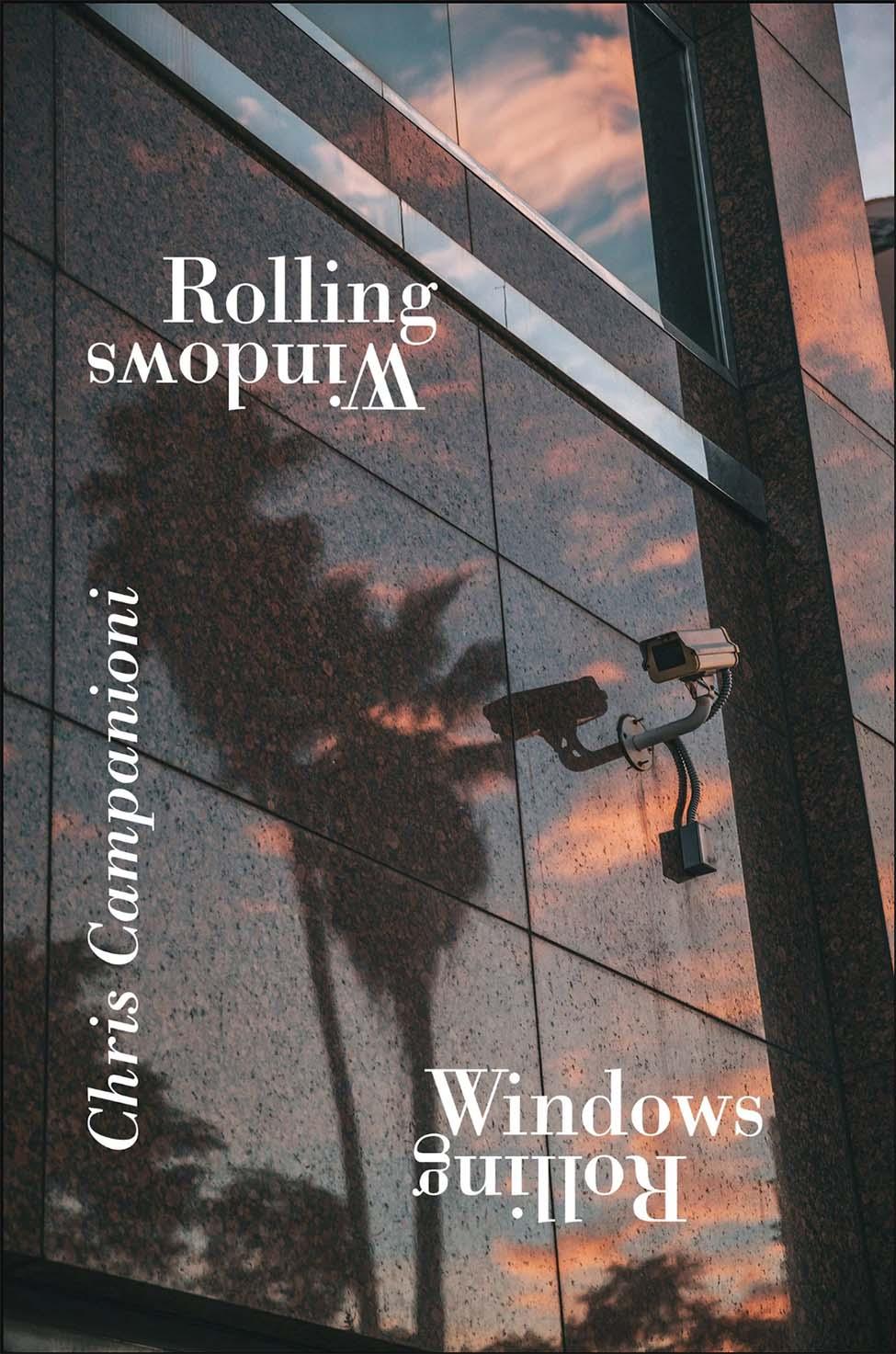

What is the central theme of your book?
Rolling Windows reenacts my investigations of migration, translation, and media ecology that rooted my earlier scholarly monograph, Drift Net. Because so much of the collection is written in prose, the narrative kernel of the book—diaspora, digital intimacies, and displacement—feels a lot more present, more cohesive or at least explicit than its sibling, Windows 85, which was written almost entirely in couplets and tercets. The poems here are much more horizontal, more sprawling and effusive, and—although I want to resist the stability of a singular “lyrical I”—maybe even also more autobiographical.
What inspired you to write this book?
Similar to many of my literary publications, Rolling Windows is a testament to my desire for testing out, complicating, and reevaluating theory and research by pushing it into the realm of poetry.
Why is this book important in your field? What does it contribute to the current body of knowledge on this topic?
There are certain ideas, gestures, intimations, moments of nascent understanding that I just don’t think are possible across all genres or modes of writing—this is why it’s important to continuously engage in exercises of self-translation. The goal, or one goal, I often tell my students, is to find a mode to accommodate different opportunities for discovery. What emerged when I began to re-write my fieldwork into a book of poems is something quite different than what I found when adapting the same research and encounters as a novel, a book of creative nonfiction, or the aforementioned monograph. Things change in translation.
Were students involved in any research related to your book?
A number of these poems were composed, at least in part and as early versions, during classroom writing activities. There’s a specific prompt—the Text as Caption—that has been so useful for my own writing; I can see why it’s such a popular assignment with my students! One aspiration of the prompt is to reverse the relationship between a caption and its image; in the Text as Caption, the caption becomes the image, restoring to the page an artifact that the reader can behold with their own eyes. It’s an ideal entry point for thinking about ekphrasis, and about the stewardship of memory and experience, to conjure something that is no longer present, no longer available to be seen. But the assignment also gets students thinking about the limitations of visual representation and the terms of visibility, particularly in relation to our practices across social media, as well as broader ideas about legibility and meaning-making that counter the protocol normalized by de facto AI assistants and Large Language Models. As a student observed this past spring: A caption can name a place, but it cannot fully hold the feeling of standing beneath it. To rethink captions, then, is to see them not as conclusions, but as openings: small invitations into a larger, unfinished experience.
Tell me about a particularly special moment in writing this book.
The title poem (“rolling windows”) was the first to be written; it’s the longest in the book—twenty pages and sixty-six verses—but it all began on a flight from JFK to Naples, where I would eventually transfer to Catania, in Sicily, to continue the fieldwork I’d begun the summer before on discontinuous paths of historical exile and the present “migration crisis,” as it was then being called by government officials and media personnel. A year earlier, I had been awarded a grant to basically travel in the footsteps of Walter Benjamin during his seven-year exile throughout France. Rising xenophobia, mass evictions and deportations, and the demolishment of former sites of refuge followed me on my journey; it was as if Benjamin’s letters became a legend from which I could decipher the whirlpool of history, swirling back to meet each of us in the very sites we both traversed.
I’ll never forget the morning I returned to Catania, by boat, after a short getaway in the nearby Aeolian Islands, because the Diciotti, rescued at sea by the Italian coastguard, also disembarked, just meters away. Its passengers were stranded in a holding pattern for many months, making me think about the ways in which one can be at once “rescued” and “refused” in the logic and structure of humanitarian discourse. So it felt like history and the present were coinciding, and that I was likewise a coincidental witness to that convergence. In the book, without explanation, I smuggle the erroneous statistic “nine hundred and thirty-seven passengers” (in reality, the Diciotti carried one hundred and seventy-seven people on board)—a reference to the MS St. Louis, which carried Jewish refugees fleeing Nazi Germany in May of 1939, and which was similarly refused by Cuba, the United States, and Canada—to further encourage proximity between the conditions that denationalized and displaced Walter Benjamin and our contemporary moment.
I especially like that the book began in its earliest composition on a plane, and that the poem’s first verse begins there, too, during a flight that would take me to another flight. In those indeterminate and scattered moments of layover, the non-signal of Airplane Mode.
What other books have you published?
This is my second poetry collection, following 2024’s Windows 85, which was also published by Roof Books. Last year, I published a novel called VHS (CLASH Books), which recently won the Mary Shelley Award for Outstanding Fictional Work; a creative nonfiction called north by north/west (West Virginia University Press), and a scholarly monograph on works of art born in translation called Drift Net (Lever Press).
What are you reading right now?
I just finished reading Kyle Carrero Lopez’s extraordinary debut poetry collection, Party Line, which was published by Graywolf a few weeks ago, before I left the country. I’m writing this from Paris, where I’m set to give a talk at the École normale supérieure for the Derrida Today biennial conference. To prepare for the discussion, which is roughly about ghost images, screenshots, and the montage processes of Computer Vision, I watched a lot of movies. The two that helped me the most were After Life (1998; directed by Hirokazu Kore-eda) and the much more recent Pictures of Ghosts (2023; directed by Kleber Mendonça Filho). The two films move so differently from one another, but both are interested in pursuing an idea about transcending mortality through the moving image.