Image
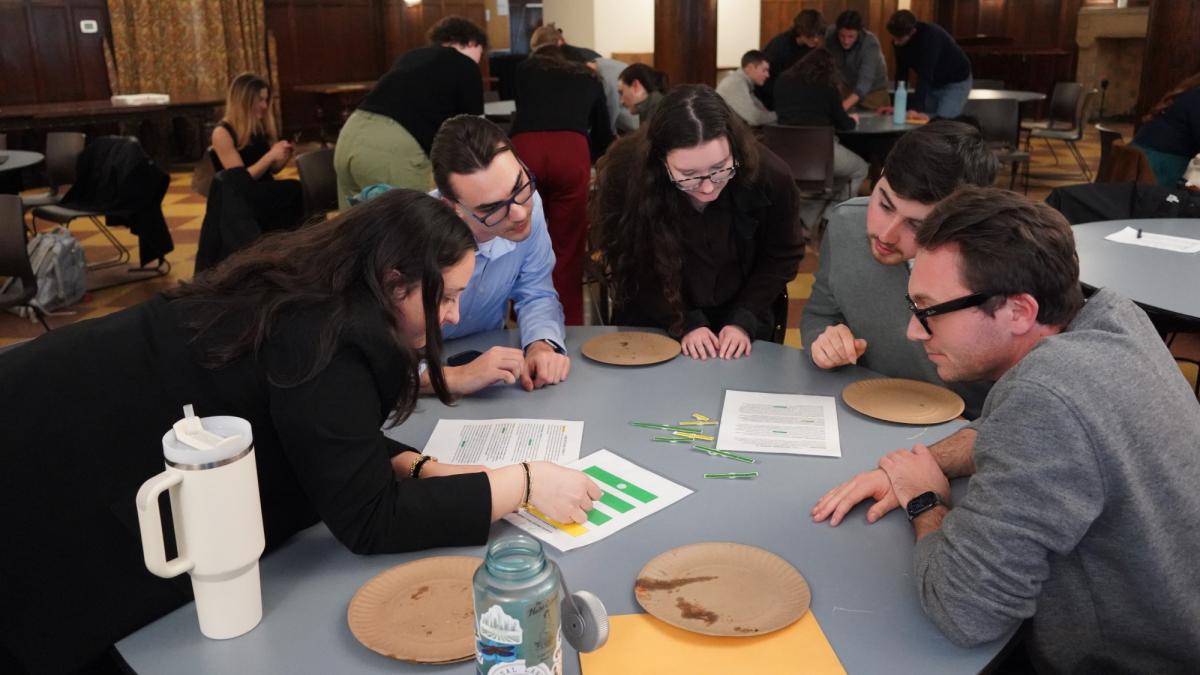

On Thursday, February 5, 2026, student scholars of the Land Use Law Center (LULC) at the Elisabeth Haub School of Law at Pace University hosted a faculty and student showcase highlighting years of research and collaboration on Climate Resilient Development. The event underscored the vital role that Pace Haub Law students play in advancing innovative legal strategies to help communities respond to the growing challenges of climate change.
The evening opened with remarks and a keynote presentation by Maureen Hartwell, a recent Pace Haub Law alum whose work has been closely intertwined with the Center’s climate resilience initiatives. Hartwell traced the evolution of the Land Use Law Center’s efforts to develop a comprehensive Climate Resilient Development Framework—an ambitious project designed to equip local governments with practical, legally grounded tools to address climate mitigation and adaptation.
At the heart of the initiative is a “Framework Law,” a one-stop resource that compiles leading case studies and model approaches. The document highlights local legal strategies, including supplemental zoning codes and special plans, organized around twelve core mitigation and adaptation topics. These range from disaster mitigation and sea level rise to distributed energy and other forward-looking resilience measures. By synthesizing years of research into an accessible, practice-oriented guide, the Framework aims to bridge the gap between climate science, community planning, and municipal law.
Following the keynote, Hartwell moderated a panel featuring Land Use Law Center scholars and 3L students Emily Petermann, Cassidy Yelincic, Alexandra Phillips, Evi Patterson, and Madison Bishop. The panelists offered insight into their research contributions to the Framework and reflected on the challenges and opportunities inherent in crafting legal tools responsive to diverse local contexts.
The discussion highlighted case studies addressing both adaptation and mitigation strategies, including approaches to sea level rise and land use planning in vulnerable communities. Panelists also explored how municipalities can deploy the Framework to strengthen resilience, as well as how the tools they studied might be applied in their own home communities. The conversation demonstrated not only the depth of the students’ doctrinal research but also their growing capacity to think strategically about implementation, equity, and long-term sustainability.
A lively Q&A session followed, with faculty and students engaging the panelists on practical applications of the Framework and the evolving role of land use law in the climate era. The event concluded with an interactive activity, led by Michael Reilly (2L student), in which small groups worked directly with the Framework to identify climate risks and the corresponding legal tools embedded in the case studies
The showcase reflected the Land Use Law Center’s longstanding commitment to training the next generation of land use and environmental lawyers through hands-on, policy-driven scholarship. By contributing to the Climate Resilient Development Framework, student scholars are not only deepening their legal expertise but also helping shape a body of work that communities can use to confront climate risks with concrete, locally grounded solutions.

Professor Thomas McDonnell offers advice to incoming law students.

The Women’s Association of Law Students (WALS) at the Elisabeth Haub School of Law at Pace University hosted its annual Pioneer of Justice and Equality Award ceremony on March 18, 2026, recognizing Cindy Kanusher, Esq., Executive Director of the Pace Women’s Justice Center, as this year’s honoree.

The Elisabeth Haub School of Law at Pace University is proud to announce that ten policy motions led by Pace Haub Law students were officially adopted at the International Union for the Conservation of Nature (IUCN) World Conservation Congress, held October 8–16, 2025, in Abu Dhabi, United Arab Emirates. A cohort of four Pace Haub Law faculty members, five students, and six alumni traveled to Abu Dhabi for the 2025 World Conservation Congress where they negotiated revisions to motions, crafted new and urgent motions, presented at sessions, addressed the IUCN President, and continued their environmental advocacy.