Image
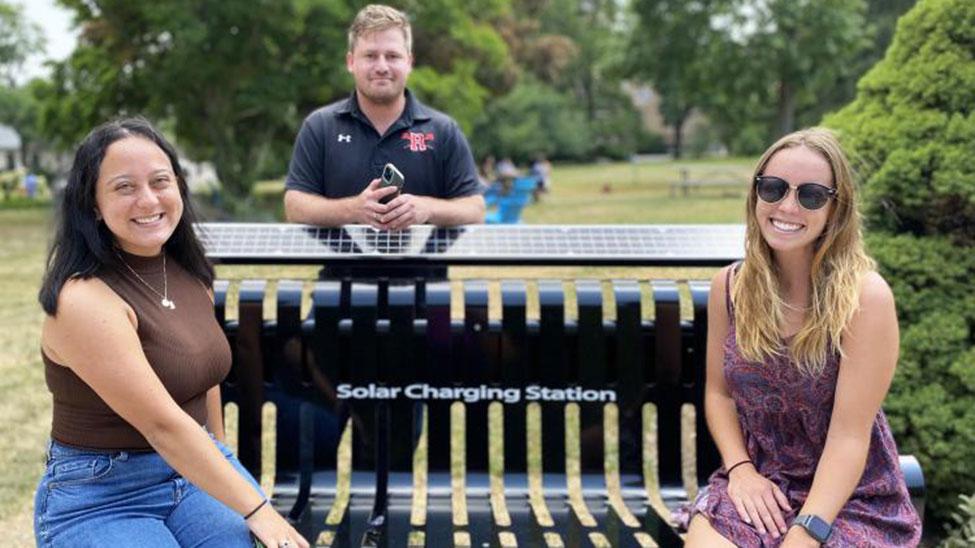
The Elisabeth Haub School of Law is proud to announce the addition of six solar charging benches along with two solar charging poles to its campus. The project is part of a multi-faceted wellness initiative spearheaded by the Office of Student & Campus Affairs titled, Haub Law’s Hub of Belonging: The 8 Pillars of Wellness. The benches and charging poles are the latest fulfillment by Haub Law in standing commitment to the school’s wellness initiative, which focuses on the wellbeing of law students during their time in law school and thereafter.
To fulfill the goals of the wellness project, last year Haub Law launched a series of programming and campus initiatives incorporating the eight pillars of wellness: mental and emotional, social, intellectual, financial, spiritual, physical, occupational, and environmental. The new solar charging benches and solar charging poles fulfill the environmental wellness pillar, with an added bonus to support the School’s continued efforts to reduce the campus energy footprint. The solar charging benches, centrally located on the Preston Quad, ensure maximum energy absorption and result in efficient energy storage and distribution in an environmentally safe and friendly manner. Similarly, the solar charging poles have many of the same features as the benches, but is also equipped with four Rapid-Charge USB ports, including one underneath the table for handicap access.
“The goal of this project has always been to enhance and ensure the optimal well-being of our law students,” said Dean for Student & Campus Affairs, Angie D’Agostino. “This project provides an amenity that is both convenient and efficient, and improves student access to outdoor workspaces. We will continue to focus on programming and initiatives to help students find fulfillment across all facets of well-being. Our programming has and will continue to also incorporate elements of diversity, equity, and inclusion.”
Funding for the solar charging poles and benches came in part from a grant received from Pace University and also from the University’s Demand Response program. Each summer, the University receives funding to reduce electric usage during the times that the Electric Grid is most stressed, which is typically during the hottest days of the year. Committed to environmental excellence, Haub Law exceeded expectations during these events, and as a result, the University was able to allocate funding specifically for this project.

Professor Emily Gold Waldman has been awarded the 2026 Goettel Prize for Faculty Scholarship.

Haub Law launches the Environmental Law Fifty Fund to support innovative research, scholarship, and collaboration among junior environmental law scholars.

The Elisabeth Haub School of Law is proud to announce that the 2026 Elisabeth Haub Award for Environmental Law and Diplomacy will be jointly awarded to environmental lawyers Alfred Lahai Gbabai Brownell Sr. and Durwood Zaelke for their groundbreaking contributions to the progressive development of environmental law and their decades of leadership advancing environmental justice, climate action, and environmental governance around the world.