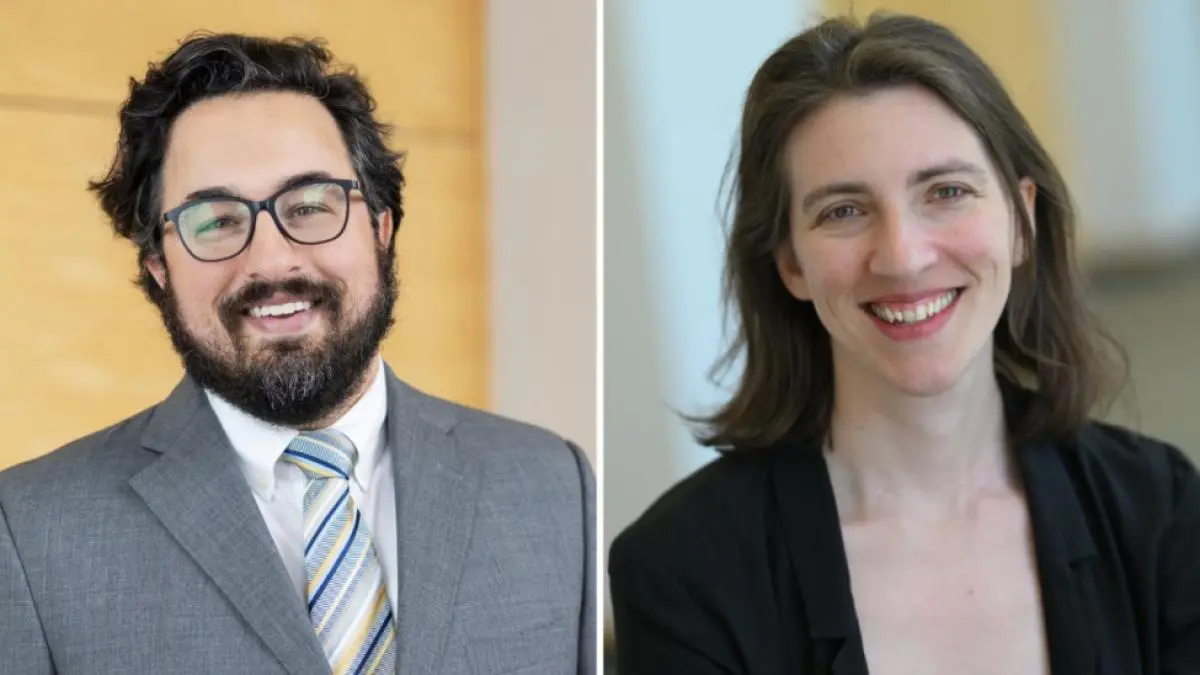
The release follows a successful premiere at Jacob Burns Film Center that brought together PaceDocs alumni, students, and faculty
Documentary celebrates the program’s legacy of connection and storytelling
Pace University’s award-winning documentary film team, PaceDocs, today released its latest film, Stories Come Together. It follows a successful premiere at the Jacob Burns Film Center, which last week brought together students, alumni, faculty, and supporters to celebrate the lasting impact of the University’s documentary filmmaking program.
Through interviews with more than 30 alumni and faculty members, the documentary captures the legacy of connection, storytelling, and mentorship that has defined the Producing the Documentary course for more than two decades.
Stories Come Together is now available on the PaceDocs YouTube channel.
The premiere also served as a celebration of Professor Emeritus Maria Luskay, EdD, whose leadership helped shape the PaceDocs program for more than two decades.
“One of the most rewarding parts of this course has always been watching students discover their voices as storytellers,” said Luskay, professor emeritus of the Producing the Documentary course and past director of the graduate program in Communications and Digital Media. “Seeing Lou carry on my legacy through Stories Come Together is incredibly special.”
As part of the production process, the 2026 PaceDocs team traveled throughout the Northeast during spring break, conducting interviews with key figures including Dr. Luskay and Andy Revkin, an environmental journalist, musician, former New York Times writer, and former Pace University professor who co-instructed the course. From managing equipment and coordinating travel logistics to logging footage and shaping the film under a tight deadline, students experienced the full scope of documentary production.
The premiere featured a post-screening Q&A session with the filmmakers and alumni featured in the documentary, many of whom reflected on the lasting influence of the course both personally and professionally.
“Working on this documentary allowed us to build meaningful connections both with the people we interviewed and with each other as a team,” said Sarah Montimaire ’26, a digital cinema and filmmaking major from Brooklyn, New York. “By the end of the semester, we really had become a family, and that sense of connection is reflected throughout the film.”
The premiere also welcomed many PaceDocs alumni featured in the film, several of whom reflected on how the course helped shape their careers in film, media, and storytelling.
“Producing the Documentary was the class that truly prepared me for my career,” said Joseph Gonzalez ’19, who worked on documentaries filmed in Cuba, Puerto Rico, and Hawaii while at Pace. “The hands-on experience and collaborative environment had a lasting impact on me, and I cannot imagine where I would be today without it.”
Over its 24-year history, PaceDocs has produced 23 documentaries across 14 countries, earning more than 30 awards. Stories Come Together continues this proud tradition of producing high-quality, meaningful, and award-winning films.
“Producing the Documentary taught me about the chaos of production, and the power of a team. And most importantly, it taught me about how telling stories can connect us,” said Lou Guarneri, clinical associate professor of media and communication arts in Dyson College of Arts and Sciences and head of the Producing the Documentary course. “My students and I hope that our film paints a picture of the beautiful chaos that is Producing the Documentary. A look into everything from script to screen, how Stories Come Together.”
In recent years, Pace filmmakers have created documentaries around the globe, exploring topics such as the musical traditions of the Azores and the cultural legacy of the Viola da Terra (Viola da Terra: Harmony of the Azores, 2025), the craft of barrel making in Spain (The Cooper, 2024), which received multiple international awards; the farm-to-table food movement in France (2023); how oysters depend on the ebb and flow of tides (2022); the importance of bees as pollinators in our food supply (2021); the eruption of Kīlauea in Hawaii (2019); the endurance of the people of Puerto Rico in the aftermath of Hurricane Maria (2018); Cuba at a cultural crossroads (2016); reviving Curacao’s coral reefs (2015); as well as many other poignant films.
“For 24 years, Producing the Documentary has given students the opportunity to immerse themselves in every aspect of the filmmaking process while telling meaningful stories around the world,” said Tresmaine R. Grimes, PhD, dean of Dyson College of Arts and Sciences. “Stories Come Together celebrates the connection, legacy, and storytelling that have defined PaceDocs and shaped generations of students and alumni.”
About Pace University
Founded in 1906 and celebrating 120 years of preparing students for success in 2026, Pace University pairs real-life learning with strong academics to launch meaningful careers. With campuses in New York City and Westchester County, Pace serves 13,600 students across a range of bachelor, master, and doctoral programs through the College of Health Professions, Dyson College of Arts and Sciences, Elisabeth Haub School of Law, Lubin School of Business, Sands College of Performing Arts, School of Education, and Seidenberg School of Computer Science and Information Systems.
About Dyson College of Arts and Sciences
Pace University’s liberal arts college, Dyson College, offers more than 50 programs, spanning the arts and humanities, natural sciences, social sciences, and pre-professional programs (including pre-medicine, pre-veterinary, and pre-law), as well as many courses that fulfill core curriculum requirements. The College offers access to numerous opportunities for internships, cooperative education and other hands-on learning experiences that complement in-class learning in preparing graduates for career and graduate/professional education choices.