Image

Research at Pace has really gone to the dogs.
And according to Dyson College of Arts and Sciences assistant professor Molly Byrne, PhD, they may hold surprising clues about what makes us human.
Molly Byrne runs the Pace University Dog Lab (PUDL), a research lab based out of the Pleasantville Campus that is dedicated to investigating “how dogs think, learn, and perceive the world and how the special bond between humans and dogs has been shaped by our shared evolution.”
One thing that I love about dog science is that it's super accessible for people of all levels.
Byrne has a background in psychology and neuroscience, with a focus on animal psychology and comparative cognition. Through PUDL—one of only 15 dog cognition labs in the United States—she is applying those disciplines to better understand both canine and human behavior. “Comparative cognition studies psychology through an evolutionary lens,” she explains. “I'm really interested in how humans became the way we are, why we’re so good at being social, cooperating, communicating, so on.”
Historically, comparative cognition research has focused on apes. But Byrne notes that, despite sharing a common ancestor, humans and apes have vastly different lived experiences. “Apes live in a very different ecological niche than humans.” she explains. “To show what kind of pressures the human niche has, we have to look at animals that live in the human niche, and that’s what led us to dogs.”
Byrne says dogs offer a unique perspective because they are raised alongside humans, and have evolved to respond to our language, emotions, and social interactions. “Dogs are really good at a lot of the social tasks that apes aren’t so good at, because they have been bred over thousands of years to be able to pick up on human social cues,” she explains. “They also tell us a bit about what we value, because we chose a lot of what dogs are.”
Though dogs are more accessible research subjects than apes, laboratory studies come with limitations. Some dogs—including those that are reactive, anxious, or unvaccinated—cannot participate, while those that do often behave differently in an unfamiliar environment, being observed by new people.
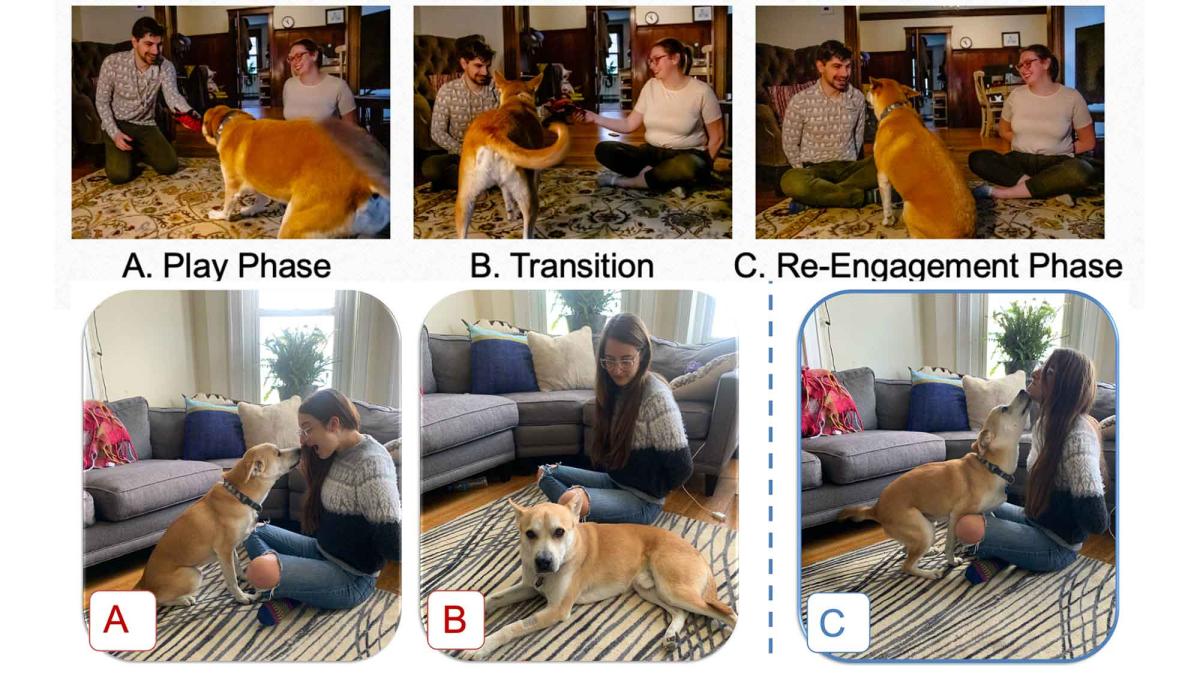
To solve those challenges, Byrne and her colleagues took dog research out of the lab and into the living room. They began conducting studies over Zoom, allowing researchers to observe dogs where they are most comfortable. “Because dogs don't really care about screens or digital communication, it's almost like being a fly on the wall,” Byrne says.
Byrne and her research team instruct dog owners while observing remotely. Using this approach, they have conducted a canine twist on the still-face experiment, measuring dogs' reactions when their owners altered typical interactions such as speaking to them without petting them. Byrne’s research has also explored joint intentions—whether dogs understand that doing something together differs from doing something alone.
Byrne's study of joint intentions may offer clues about what scientists call theory of mind: the ability to recognize that others have thoughts, beliefs, and feelings different from our own. According to Byrne, theory of mind is central to understanding what sets humans apart. “That concept is critical to what we think is different about humans, because humans have very advanced theory of mind,” she says.
While Zoom expanded the pool of canine participants, PUDL is also opening doors for student researchers, where all the data collection is conducted by undergraduate students. "One thing that I love about dog science is that it's super accessible for people of all levels," she says. "I'm always happy to take and mentor students who are interested in participating in the research process." As PUDL continues to grow, Byrne hopes to introduce in-person studies that will provide students with additional hands-on research experience and welcome more dogs and their owners to participate in research.
I'm really interested in how humans became the way we are, why we’re so good at being social, cooperating, communicating, so on.
For Byrne, her research poses questions that extend far beyond dog psychology. By studying how dogs communicate, build relationships, and respond to the people around them, she hopes to better understand the social abilities that make us human.
"I think a lot of my research suggests that the social part of being a human is maybe the most important part," says Byrne. "And I think that dogs showcase that."
Get involved with PUDL as a dog owner or student researcher and check out Byrne’s First Year Seminar, Mind of the Dog.

In a world where everyone can share the news, who decides what's true? Drawing on more than a decade of research, associate professor Mirjana Pantic explores how readers can participate responsibly in the news while separating fact from fiction in her book, Digital News Literacy and Participatory Journalism.

Inside the newly revitalized One Pace Plaza East, Pace University’s Commercial Dance students got their first glimpse of a space built for the way they move, create, and collaborate. What began as a social media shoot became a live lesson in experiential learning, as Sands students choreographed, directed, and performed original movement in minutes—offering a joyful preview of Pace’s next chapter in the performing arts.

From virtual patients to real-world readiness, students are training in high-stakes scenarios before they ever enter a clinic. Nancy Owen reveals how AI is reshaping that experience at Pace’s Center for Excellence in Healthcare Simulation.