Image
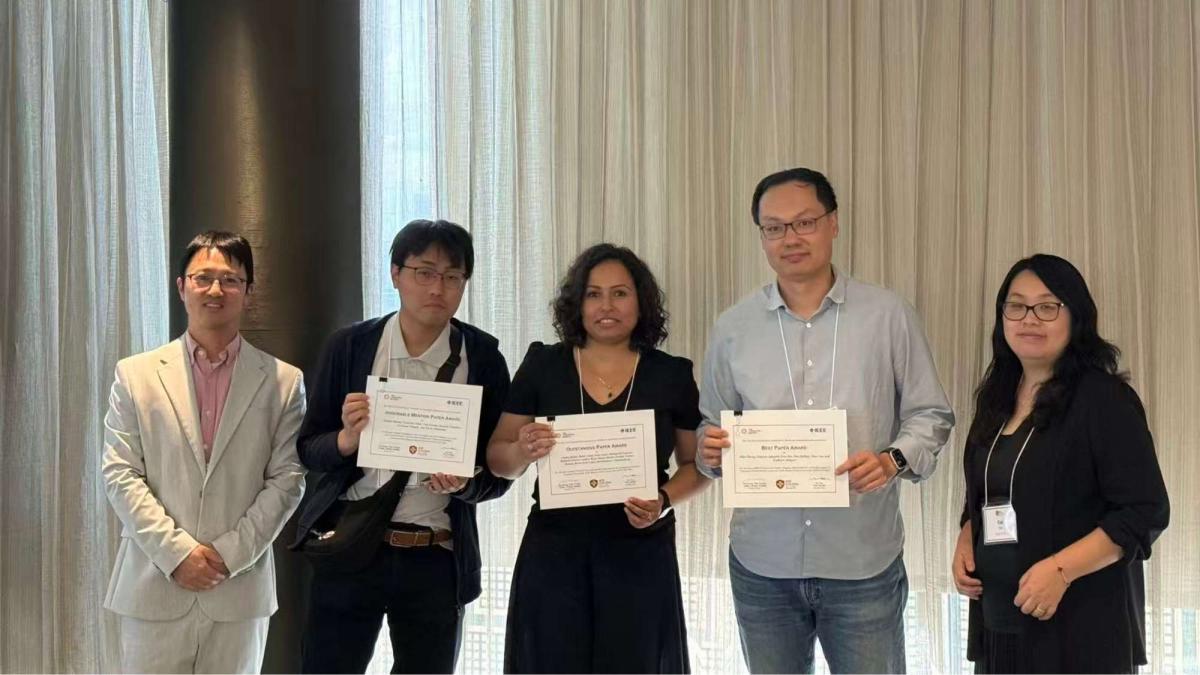

Zhan Zhang, PhD, Associate Professor and Director of the Human Centered Design program at Pace University’s Seidenberg School of Computer Science and Information Systems, received the Best Paper Award at the 14th IEEE International Conference on Health Informatics (ICHI), a flagship conference in the field of health informatics, for their research exploring how artificial intelligence can support decision-making in emergency medical services.
The award-winning paper, Promise and Caution: Mapping Opportunities for AI Decision Support in Emergency Medical Services, examines both the opportunities and challenges of integrating AI into emergency care. Co-authored by Pace student researchers Vanessa Fechi Agbugba, Enze Bai, and Sian Billings, along with collaborators from Southern Methodist University and the University of Colorado, the research seeks to identify where AI technologies can meaningfully support emergency care providers while ensuring that solutions remain practical, trustworthy, and aligned with real-world clinical workflows. As healthcare organizations increasingly explore AI-powered tools, the study offers important insights into how these systems can be designed to enhance care without disrupting the fast-paced realities of emergency medicine.
The recognition is particularly significant, as the Best Paper Award is typically reserved for the conference's top research contributions, highlighting the impact of the team's work in advancing the fields of AI and health informatics.
“Emergency care providers work in some of the most challenging and time-sensitive environments in healthcare,” said Zhang. “Our research focuses on understanding how AI can support their decision-making in ways that fit naturally into their workflow. Ultimately, the goal is to develop technologies that improve efficiency, reduce errors, and help providers deliver the best possible care to patients.”
The award-winning research reflects Zhang's broader focus on human-centered AI for healthcare, an area that has become increasingly important as hospitals and healthcare providers evaluate how artificial intelligence can be integrated into patient care. Rather than treating AI as a replacement for clinical expertise, Zhang's work emphasizes the development of workflow-compliant, easy-to-use, and interpretable systems that support healthcare professionals in making informed decisions during time-sensitive situations.
In addition to the award-winning paper, Dr. Zhang presented a second full paper at the conference, Pseudocode Generation from Clinical Protocol Flowchart using Large Vision-Language Models. The research investigates how advanced large vision-language models can help translate complex clinical protocols (e.g., flowcharts) into computer-executable pseudocodes that support the development of clinical decision support tools, a process that has traditionally required significant manual effort. Together, the two papers highlight different aspects of a shared goal: leveraging artificial intelligence to improve the delivery of emergency care.
The conference recognition builds on a series of notable research accomplishments for Dr. Zhang. Over the past several years, he has built one of Pace University's most distinguished research programs, receiving more than 2.5 million federal grants and becoming the first Pace professor to secure grants from both the National Institutes of Health and the National Science Foundation. He is also the first Pace faculty member to receive the NSF CAREER Award, one of the most prestigious awards for researchers in STEM fields. His federally funded research has evolved from wearable technologies and smart glasses designed to improve communication between emergency medical service providers and emergency department physicians to AI-powered clinical decision support systems that help healthcare professionals make more informed decisions in high-pressure environments. More recently, his NSF Research Experience for Undergraduates supplement grant has expanded opportunities for Pace students to participate directly in cutting-edge healthcare technology research while contributing to projects with real-world applications.
The recognition also highlights Seidenberg's growing impact in applied artificial intelligence research. Through collaborations with students, academic partners, and healthcare organizations, faculty researchers are advancing solutions to complex societal challenges while providing students with opportunities to contribute to meaningful, cutting-edge research.

Pace’s Break the Pattern with AI event explored how women in tech can use AI thoughtfully to challenge familiar ways of thinking and creating.

From empathetic chatbots to smarter AI project management, Seidenberg Professor Youngsoo Shin's latest research is advancing human-centered AI and positioning Pace University at the forefront of innovation across multiple disciplines.

Whether he's leading an AI internship, hosting a campus barbecue, or mentoring students, Seidenberg professor Matt Ganis approaches every opportunity with one goal: helping students succeed.