Image
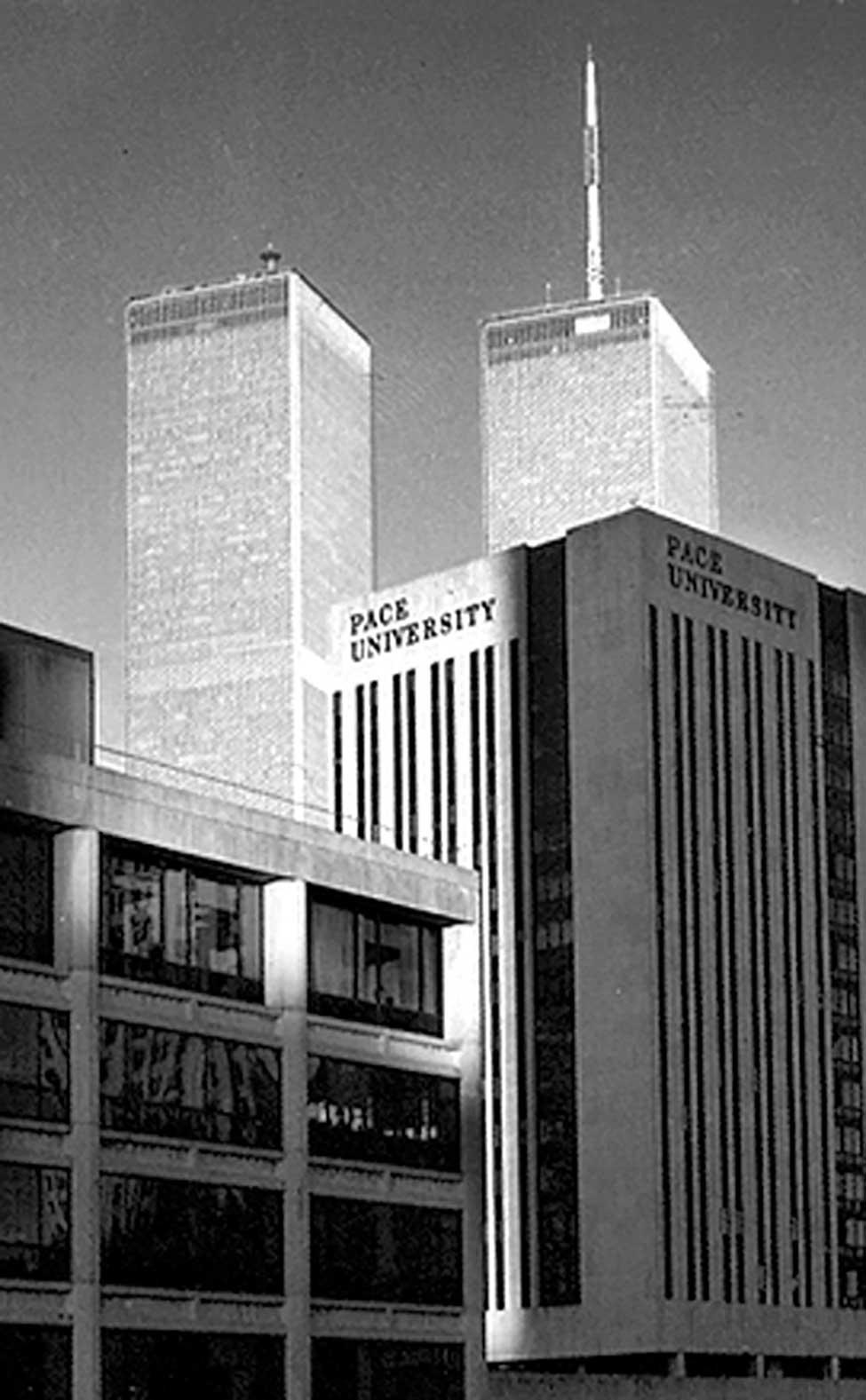

As Pace University marks the 25th anniversary of September 11, we are republishing this timeline, curated by Pace University Archivist Ellen Sowchek as part of the Pace University 9/11 Oral History Project. Drawn from University records and contemporary Pace publications, it documents how the events of that day and their immediate aftermath unfolded across the Pace community, from Lower Manhattan to Westchester, and captures the University’s response, recovery, and role in supporting students, employees, first responders, and the surrounding downtown community.
Tuesday, September 11, 2001, was the fifth day of regular classes and the second day of early-bird and evening classes for Pace University’s fall semester. In 2001, Pace’s Lower Manhattan campus, located in the heart of the civic and financial center of New York City, comprised several facilities:
It began as a beautiful day, with perfect weather, the kind of day when many would have probably preferred being outside rather than in class or at work. With classes beginning at 7:00 a.m., many students, faculty, and staff were already on Pace premises when American Airlines Flight 11 crashed into the north facade of the World Trade Center’s north tower at 8:46 a.m. Others were just emerging from adjacent subway and PATH stations when United Airlines Flight 175 crashed into the south tower 17 minutes later. Still others were on their way in, turned back farther uptown as first the south tower and then the north tower fell at 9:59 a.m. and 10:28 a.m., bringing the public transportation system and then the entire city to a halt, 102 unforgettable minutes that changed New York City forever.
There are many timelines available, some minute by minute, chronicling the events of that day and its immediate aftermath on a global level. At Pace, we are fortunate to have several chronicles of our own experience and our own response to events. The following is a general outline of what happened, compiled from information in two Pace periodicals: the student-generated Pace Press and the monthly in-house newsletter Opportunitas.
Within minutes of the planes crashing, Dean for Students Marijo Russell-O’Grady sends Student Life staff to the dormitory space at the College of Insurance on West Street, a block north of the World Trade Center. Staff urge students to come to the One Pace Plaza building.
Uptown, at the Pace Midtown Center, located on Fifth Avenue and 45th Street, President David A. Caputo is attending a meeting of the Executive Council and the Board of Trustees. He is notified of the crashes by New York Safety and Security Director Richard Abbinanti. The president sends the vice president for finance and administration, Leonard Sippel, downtown, and the Midtown Center is set up as a communications base. Pace’s main switchboard, located on the Briarcliff campus, erupts with a steady stream of calls, many from parents.
At 10:00 a.m., classes are canceled. Fearing additional attacks, security staff suggest that everyone remain in the building, but those wishing to leave are directed north. Some are already outside when the towers collapse.
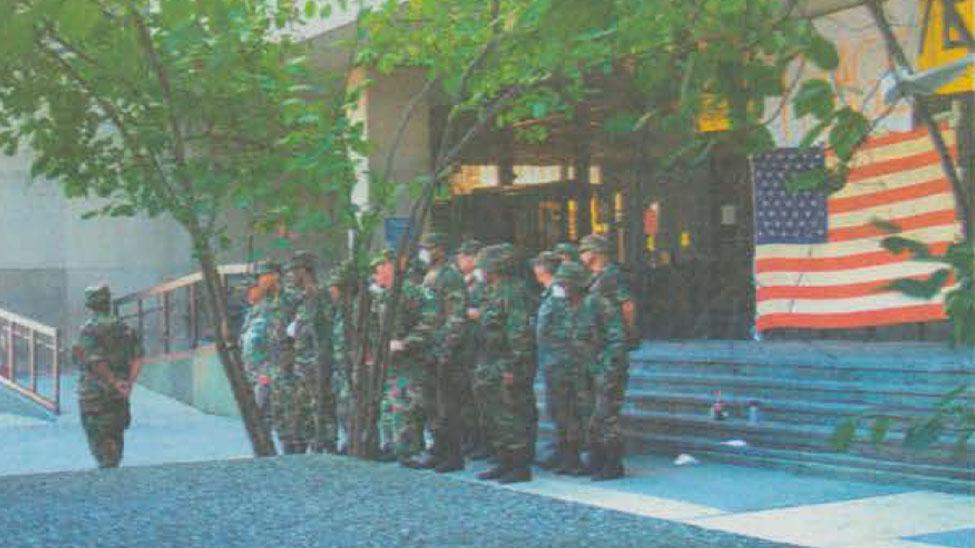
Security and Buildings and Grounds staff move everyone to the gym, the Spotlight Café, and the theater, where the air quality is best. Thanks to quick thinking by Victor Jabar, NYC Buildings and Grounds director, the building’s ventilation system is shut down to prevent contaminated smoke and dust from entering. A temporary cell phone system is set up to relay information to the switchboard operators in Briarcliff.
Pace is contacted by the New York City Fire Department to use the One Pace Plaza building. President Caputo gives the OK, and the New York City Office of Emergency Management transforms the admissions area into a field hospital. It later becomes a triage center for rescue workers and for anyone in the vicinity needing a place to stay.
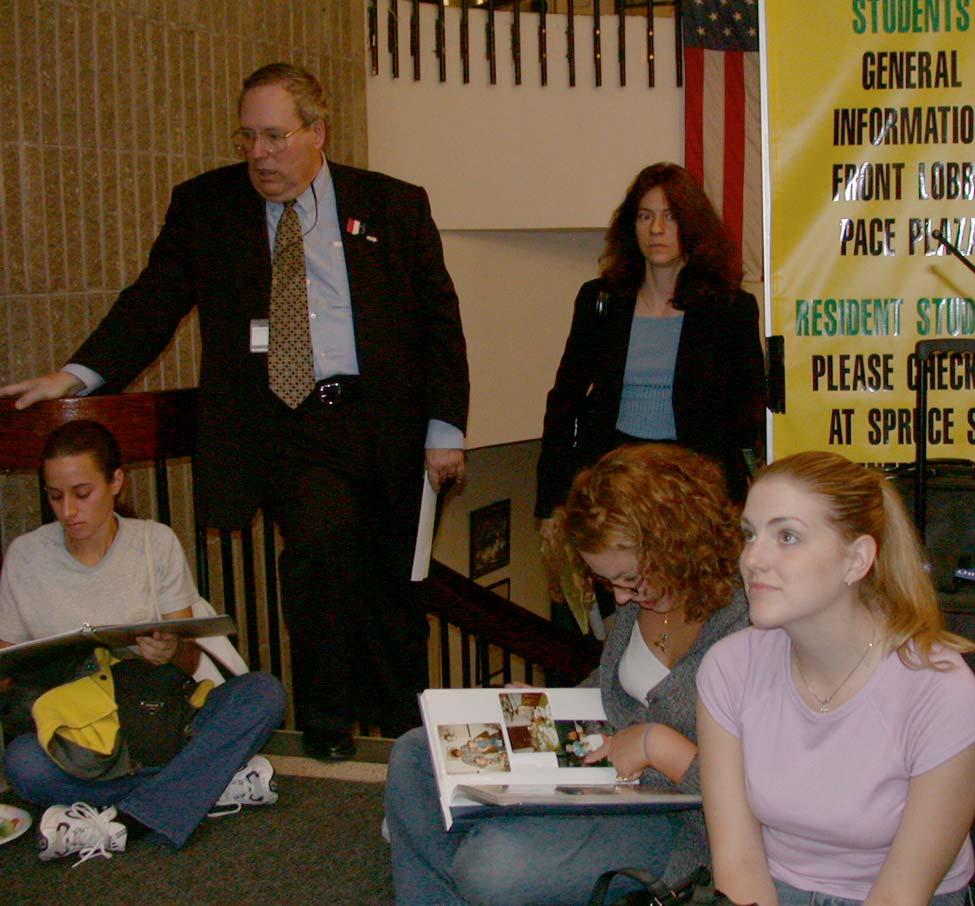
The director of Auxiliary Services asks the nine food service employees to stay and feed whoever is in the building. Thousands of students, faculty, staff, firefighters, police, and EMS workers are fed.
By late afternoon, students are allowed to return to the Maria’s Tower dorm. They are joined by President Caputo, Vice President Sippel, Dean Russell-O’Grady, Executive Assistant to the President Cindy Heilberger, and the director and two staff members from the Counseling Center. They remain all night.
By 7:00 p.m., Provost Marilyn Jaffe-Ruiz reports that faculty and staff, including those from the World Trade Institute, located on the 55th floor of the north tower, appear to be safe.
Pace loses electricity on Tuesday and must rely on emergency generators to power emergency lights in the dormitory, one elevator, and water and sewage pumps. More electricity is needed for the triage center. Paramount Studios in Long Island City arrives with portable receptacles and lighting, followed by a larger generator from Con Ed at 10:00 p.m.
On Wednesday morning, NYC Security Director Abbinanti secures five NYC buses to take New York students to Brooklyn and Pleasantville. Pleasantville students share their dorm rooms with their New York classmates.
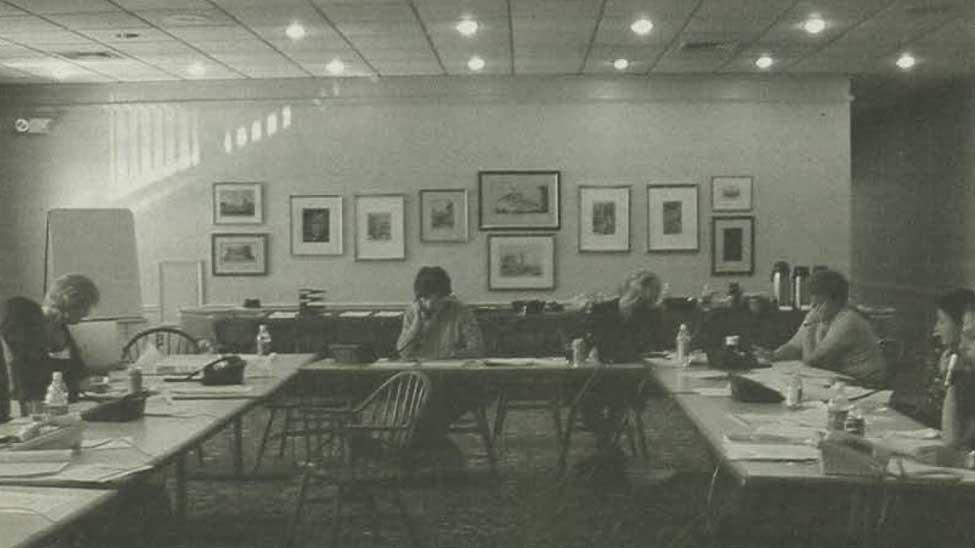
Westchester classes resume on Thursday. With phone service out, two toll-free hotlines are set up on Friday, one for employees and the other to field calls from parents and communicate with nonresident New York City students. Over the course of two weeks, 99 volunteers handle 6,692 phone calls. The University begins offering group counseling sessions for faculty and staff at the Midtown Center. More than 700 people attend.
On Friday, the decision is made to try to reopen on Wednesday, September 19.
One Pace Plaza remains open thanks to Security and Buildings and Grounds personnel. Cleaners and maintenance workers maintain restroom and shower facilities for the National Guard, which uses One Pace Plaza as a command post.
An emotional day in the life of the University, resident students, faculty, and staff begin returning to campus. Many are eager to resume their routine and look for ways to help. The Center for Community Outreach works with students to create a remembrance quilt and to publish a compilation of student photography, poetry, artwork, and prose stemming from their experiences.
The Center, together with the Dyson College of Arts and Sciences Dean’s Office and the Office of Multicultural Affairs, coordinates a four-session campus forum series on U.S. foreign policy, the history of the Middle East, terrorism, and civil liberties. The Michaelian Institute for Public Policy and Management offers a forum titled “The September 11 Tragedies: A Discussion of the Psychological, Economic, Security, and Political Implications.” These sessions are attended by more than 400 students.
In the days and weeks following its reopening, Pace University establishes itself as an important resource for the downtown community and a contributor to rebuilding and revitalization efforts. Primarily through the Center for Downtown New York (CDNY), created by President David A. Caputo, the University opens its doors to the community as a source of expertise in a variety of disciplines and as a gathering place.
In early October, Pace announced additional support for those affected by the attacks. The University established the Pace Remembers Memorial Fund to provide tuition assistance to spouses and children of September 11 victims, along with an endowed scholarship fund and emergency grants for current Pace students who had been displaced, lost employment, or lost a family member. Pace also contributed $25,000 each to the New York Police and Fire Widows’ and Children’s Benefit Fund, the United Way September 11 Fund, and the American Red Cross.
CDNY joins with the Pace University Small Business Development Center (SBDC) to promote the SBDC’s free services available to Lower Manhattan businesses. In the weeks immediately following September 11, the SBDC helps more than 100 merchants file for disaster and recovery loans. It also sponsors a number of conferences:
Faculty and students also play an important role during this time. The Pace Press, under the editorship of Shams Tarek, becomes a vital source of communications in the days following September 11.
History professors Bill Offutt and Nancy Reagin create a Yahoo! listserv and bulletin board for students after Pace loses communications capabilities.
More than 200 law students, led by Professor Vanessa Merton, provide free legal assistance to victims of the attacks. The Disaster Assistance Program helps those affected by the attacks identify their needs and secure representation.
The Student Government Association, led by President Nancy Owen, sponsors a three-day Antiterrorism Conference. Four students from Oklahoma City attend and participate in a panel discussion with six Pace students. Other panels include faculty-led discussions covering business and economic perspectives and the prevention of terrorism.