Image


On November 12, 2026, Professor Meghana Nayak, PhD, and her class of first-year students watched as the Elizabeth Jennings street sign was restored to its place on the corner of Spruce Street and Park Row. Weeks earlier, when preparing for her class, Feminist New York, Nayak checked for the street sign, only to find the sign missing. Her class leapt at the opportunity to work with the city to reclaim the site.
Natalie Hubbard ’30, who is studying political science, said, “When looking at where the sign used to be for Elizabeth Jennings, the placement is incredibly meaningful because of the history and current reality. It is powerful to think about standing here today, where millions of people take cabs and Lyfts without having to fear being denied transportation because of their skin color. People like Jennings are rarely given attention. When physical reminders of people like Jennings disappear, their stories could disappear as well.”
Elizabeth Jennings Graham was a Black female schoolteacher discriminated against when boarding a “white only” streetcar in NYC in 1854. At the time, streetcars were segregated, and she didn’t want to wait for a car which allowed people of color. She and a friend boarded. After the conductor kicked her off, police were involved and she was harmed. She wrote about the experience in The New York Daily Tribune, “I…told him I was a respectable person, born and raised in New York…and that he was a good-for-nothing impudent fellow for insulting decent persons on their way to church.”
She sued the privately-owned Third Avenue Railway, winning a small compensation. Her case paved the way for a moment for transportation desegregation in New York. He friend, Frederick Douglass wrote in Frederick Douglass’ Paper, “Our readers will rejoice in the righteous verdict. Miss Elizabeth Jennings, whose courageous conduct in the premises is beyond all praise…”
Jennings and her father co-founded the Legal Rights Association to fight in other cases of transportation segregation, and, with the collective efforts of New Yorkers, the New York State Civil Rights Act passed in 1873, which outlawed discrimination on all forms of public transportation and ended segregation.
Jennings went on to found New York City’s first kindergarten for Black children.
In 1991, four sixth-grade girls in a history club at the Museum of the City of New York researched the life of Elizabeth Jennings. Their work contributed to a play at the museum’s first history fair as well as a petition to ask the City Council to name one of the corners on Park Row after Elizabeth Jennings. The City Council never responded to the petition.
Years later, Miriam Sicherman’s elementary school students at PS 361 researched Jennings and, through meetings, signatures, and public pressure moved the City Council to produce the street sign in 2007. While Nayak’s course was advocating for the sign replacement, students from the Peace and Justice Studies program separately connected with Sicherman to work on getting the sign replaced as they recognized the significance of the memorial. The two routes of advocacy work came together in replacing the sign in November 2026. Sicherman will join Nayak’s course in December to share her story about how teachers and students make an impact.
When Nayak discovered the sign missing nineteen years later, her class took the opportunity to fight for justice and visibility for Jennings. “[I] had to include Elizabeth Jennings in [my Feminist New York course] because of her profound impact on Black women’s lives in New York City and the legacy of her fight for desegregation. After all, whose story could better illustrate the importance of feminist stories of New York City?”
Nayak’s students led the charge. The students worked with the City Council to replace the sign. After weeks of working in collaboration with the city, a new sign was produced and returned to its designated place at the corner of Spruce Street and Park Row. The first-year students were joined by representatives across the city, including; Council Member Christopher Marte; President of the Alliance for Downtown New York Jessica Lappin; Regina Shepherd, acting director of the New York Transit Museum; and Pace University President Marvin Krislov. After the sign was unveiled, a class of fourth-grade students from a local elementary school sang “Back of the Bus” by Harry Belafonte to commemorate the moment.
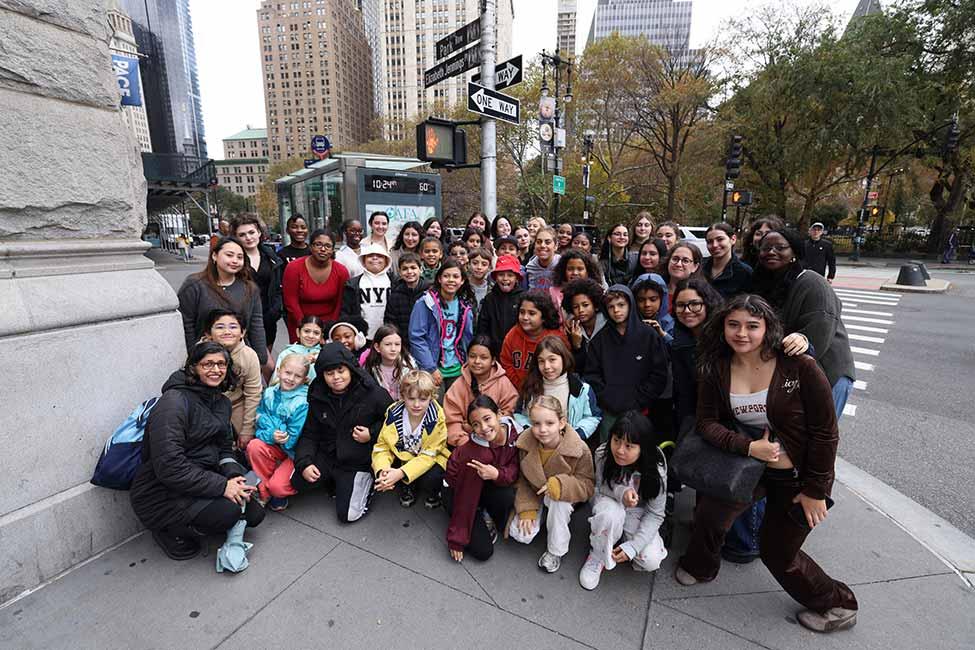
The impact of this research and work is felt strongly by the students who participated. Hailey Foster ’30, studying economics, shared, “Reading the accounts of Elizabeth Jennings, I am incredibly moved and empowered. Her resilience to not only fight for her rights verbally, but also physically had a great impact on me. Reading about how she was assaulted by the driver and still went back to get in the car for a second time moved me with her resilience. Jennings empowered me to use my voice and push it further and not give up when the world drags you down—even physically. She showed me that change is made when you keep fighting, no matter how hard it becomes.”
The class’s work on replacing the street sign for Jennings is an example of the way students are empowered to engage with the social and political world around them. These skills and lessons carry on long after they are done with this course.
Other students shared that this changed the way they viewed history. Olivia Salo-McCluskey ’30, studying film and screen studies, said, “Walking through New York City streets you feel more engulfed the more you learn of its history. Elizabeth Jenning’s story reminds me of other NYC female activists that I grew up learning about, who paved the way for the rights, world, and voices we hold today. I believe, as educated women in New York City, it is important to research the female activists who paved the way before us.”
And Anah Simwenyi ’30, pursuing a degree in writing for diversity and equity in theater and media, shared, “As a Black woman myself, I recognize that Jennings paved the way for me to advocate for myself. She walked so that Rosa Parks could run, and so that I could have a better future. So many unsung heroes remain in the shadows, and that raises the question: Why? Why do we, as a society, choose to tell certain stories while leaving others untold? What is there to hide, and who gets to silence history? I say no more.”

University Distinguished Professor Bennett L. Gershman of the Elisabeth Haub School of Law has published his debut novel, LAW STORY, a work of fiction that explores the intersection of professional ethics, personal relationships, and the complexities of human behavior.

As the pace of AI development accelerates, what’s trending in cybersecurity can quickly become an immediate threat. We reviewed what top analysts are saying is trending to offer an overview of the top cybersecurity trends for 2027. Read the post for full details and how Pace’s Seidenberg graduate programs teach the skills essential for staying ahead of the AI curve.

From the classrooms of Pace University to the stages of Romania, Sands College of Performing Arts faculty members Cosmin Chivu, PhD, and Graham Kindred, MFA, joined forces with student Mel Zago ’27 to bring an original musical to life, blending creative perspectives, theatrical traditions, and hands-on learning across cultures.