Joseph R. Ianniello '90 is the newest recipient of the Peter X. Finnerty Leadership Award. He'll be presented with this honor at the 2024 Pace Athletics Hall of Fame Brunch and Awards Ceremony, which will be held on Sunday, October 27.
The Peter X. Finnerty Award is presented to members of the Pace University Athletics community for outstanding leadership and service to the University or to society as a whole. Honorees exemplify those characteristics for which Peter Finnerty was best known: hard work, a spirit of competition, and the ability to serve and lead with integrity and to inspire others to do the same. This will mark the 10th time this honor has been awarded since its creation.
Ianniello earned a Bachelor's of Business Administration at Pace, and was a member of the University's football team and the Alpha Chi Epsilon fraternity on campus. Over the years he frequently mentored Pace students, returning to Pace's Lubin School of Business to share career and industry advice.
In April 2015, it was announced that Ianniello made a $2 million commitment to the construction of a new athletics field house at the University's campus in Pleasantville. Ianniello Field House was completed later that year and became a flagship facility of Pace University Athletics. Ianniello's contribution was a part of the University's Campaign for Pleasantville, which transformed and revitalized the 200-acre campus that also included new residential facilities, an expanded student center, and a new environmental center.
The Ianniello Field House is one of the most heavily utilized buildings on campus, with thousands of visitors per year. Pace athletes and coaches use this facility for practice, conditioning, and meetings, while the space is also used for special events with alumni, family, friends, and recruits. The 14,010 sq. ft. facility includes a strength and conditioning center and a sports medicine component.
Ianniello has also been a member of the Board of Trustees of Pace University since 2014. He joined the Board during a time of great change and significant investment in learning and living facilities at both the Westchester and New York City campuses.
"Over the course of my tenure here at Pace, no other gift has been as impactful as the support of Joe Ianniello," said Director of Athletics Mark Brown. "His visionary gift allowed for the construction of the Joseph R. Ianniello Fieldhouse and that building has transformed our entire athletic operation. In addition to his philanthropy, he also has provided his athletic perspective through his participation on the Pace Board of Trustees and his support of the entire Pace community. I acknowledge and thank Mr. Ianniello for his tremendous leadership and his belief in our athletic department."
Ianniello will be recognized with this year's Athletics Hall of Fame inductees. The newest members to be inducted into the Pace Athletics Hall of Fame will be Jeane Drury (Softball and Women's Basketball '15), Al Elliott (Men's Basketball '02), Casey Gelderman (Women's Lacrosse '18), Brian Pirone (Football '96) and Claudia Stable (Head Softball Coach/SWA). The Pace Athletics Hall of Fame was started in 1997 with this year's ceremony marking the 21st induction class.
Tickets for the event are available for $115 per person. For more information on the 2024 Pace University Athletics Hall of Fame Induction Ceremony, please contact Director of Athletic DevelopmentDrew Brownat (914) 773-3271 ordbrown4@pace.edu.
Congratulations to Jeane Drury '15, Al Elliott '02, Casey Gelderman '18, Brian Pirone '96, and Claudia Stabile, who will be inducted into the Pace Athletics Hall of Fame on Sunday, October 27 as part of Homecoming Weekend.
Seidenberg School of Computer Science and Information Systems
Pace University’s first-ever Game Development Playtesting Day saw nearly 30 students showcase more than a dozen homemade videogames. From small aesthetic tweaks to major gameplay changes, students like Brennan Moores '26, a computer science major, gained invaluable feedback on their creations.
Johnni Medina
This past spring, 27 students gathered for a Game Development Playtesting Day, showcasing their in-progress games to peers and visitors. The event featured 19 games created by 8 teams and 11 individual developers.
Playtesting is a key component of any game development, especially for video games where there are more technical variables. Having people test a new game not only helps gauge logistical functionality but also explores the player experience and, most simply, whether or not audiences enjoy the game. For students, it’s an invaluable opportunity to receive feedback and grow more confident in responding to constructive criticism, essential skills for their future careers.
Games are another way for people to express themselves and tell stories, just like film, music, theater. —Guida
Seidenberg Professor Carmine Guida, PhD, head of Pace’s new game development major, highlighted the importance for student’s to showcase their work. "I really want students to see what other students are up to in other courses so they get excited," he said. “Games are another way for people to express themselves and tell stories, just like film, music, theater.”
Image
A screenshot from the beginning of Moores' game Trigger Happy.
The playtesting day also offered students a valuable opportunity to see firsthand how others interacted with their creations. Brennan Moores ’26, a computer science major minoring in game development, shared how valuable it was to see the responses to his game, Trigger Happy. “It felt really good to have others play and test my game,” says Moores. “When each player was done, I received helpful feedback from them, ranging from small aesthetic tweaks to major changes in gameplay.”
It felt really good to have others play and test my game. —Moores
The event not only fostered peer-to-peer learning but also highlighted the collaborative and artistic nature of game development. “Game development is very collaborative,” Guida says. “I'm looking forward to seeing students who are interested in art, music, coding, etc, come together to build great things."
In the Seidenberg Lounge of 15 Beekman, Pace students have set up an arcade machine displaying games made by the Pace Community, for the Pace Community. Learn more about how this machine not only celebrates the love of gaming, but the importance of accessibility.
Discover incredible stories that showcase the amazing achievements and initiatives happening at Pace. From top rankings to groundbreaking programs and student journeys, there’s something to inspire everyone.
From campus renovations to pioneering research, the Summer 2024 edition of Pace Magazine captures the vibrant spirit and accomplishments of our community. We are proud to share stories of our top-ranked Environmental Law program, new faculty members, and much more.
Meet alumnus Drew D’Auteuil ’21, a true Pace Go-Getter! Despite battling a rare blood condition as a child, Drew transformed his experience into a passion for medical research. Today, he's a research technician at the same hospital where he received life-saving treatment. Read his inspiring journey of resilience and determination.
Zack Boehm
As a child, a rare blood condition changed Pace alumnus Drew D’Auteuil ’21’s life forever. Now, armed with a Pace education, he’s using the lessons of that experience to serve others.
In June 2009, as the end of fourth grade approached and the days warmed with summer’s arrival, ten-year-old Drew D’Auteuil was preparing for the next chapter of his typical Amherst, New Hampshire, childhood. He was a standout student with many friends, an avid soccer player and talented gymnast, a dog lover, a Nickelodeon watcher, and the third child of three.
Another school year was ending, another year passing in what had been a happy, healthy adolescence. But over the next several months, a series of debilitating medical challenges, rare diagnoses, prolonged hospitalizations, and miraculous recoveries would upend Drew’s typical childhood and change his life forever, setting him on a path that would lead him through Pace University’s Biology Department and into a research position at the same hospital where he had received pediatric treatment.
It started with shortness of breath, skin rashes, and the odd bruise after gymnastics practice. “Being young, I didn’t think much of it,” Drew said. “You don’t take those things seriously at that age.”
When his mother, an attentive nurse practitioner, noticed the severity and persistence of his symptoms, she brought him in for blood work. The results were immediately alarming, and Drew was rushed to the hospital for further evaluation.
It wasn’t long before Drew and his family received the diagnosis: aplastic anemia, an extremely rare blood condition resulting from damage to the bone marrow.
Image
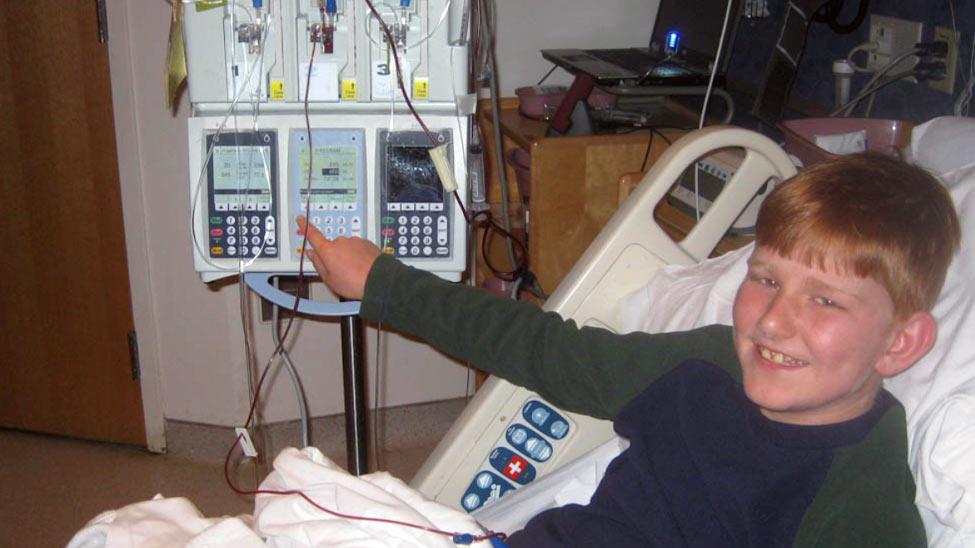
Drew as a boy receiving treatment at the Dana-Farber Cancer Institute.
“Basically, your bone marrow ceases to produce the blood cells your body needs,” Drew said. “Even today, we don’t really know what caused it. It could have been a fluke, maybe a virus. Who knows? But my bone marrow stopped producing enough white blood cells, red blood cells, and platelets.”
Drew and his family spent those first weeks of summer vacation adapting to the new normal of his condition and working with doctors to devise a way forward. The first treatment option involved specialized chemotherapy designed to clear the damaged bone marrow and revitalize blood cell generation. When that failed to produce the desired results, a full bone marrow transplant was scheduled for the fall.
The date was set, a donor was identified, and just weeks after his eleventh birthday, Drew received his transplant. The procedure was a success, and the next 100 days—a crucial period for transplant patients during which the risk of significant side effects is at its highest—elapsed with no sign of major complications. The new bone marrow was doing its job, and while Drew would never fully return to the typical childhood that had been so suddenly disrupted, it seemed that the worst was finally behind him.
But then, just a few months later, he started to develop a cough. “It just wouldn’t go away,” Drew said. “And then I started feeling tired.”
He was taken to the emergency room, where doctors discovered that his oxygen levels were plummeting fast.
“The next thing I remember was waking up and not being able to move,” Drew said. “Then my parents told me I had been in a medically induced coma for a week.”
It was definitely a full circle moment for me.
Drew had suffered from acute respiratory distress syndrome, an often-fatal condition in which the body is deprived of essential oxygen due to fluid in the lungs’ air sacs, likely resulting from the immunocompromising effects of his aplastic anemia treatment. That critical oxygen depletion led to multi-organ failure. His condition quickly turned grave, and his family began to prepare for the worst. Visitors came to the hospital for what they feared might be their final goodbyes. Last rites were given.
And then, one week after arriving at the hospital, he woke up. He didn’t know where he was, he didn’t know what he had experienced, he could not move his neck without extreme difficulty, but he had survived.
“It can be traumatic to think about,” Drew said. “For someone like me, a bone marrow transplant patient, an immunocompromised person, to go through something like that—the prognosis is basically in the negatives. But thankfully, I got through it. It was kind of miraculous.”
Recovery was arduous. The next year was spent relearning to walk, and more than five years of intensive physical therapy were required to regain the majority of his strength. But the unfaltering support of his family and his own inexhaustible perseverance continued to carry him through.
“My own memory is a little hazy, but my parents and my doctors always tell me that I rarely, if ever, complained,” he said. “I guess I realized that this was my new normal. This is how it was going to be, and I was going to roll with it.”
When high school was ending, Drew knew that he wanted to attend college in the big city, and he knew that—inspired by his mother’s success as a nurse practitioner and by his own history of health challenges—he wanted to pursue a career in the medical field. When Pace recognized his record of high achievement with a generous scholarship package, the decision of where to enroll was an easy one.
“It was a great community and great sense of camaraderie in Pace’s Biology Department,” Drew said. “It was very easy to get to know my classmates, and I was able to make connections with almost all the students in my program. My time at Pace cemented for me that, yes, I definitely want to be in a STEM-related field.”
Image
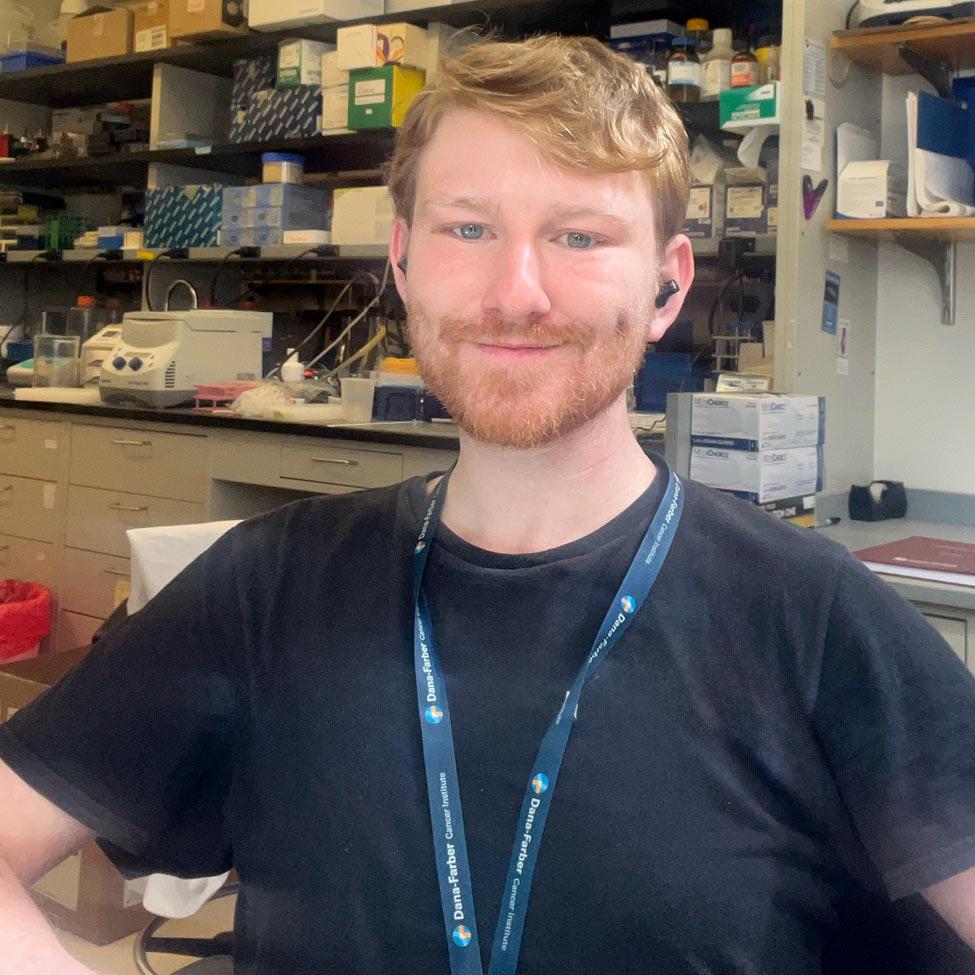
Drew now works at the same medical facility that treated him as a child.
In 2021, Drew graduated from Pace magna cum laude with a degree in biology and a determination to build vital medical research experience. He immediately began submitting applications to major hospitals in his native New England, including the Dana-Farber Cancer Institute in Boston, which had played a crucial role in his own treatment as a child.
After emailing the principal investigator of a Dana-Farber neuro-oncology lab about a vacant position, Drew secured a role as a research technician helping to explore novel treatments for brain tumors.
Just over a decade after Drew first began visiting Dana-Farber as a patient, he was now a member of the Dana-Farber team, contributing to groundbreaking research with the potential to change lives.
“It was definitely a full circle moment for me,” Drew said.
Today, while lingering side effects often remind Drew of the health crises that turned his typical New Hampshire childhood upside down, he is driven to use the lessons of those memories and the education he received at Pace in service of those who, like him, have been forced to navigate life-altering illness.
“I think I bring to the table an empathetic approach,” he said. “I know on a very personal level what patients are going through. It’s beyond studying something in a textbook. I’ve dealt with these things myself.”
From campus renovations to pioneering research, the Summer 2024 edition of Pace Magazine captures the vibrant spirit and accomplishments of our community. We are proud to share stories of our top-ranked Environmental Law program, new faculty members, and much more.
Why do humans speak the way they do? College of Health Professions Associate Professor Sethu Karthikeyan, PhD, is exploring the evolutionary biology behind voice pitch.
Lubin’s Ivan Fox Scholar and Professor of Law Jessica Magaldi, JD, is helping to close the gap between what’s reflected in course material and reality, by examining representation of women as protagonists and antagonists in case studies.
Through the exceptional achievements of men's and women’s lacrosse, baseball, and softball, Pace celebrated a spring season to remember.
Pace University Athletics boasted a spring season filled with success. Throughout the four spring season programs—men’s and women’s lacrosse, baseball, and softball—Pace celebrated several All-American honors, memorable moments, and postseason victories.
Women’s lacrosse earned their first-ever Northeast-10 Championship in program history, defeating Adelphi University, 16-14, at Northwell Stadium. Despite falling short in the NCAA (National Collegiate Athletic Association) tournament, the Setters put together an impressive season, finishing with a 21-1 overall record. The team was honored with four All-America selections, as Angelina Porcello and Alexandra Quinn earned IWLCA First Team All-America honors, while Delilah Doyle and Samantha Tanguay were selected to the IWLCA All-America Second Team. Regarding NE-10 major awards, Porcello earned Midfielder of the Year, Tanguay was selected as Goalkeeper of the Year, Quinn captured Defender of the Year, and Maddie Schubert took home Rookie of the Year while head coach Tricia Molfetta was honored as Coach of the Year. Porcello solidified herself as one of Pace's greatest athletes ever as she became the all-time points leader in Pace history with 284 points (206 goals, 78 assists).
Men’s lacrosse reached new heights on the field in 2024. The squad ended their season with a 13-4 overall record and earned their first NCAA Tournament win in program history against Mercyhurst University. Their NCAA Tournament run ended in the quarterfinals, but the Blue and Gold exceeded expectations in 2024. Their stellar season led to a handful of USILA All-American selections. Ryan Kemp was chosen for the first team, while Rafael Rodriguez, Jr. and Chris Caputo were named to the second team. The trio of Rowan Kelly, Maxwell Streety, and Daniel Zabbia were given honorable mentions. The season had a notable milestone for Head Coach Tom Mariano, as he earned his 100th career win.
Softball matched a program record for wins, finishing with an overall record of 33-16. In their outstanding season, the Setters earned an NCAA Tournament win over Bridgeport University that included a no-hit performance from Gisselle Garcia, her fifth of the year. After the season, Garcia was selected as the first-ever All-American in Pace softball history, earning NFCA Third Team honors and a D2CCA Second Team selection. Garcia put together one of the best pitching displays in Pace history, which included breaking the record for career strikeouts and earning NE-10 Pitcher of the Year. Garcia and Brianna Shea were chosen for the D2CCA All-East Region First Team, while Raelle Gorman earned a Second Team selection.
Baseball had an accomplished season in 2024, concluding with a 28-19 overall record. The Blue and Gold took home a win in the Northeast-10 tournament, defeating the College of Saint Rose 8-5. Although the team came up short of back-to-back Northeast-10 titles, they had many positive takeaways from their season. Dan Brown was selected as the Southwest Division Pitcher of the Year, along with an NCWBA All-East Region Second Team honor and his impressive year led to Brown signing with the Windy City Thunderbirds of the Frontier League. Freshman Dylan Koch earned the Southwest Division Rookie Hitter of the Year and an All-Rookie team selection. 13 total All-Conference selections were earned which marked the most from a spring team.
With the abundance of success in each program, it certainly was a spring season to remember at Pace.
Joseph R. Ianniello '90 is the newest recipient of the Peter X. Finnerty Leadership Award. He'll be presented with this honor at the 2024 Pace Athletics Hall of Fame Brunch and Awards Ceremony, which will be held on Sunday, October 27.
Congratulations to Jeane Drury '15, Al Elliott '02, Casey Gelderman '18, Brian Pirone '96, and Claudia Stabile, who will be inducted into the Pace Athletics Hall of Fame on Sunday, October 27 as part of Homecoming Weekend.
Alumni, we’re excited to announce the follow-up to our 2019 survey, launching on September 10, 2024! Your feedback has been vital in shaping the Alumni Association, and we need your input to continue improving.
In 2019, Pace University’s Office of Alumni Relations made a significant investment in its alumni community. By implementing our first comprehensive all-alumni survey, we sought to understand how we could enhance the alumni experience. Through email, mail, and social media, we asked you to “Join the Conversation” and share your insights. Your feedback was invaluable and led to the creation of the Alumni Association, which has provided new and exciting ways for alumni to engage with the University.
Since its inception, the Alumni Association has enabled Pace alumni to build community, support current students, and make impactful changes. Now, as we continue to strive for excellence, we want to hear from you again. Our work is far from complete, and we are inviting you to “Reflect, Respond, and Reconnect” to help shape the future of our alumni program.
We are excited to announce the launch of our follow-up survey on September 10, 2024. Please keep an eye on your emails and our social media channels for more details. In the meantime, ensure your contact information is up to date. Your participation is crucial in helping us build a stronger, more connected alumni community.
Let’s work together to continue making meaningful changes for all Pace alumni.
Meet alumnus Drew D’Auteuil ’21, a true Pace Go-Getter! Despite battling a rare blood condition as a child, Drew transformed his experience into a passion for medical research. Today, he's a research technician at the same hospital where he received life-saving treatment. Read his inspiring journey of resilience and determination.
From the uplifting words of LaChanze to the accolades for our esteemed honorees, Pace University's Commencement was a day to remember. We celebrated 4,093 graduates at the USTA Billie Jean King National Tennis Center, marking a new chapter filled with promise and potential.
Pace’s Sands College of Performing Arts is getting a brand new, state-of-the-art Performing Arts Center at One Pace Plaza East. This ambitious project will feature cutting-edge classrooms, creative arts spaces, and a premier Performing Arts Center, making Pace University a hub for the arts.
In a remarkable career that spans over four decades, Barbara Farrell, EdD, CPA, has been an indomitable force in the field of accounting education at Pace University. The Lubin School of Business professor was recently honored with the prestigious Presidential Lifetime Achievement Award, recognizing her unwavering commitment to teaching, service, scholarship, and her significant contributions to the Pace community.
In a remarkable career that spans over four decades, Barbara Farrell, EdD, CPA, has been an indomitable force in the field of accounting education at Pace University. The Lubin School of Business professor was recently honored with the prestigious Presidential Lifetime Achievement Award, recognizing her unwavering commitment to teaching, service, scholarship, and her significant contributions to the Pace community.
Professor Farrell's journey with Pace began humbly in 1980, when she joined as an adjunct professor while concurrently working in public accounting and the private sector. Her expertise in auditing information systems quickly became an asset, and by 1983, she transitioned to a full-time faculty role. Over the years, she has taught a myriad of accounting courses, imparting knowledge that has shaped the careers of countless students.
The impact of Professor Farrell's dedication is evident in the success of her students. Many of them have risen to prominence in the business world and continue to give back to the university. The establishment of the EY Tutoring Lab, the EY Scholarship program, and the Deloitte Video Conference rooms in both New York City and Pleasantville are testaments to the enduring influence of her mentorship and teaching.
Beyond her teaching responsibilities, Professor Farrell has been a stalwart supporter of student organizations and university committees. Since 1983, she has served as the faculty advisor to the Robert S. Pace Accounting Society, nurturing the next generation of accounting professionals. Her leadership extends to numerous committees, including the Budget Committee, the Curriculum Committee, and the Audit and Finance Committee of the Board of Trustees, where she has played a pivotal role in shaping the strategic direction of the university.
Professor Farrell's academic credentials are as impressive as her professional achievements. She earned her BBA/MBA from Pace University in 1978, passed the CPA exam that same year, and joined Touche Ross, NYC, in June 1978. Her pursuit of knowledge led her to Columbia University, where she completed her EdD in 1993.
The Presidential Lifetime Achievement Award is a fitting tribute to Professor Farrell's extraordinary career and her unwavering dedication to excellence in her discipline. Her legacy at Pace University is not just one of academic rigor and professional success but also of profound personal connections and lasting contributions to the university community. As we celebrate her achievements, we are reminded of the indelible mark she has left on Pace University and the generations of students who have benefited from her wisdom and guidance.
Celebrating half a century of dedication! Barbara Egidi and Rosa Ament have devoted a combined 105 years to Pace University, shaping countless lives with their passion and commitment. Join us in honoring their incredible contributions to our community.
From the uplifting words of LaChanze to the accolades for our esteemed honorees, Pace University's Commencement was a day to remember. We celebrated 4,093 graduates at the USTA Billie Jean King National Tennis Center, marking a new chapter filled with promise and potential.
Meet alumnus Drew D’Auteuil ’21, a true Pace Go-Getter! Despite battling a rare blood condition as a child, Drew transformed his experience into a passion for medical research. Today, he's a research technician at the same hospital where he received life-saving treatment. Read his inspiring journey of resilience and determination.
Congratulations to Jeane Drury '15, Al Elliott '02, Casey Gelderman '18, Brian Pirone '96, and Claudia Stabile, who will be inducted into the Pace Athletics Hall of Fame on Sunday, October 27 as part of Homecoming Weekend.
Pace University Athletics is thrilled to announce the 2024 class of the Pace Athletics Hall of Fame presented by Northwell, scheduled to be officially inducted on Sunday, October 27 as part of Homecoming Weekend.
This year’s Hall of Fame class, the 21st in program history, will include Jeane Drury '15 (Softball and Women’s Basketball), Al Elliott '02 (Men’s Basketball), Casey Gelderman '18 (Women’s Lacrosse), Brian Pirone '96 (Football), and Claudia Stabile (Head Softball Coach and Senior Woman Administrator).
"This is an exceptional group of inductees and I look forward to welcoming this class into our Athletics Hall of Fame this fall," said Pace Director of Athletics Mark Brown. "Through their contributions and achievements, each of these individuals has brought incredible pride to Pace University, our department, and their teams. This will be a very special weekend for all of us and I cannot wait to celebrate their careers."
"Through their contributions and achievements, each of these individuals has brought incredible pride to Pace University, our department, and their teams. This will be a very special weekend for all of us and I cannot wait to celebrate their careers."
Drury finished fifth all-time in softball program history in hits (189) and tied for second in home runs, leaving the park 22 times. In addition to those marks, she also finds herself in the top-10 all-time in multiple other statistics including, batting average (.365), doubles (33), RBI (104), stolen bases (33) and runs (114). On the basketball court she appeared in 52 career games, tallying 132 points, 99 rebounds and 46 assists.
Elliott, who was named Pace Male Athlete of the Year in 2002, has his name etched into the history of Pace University Men's Basketball. He is fifth all-time in career points with 1,775 while also ranking 11th in assists with 336, and hauled in 633 rebounds, which is good for 15th all time. He is also tenth in career steals with 166 while also being tied for tenth in career triples made with 163.
Gelderman was instrumental in establishing an incredibly successful women's lacrosse team at Pace as a member of the first roster in program history in 2015. She became the first IWLCA All-American in program history, earning the honor as a junior. Gelderman finished her illustrious career as the program record holder with 218 career goals, a mark that still stands today, and 252 career points, which is currently second all-time.
Pirone is one of the most accomplished defensive players in Pace football history. He is the only three-year captain and was a two-time Pace Homecoming MVP. He is fourth in program history with 18.5 sacks and second all-time with 412 career tackles. Pirone holds the record for most tackles in a game (28) and most tackles in a 10-game season (142). During his career, he earned four ECAC All-Conference honors, and was also a four-time Don Hansen Gazette Division II Non-Scholarship honoree.
Drury's coach, Claudia Stabile, has been the only Pace softball coach during Pace's Division II era, and is the longest-tenured active head coach across all NCAA Divisions. Stabile has earned over 800 career victories in her 43 seasons at the helm of the program, with her 800th coming during the 2023 campaign in a 5-2 victory over St. Thomas Aquinas College. Stabile has had the Setters finish at .500 or above 25 times, including numerous trips to the Northeast 10 championships, and the NCAA East Regional.
The Hall of Fame Class of 2024 will be honored during halftime of the Pace Homecoming football game against American International College on Saturday, October 26. The induction ceremony and awards brunch will be held Sunday, October 27 in the Stephen J. Friedman Room of Wilcox Hall on the Pleasantville Campus, beginning at 11:30 a.m.Register for the Pace Athletics Hall of Fame and Awards Brunch presented by Northwell.
Joseph R. Ianniello '90 is the newest recipient of the Peter X. Finnerty Leadership Award. He'll be presented with this honor at the 2024 Pace Athletics Hall of Fame Brunch and Awards Ceremony, which will be held on Sunday, October 27.
Celebrating half a century of dedication! Barbara Egidi and Rosa Ament have devoted a combined 105 years to Pace University, shaping countless lives with their passion and commitment. Join us in honoring their incredible contributions to our community.
Pace University has long been a beacon of academic excellence and community spirit, largely due to the dedication and passion of its staff and faculty. Among these exceptional individuals, Barbara Egidi and Rosa Ament, PhD, stand out for their extraordinary commitment and service. Together, they have devoted a combined 105 years to the University, shaping the lives of countless students and colleagues.
Barbara Egidi: A Legacy of Dedication and Passion
Image
Barbara Egidi's journey at Pace University began 55 years ago. Over the decades, she has become an integral part of the institution, particularly within the MS in Publishing program. Reflecting on her remarkable tenure, Barbara shared, "Pace has given me years of beautiful memories, such as earning my BS in Office Information Technology and graduating at the same time as my daughter, who received her BS in Marketing. Working on the Pace Study Abroad Program and meeting my Italian husband in Rome while on a Pace trip are moments I cherish deeply. We’ve been married 53 years. I have fond memories of advising all the wonderful students for the past 40 years in the MS in Publishing program. Pace life has been good!"
Barbara's impact on the University community is echoed by many, including Sherman Raskin, professor emeritus. "I have known Barbara Egidi for more than 55 years and have fond recollections of when she first began working in the English department on the New York City campus," Raskin recalls. "Barbara is a hardworking professional who is committed to helping students succeed and to assisting faculty in fulfilling their responsibilities. As former chair of the English department and director of the Publishing program, I relied on Barbara to work closely with our students and faculty. Many faculty and students have fond memories of the assistance they received from Barbara, which made a difference in shaping their experience at Pace. To this day, Barbara is a dedicated professional committed to her job. Congratulations, Barbara, for 55 years of service to Pace University!"
Manuela Soares, PhD, clinical associate professor in the MS in Publishing program, also highlights Barbara's crucial role in the program's success. "Barbara Egidi was a founding member of the MS in Publishing program and has provided students with her expert and thoughtful guidance through the years. Her generous and caring advisement is a major reason why the program has been so successful. As we celebrate Barbara's 55th anniversary at Pace and look to the program's 40th anniversary next year, let's remember that people like Barbara are our most important asset. Congratulations, Barbara, and thank you for your service and dedication!"
Rosa Ament: A Pillar of Support and Leadership
Image
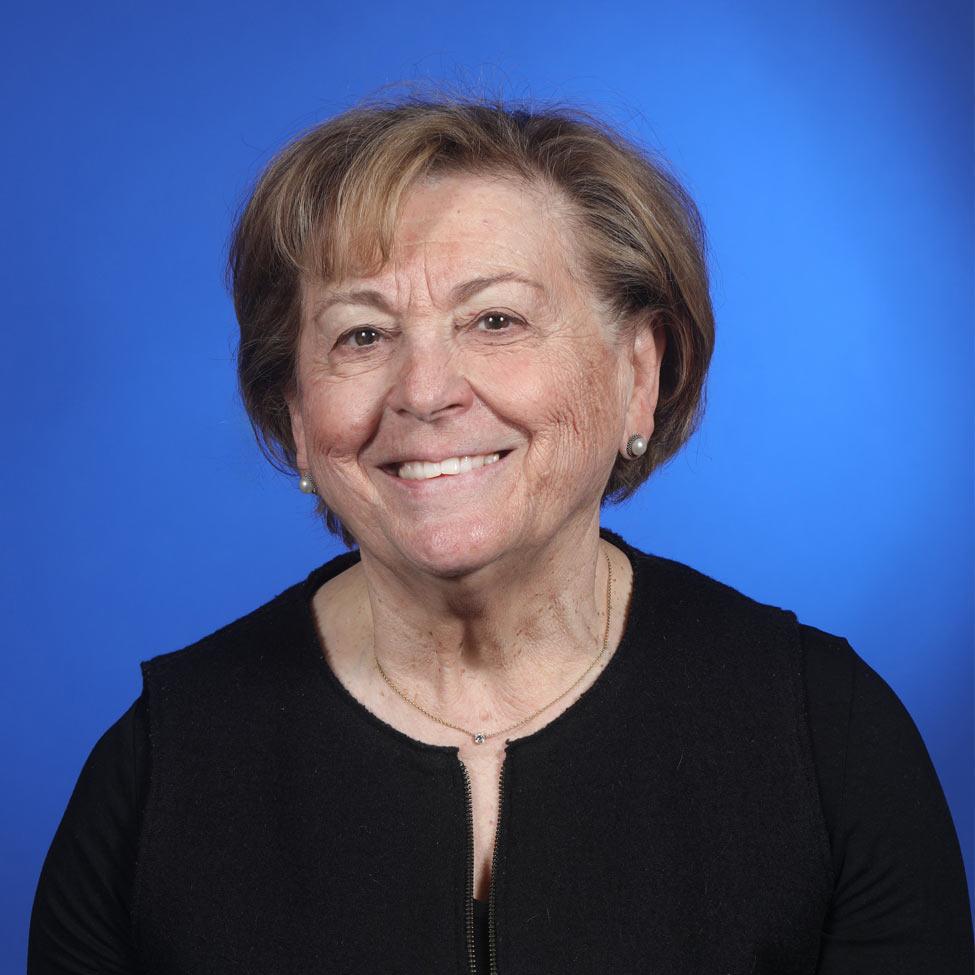
Rosa Ament, PhD, the director of the Counseling Center, has been a steadfast presence at Pace University for 50 years. Her contributions to the mental health and wellness of the University community are immeasurable. Reflecting on her career, Rosa expressed, "Over the course of the last 50 years and currently, I am fortunate to work with dedicated, collaborative, hard-working professionals who make work a joy and who make me look good. In addition, I have had multiple wonderful leaders who supervised and supported me to grow professionally and provided me and my staff a secure platform to serve the personal growth, wellness, and mental health of students and the Pace University community. WOW, 50 years—overall, it is a wonderful dream that feels like a blink of an eye."
Mariesa Cruz-Tillery, associate director of the Counseling Center, commends Rosa's extraordinary dedication and expertise. "Dr. Ament is a counseling psychologist with over 50 years of direct counseling service experience within college and university settings, helping people from multicultural backgrounds cope with stress caused by major life transitions. During her tenure as director of the Counseling Center, she has been called upon to work with both academic and administrative departments to facilitate the development of numerous protocols and intervention programs that foster mental health on campus, assist students in their transition to academic life, and minimize risk associated with alcohol and other drug abuse. She is an outstanding administrator recognized by students, faculty, staff, and administrators for her leadership and management skills. Congratulations and thank you for your service and dedication!"
A Legacy to Remember
As we celebrate these incredible milestones, we acknowledge the profound impact Barbara Egidi and Rosa Ament have had on Pace University. Their dedication, passion, and commitment have shaped the experiences of countless students and colleagues, leaving a legacy that will be cherished for generations to come. Their stories are a testament to the enduring spirit of service and the remarkable bonds formed within the Pace Community.
From the uplifting words of LaChanze to the accolades for our esteemed honorees, Pace University's Commencement was a day to remember. We celebrated 4,093 graduates at the USTA Billie Jean King National Tennis Center, marking a new chapter filled with promise and potential.
Discover incredible stories that showcase the amazing achievements and initiatives happening at Pace. From top rankings to groundbreaking programs and student journeys, there’s something to inspire everyone.
Sands College of Performing Arts has a new faculty member, who you may know from her many starring and scene-stealing roles over the years. Meet Professor Kathleen Turner, who shares her passion for teaching in a candid Q+A.
The Elisabeth Haub School of Law at Pace University is pleased to announce the creation of the Vanessa Merton Immigration Justice Fellowship, a key component of the school’s Immigration Justice Clinic focused on ensuring the legal system’s just treatment of immigrants in the Hudson Valley and local New York Metropolitan region. Barbara Sarmiento, a 2024 graduate of Haub Law, has been selected to serve as the program’s inaugural fellow beginning this fall.
Image
The Elisabeth Haub School of Law at Pace University is pleased to announce the creation of the Vanessa Merton Immigration Justice Fellowship, a key component of the school’s Immigration Justice Clinic focused on ensuring the legal system’s just treatment of immigrants in the Hudson Valley and local New York Metropolitan region. Barbara Sarmiento, a 2024 graduate of Haub Law, has been selected to serve as the program’s inaugural fellow beginning this fall.
Through the generosity of her family, the Immigration Justice Fellowship was established in honor of Professor Vanessa Merton, founder and recently retired director of the Immigration Justice Clinic, who has been a renowned visionary, providing leadership and advocacy in support of the clinic’s important mission for nearly two decades. The Fellow will serve as a liaison between the clinic, immigration organizations, and the migrant community, helping to connect those in need with free legal services, resources or referrals.
"We are deeply grateful for the inauguration of this new fellowship that will enable the Immigration Justice Clinic to expand its reach, particularly to those community members and families who are barred from most immigration relief,” said Stephanie Tombrello, Vanessa's sister. “Vanessa is known for her tenacity and dedication to accompanying and advocating for her clients, always exhausting every option. Now, the next generation of new students will carry on this commitment and thrive with the support and guidance of the inaugural fellow, Barbara Sarmiento, a recent Haub Law graduate who herself has witnessed Vanessa's passion and compassion over the past half decade."
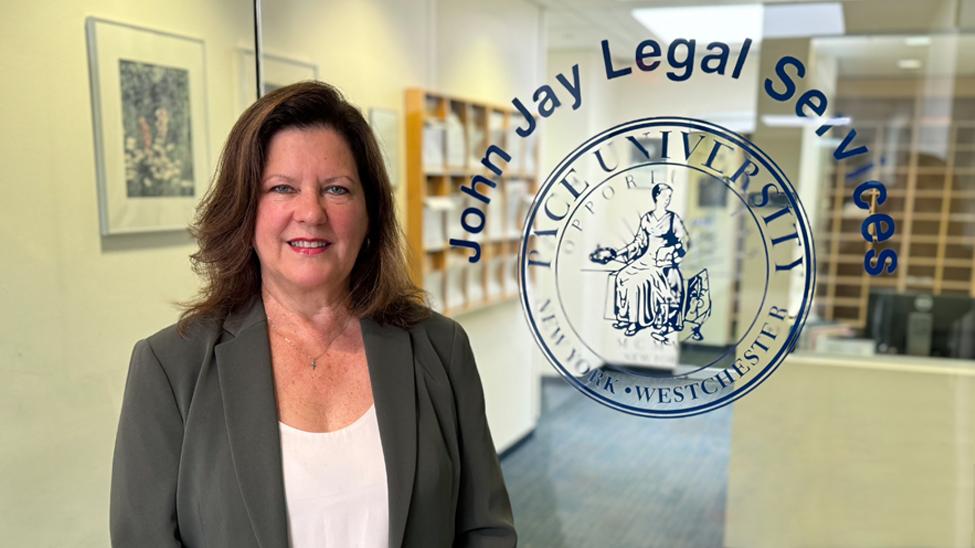
A former paralegal, Barbara Sarmiento first joined Haub Law in 2018 as the Immigration Justice Clinic Administrator and an Assistant Clinic Administrator for John Jay Legal Services, the not-for-profit legal services firm that houses and runs the clinic and externship programs at the Elisabeth Haub School of Law. Working closely under the auspices of Professor Merton, she was responsible for leading orientation and training for legal interns, supporting interns with their case management, and often worked directly with clients as a Spanish translator. “Professor Merton has had a profound effect on my life,” said Barbara. “I have always been impressed by her extraordinary intellect, knowledge of the law and passion as an advocate for immigrant rights. She has been an inspiration to so many students, like myself, demonstrating the hard work needed to represent clients well and further their interests.”
Realizing the vast need for immigration lawyers, it was this experience at the clinic and with faculty such as Professor Merton, that inspired Barbara’s interest in a law degree “to be able to do more to help clients.” As a part-time Flex JD student, Barbara has pursued her law degree at Haub Law for the past 4 years, all while juggling roles at the clinic and internships at organizations such as the Empire Justice Center. She is currently preparing to take the Bar Exam and looks forward to joining the clinic in her new capacity as Immigration Justice Fellow this fall.
“We are honored to have the opportunity to continue Vanessa’s extraordinary and vital work in immigration justice, through the creation of this fellowship which will enable us to expand our legal services to underserved immigrant communities, and support the hard work of our students and supervising faculty,” said Haub Law Dean Horace E. Anderson Jr. “Barbara is a most deserving fellow; as both a law student and a member of the clinic staff, she has demonstrated the type of dedication and personal commitment that has typified Vanessa’s tenure at Haub Law.”
If you wish to contribute to the Immigration Justice Fellowship and help further the important work of Haub Law’s Immigration Justice Clinic, pleasemake a gift online“in honor of Vanessa Merton.”
Sands College of Performing Arts has a new faculty member, who you may know from her many starring and scene-stealing roles over the years. Meet Professor Kathleen Turner, who shares her passion for teaching in a candid Q+A.
Peggy Sue Got Married. Romancing the Stone. Friends. The Kominsky Method. Serial Mom.
Image
Kathleen Turner’s illustrious career, which includes dozens of notable roles across various genres and two Golden Globe Awards (plus nominations for an Oscar, a Grammy, and two Tony Awards) has made her a household name across generations.
Having recently joined the faculty at Pace University’s Sands College of Performing Arts, Turner is channeling her decades of high-level performing arts experience into educating the next generation of performers. In a candid discussion, she reflects on her decision to join Pace, emphasizing her belief in the importance of higher education within the performing arts.
What excites you about teaching?
A lot of it is passing it on. I’ve done a lot of work—a good body of work. It’s more than that; it’s about the ethics of it. What do we owe each other? What is the responsibility toward the audience? If you have this kind of ability, this gift of communication, then you really have to be aware of the responsibilities inherent in that, and choose them. Choose what kind of material you represent and do so with great care—this is probably more important than anything.
In your opinion, what makes a great teacher?
I suppose you’d have to start with passion for the subject of what they’re teaching. A real love of it. A real belief in it. Why else do it?
What are some qualities that you see in Pace students today that excites you?
I like the curiosity. I like the fact that they are willing and wanting to learn, to explore, in terms of material and process. The technique of it. I’m not dealing with performers who are already stuck in their ways which would be useless to me. I don’t subscribe to any one method or discipline; I would think that excluding things would be rather short-sighted. I’m pleased with the open-mindedness of the students.
On a technical level, what course(s) will you be teaching?
Pace has allowed me to pretty much design the course, which we’re calling: Stage to Screen. I’m trying to show and teach the choices and the difference in choices that you make for one medium as opposed to another. And also to teach them how to read a film script, how to visualize it.
It’s rather complicated at times, but I've got all seniors in the course, which I like–by the time they come into my class they have a certain level of experience and knowledge to begin with, so we can just take off.
In the course, do you spend any time on the business side of the industry?
Yea. Absolutely. This week, I brought in some very highly qualified agents to talk about their job, what the actor can ask of them, what they will be asked of, it was quite fascinating, the discussion and the questions that the students asked and did not really know before.
This is a business. This ain’t no hobby, honey.
Having now been around the University, what do you think has changed since you were studying to be a performer? What has remained the same?
We had no camera training at all 45 years ago. Nobody had the equipment. At that time, cameras were 500 pounds each. No school had that kind of capacity to handle that kind of thing. Technology has enabled us to do amazing things that were quite impossible in the past.
But I think the core thing that has not changed is doing it. Just doing it as much as possible. I tell students not necessarily to go to a conservatory or school which only emphasizes the craft–the broader the education, in many ways, the more beneficial for the actor. We need to know just about everything. I think again, why close yourself off? Go to a school where you get to work, to get on camera.
These schools that say you’re not allowed to perform for the first two years or whatever, to me are two years of wasted time. Don’t talk about it, do it!
What do you hope students will take away from spending time with you in the classroom?
I want the students who worked and learned with me to go out and to be able to do professional work. To be able to fulfill the actor’s role. Everybody has a learning curve, of course. And experience is always a teacher. But that being said, I don’t want any of my students to go out and let a production down.
If you were starting out today, what advice would you give to your younger self?
What I remember has remained true is to have true confidence in yourself. Don’t walk into an audition, don’t walk into a job, wondering if you can do it. You can do it.
The only responsibility is to be sure that you did the very, very best job that you could do that day. You may wake up in the middle of the night and say “Oh hell, I should’ve made that choice.” That’s okay. At the time, in the place, you made the best choice you could. That’s what you owe. Nothing more.
Discover incredible stories that showcase the amazing achievements and initiatives happening at Pace. From top rankings to groundbreaking programs and student journeys, there’s something to inspire everyone.
In a remarkable career that spans over four decades, Barbara Farrell, EdD, CPA, has been an indomitable force in the field of accounting education at Pace University. The Lubin School of Business professor was recently honored with the prestigious Presidential Lifetime Achievement Award, recognizing her unwavering commitment to teaching, service, scholarship, and her significant contributions to the Pace community.
Why do humans speak the way they do? College of Health Professions Associate Professor Sethu Karthikeyan, PhD, is exploring the evolutionary biology behind voice pitch.