Image
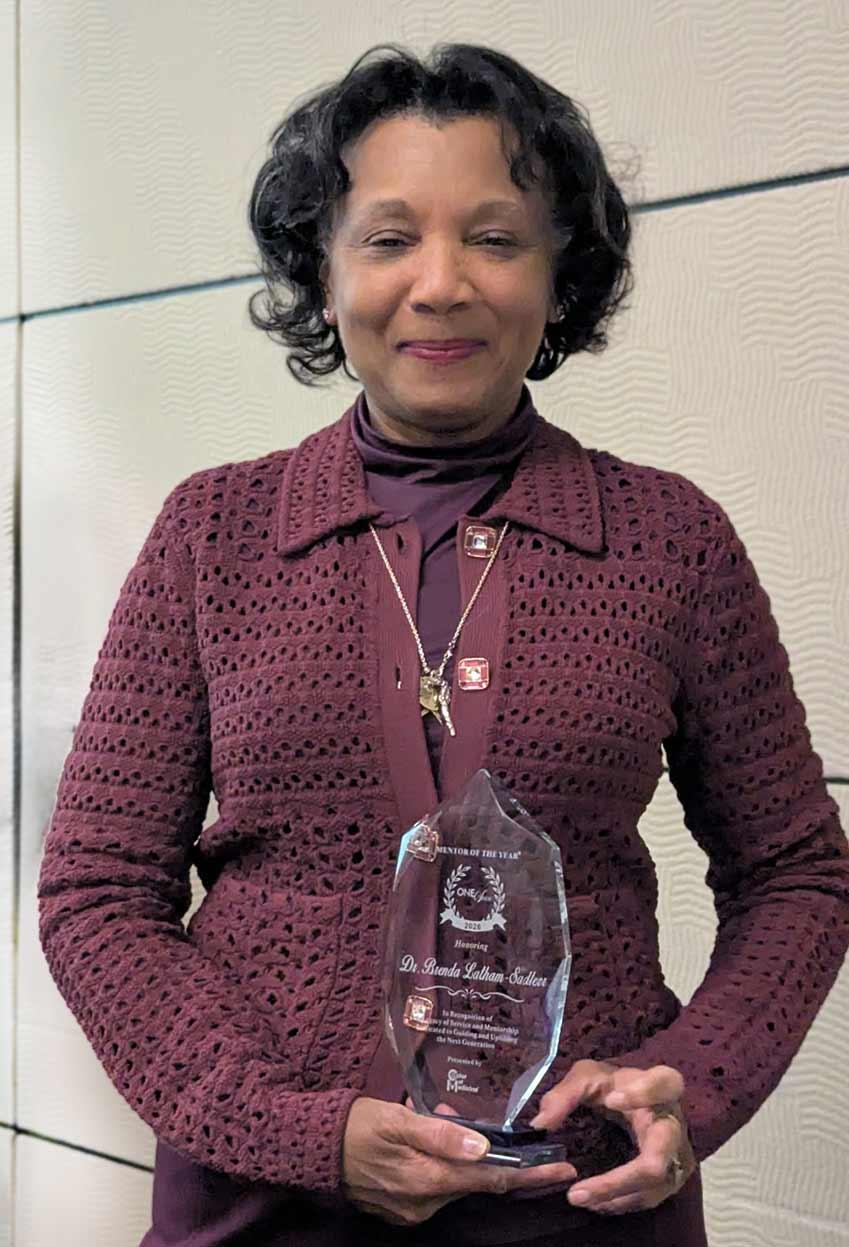
When Brenda Latham-Sadler, MD, ’78 looks back on her academic and professional career, the far-reaching impact of her time as an undergraduate student at Pace University is never far from her mind. Retirement presents a new chapter and a journey of its own—one that Brenda is pleased to be starting. It’s a time for well-deserved celebration: “I had about 150 people at my retirement party,” Brenda said. “We had margaritas and a DJ. How many academic medical centers do all that?”
For Brenda, it’s also an opportunity to reflect on a fruitful career as a medical professional and educator. Throughout her career, Brenda worked as a primary care doctor and spent more than three decades teaching as a professor at Wake Forest Baptist Health and Wake Forest University School of Medicine, where, though officially retired, she returns for guest lectures as professor emerita: a deeply fulfilling professional journey that began in Pace’s then small but mighty biology department.
At Pace, Brenda built the foundation for a proud career steeped in a deep passion for medicine and education—and she is not alone. Brenda recalls the Pace biology program of the 1970s as a tight-knit community of hardworking students and encouraging faculty members who helped lift each other up. Her fond memories reveal how Pace has persisted as a lasting presence in her and her classmates’ lives, the enduring impact of her professors’ support, and the ways the University has evolved and grown since her time on campus, while remaining a steadfast beacon of transformation and opportunity.
Brenda was born at Walter Reed Medical Center in Maryland. Both of her parents were in the Air Force, and she was raised in South Carolina on her grandparents’ tobacco farm. For much of Brenda’s upbringing, public schools in Horry County, South Carolina, were still segregated—only integrating in 1970, when Brenda entered high school. Despite the many challenges, Brenda is grateful for the education she received.
“Myrtle Beach is in Horry County, so we were fortunate to have that tourist base, which helped with funding education,” Brenda said. “We didn’t get hand-me-down books; we had good schools and teachers—and I think that made a difference.”
After her parents split up, Brenda spent her summers in New York, where her mother had moved for work.
Growing up, Brenda didn’t have the slightest inkling that she would one day pursue a career in medicine. “When I was young, I wanted to be a movie star,” Brenda said. “But then I realized I couldn’t sing and I couldn’t act, so that was out.”
Her mother was a medical assistant at a federally funded clinic in New York City. As she was exposed more to her mother’s work at the clinic, Brenda eventually became drawn to the study of medicine. Encouraged by the testimony of a colleague whose daughter had attended and loved her experience at Pace, Brenda’s mother urged her to attend the University and become a doctor.
“She was such a fan of Pace,” Brenda recalled.
Brenda heeded her mother’s advice and soon fell in love with Pace’s campus, location, and sense of community.
“When I visited, everybody just seemed really nice,” Brenda said. “I used to love to study in the library and look at the Brooklyn Bridge. I’d walk down to the World Trade Center. I just love that area. It’s so vibrant and alive, and right across the street from City Hall.”
As a student, Brenda remembers Pace’s biology program being smaller than other science departments—which she says allowed her and her classmates to form uniquely close relationships with their professors.
“Classes were relatively small, so you really got to know your professors,” Brenda said. “They were always so helpful and supportive.”
“Pace means opportunity—for me and for a lot of working people,” Brenda said. “They’re trying to do better, and Pace helps them get there."
Dudley Cox, PhD, the biology program’s chair during Brenda’s time at Pace, was a particularly influential presence for Brenda and her classmates.
“He was always helping us get our work done and supporting our education,” Brenda said. “He was very hands-on in helping students get jobs in labs and encouraging us to thrive academically.”
Professors like Cox helped prepare Brenda and many of her peers for the challenges of medical school. Fellow classmate Donald Moore ’76, an NYC-based physician and current Pace adjunct professor, echoed Brenda’s gratitude toward the biology faculty and the culture of support they cultivated.
“My academic memories are anchored in classrooms where curiosity was sparked and rigor was embraced,” Donald said. “My interest in medicine was awakened by a course called Biology for Non-Science Majors, taught by Dr. Chunosoff. What began as a general education requirement became a moment of transformation, helping me envision a future in medicine. Looking back, it stands as a reminder that inspiration often arises in unexpected places—and that a single course can alter the course of a life.”
Donald, too, fondly remembers the difference that program chair Cox made in the lives of his students: “His warmth, approachability, and characteristic smile conveyed a genuine care for students that left a lasting impression, even from afar. Sometimes it is these brief encounters that quietly shape our sense of belonging within an academic community.”
Brenda recalls feeling a strong sense of community among her classmates as well. Despite its relatively small size, the program was highly diverse.
“We had white, Black, Puerto Rican, Dominican, Jewish, and Catholic students,” Brenda said. “We all really supported and encouraged each other.”
The bonds Brenda formed at Pace have traveled with her long after graduation, including her friendship with Ronald Klinger ’78, who attended medical school alongside her at Wake Forest. Brenda said their education at Pace and their friendship with one another helped considerably in navigating the challenges of med school.
“Just like at Pace, we got our group together at Wake, we supported each other, and laughed, and dined together, and just made it through,” Brenda said. “I feel that Pace prepared us very well.”
Since her time at Pace, Brenda has enjoyed a flourishing career, primarily as an educator and administrator, passing the gift of education along to the next generation of medical professionals.
“Education is really important to me, because I see it as the stepping-stone that gets people out of poverty,” Brenda said. “That’s the other thing about Pace—I felt like it was a place where you could come in with very little and get support. A lot of my friends at Pace were from families who were struggling. I know the struggle, and I know the difference that education makes.”
A beneficiary of scholarship support herself—without which, Brenda says, she would not have been able to attend college—Brenda has leveraged her success to help others receive an education.
“Between my husband and me, we have given to eight different educational institutions,” Brenda said.
Among those institutions is Pace, where Brenda has founded a scholarship in honor of her brother, Curtis Cotton.
“My little brother has since passed, which is why I wanted to put the scholarship in his name,” Brenda said. “He also graduated from Pace. He was an educator too, in the New York school system.”
In addition to her philanthropy, Brenda is a dedicated volunteer. She was previously a board member at Youth Opportunities, an organization focused on providing a safe living space for disadvantaged youth. She was also a board member with the Urban League, whose work seeks to provide African Americans and other underserved communities with greater educational opportunities, and United Way, a nonprofit dedicated to providing support and promoting self-sufficiency among low-income earners.
"A lot of my friends at Pace were from families who were struggling. I know the struggle, and I know the difference that education makes.”
For as much as Pace may have done for her, it was Brenda’s industry, strength of character, and commitment to the principles of lifelong learning that have enabled her to build a career worth celebrating and to open doors for so many others along the way. When asked what Pace means to her today, Brenda answers without hesitation: opportunity.
“Pace means opportunity—for me and for a lot of working people,” Brenda said. “They’re trying to do better, and Pace helps them get there. Whether they’re trying to go into nursing, or finance, or the arts . . . oh man, you didn’t hear much about the theater department when I was there, but if I were there now, maybe I would learn to sing and dance.”
Looking at all that Brenda has accomplished, it’s not hard to imagine she would.
“In my office, I had all kinds of inspirational posters and things for students,” Brenda said. “‘If you want it, go get it.’ ‘Don’t be afraid to dream big.’ I think my favorite was this plaque that said, ‘When you feel like quitting, remember why you started.’ There’s going to be plenty of days when you feel like quitting—but if you can remember why you started, you know why those challenges are worth overcoming.”

From celebrating 120 years of Pace pride to earning national recognition, launching new centers, advancing sustainability, and empowering students to lead, this semester offered 10 inspiring reminders of Pace’s momentum—and the community driving it forward.

With record-breaking fundraising, growing alumni engagement, and a bold vision for Pace’s next chapter, Vincent D. Clark has been appointed Vice President for Development and Alumni Relations after leading the University through two historic years of philanthropic momentum.

From virtual patients to real-world readiness, students are training in high-stakes scenarios before they ever enter a clinic. Nancy Owen reveals how AI is reshaping that experience at Pace’s Center for Excellence in Healthcare Simulation.