Image
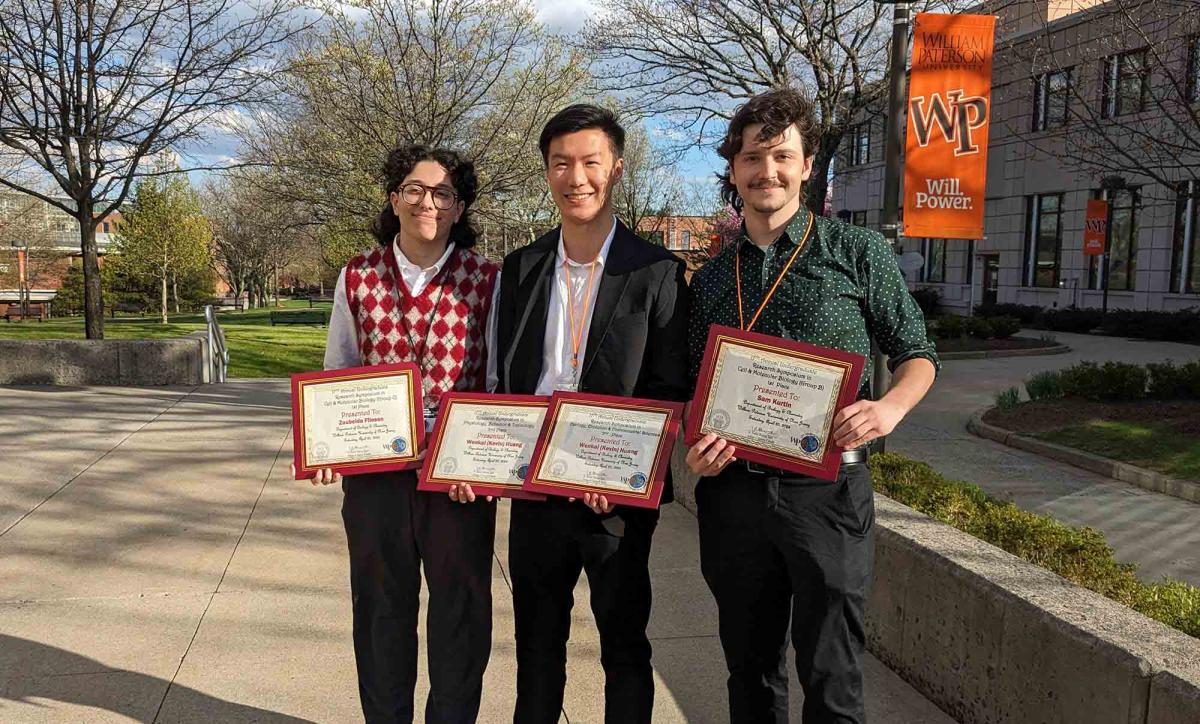
Three Pace University students earned awards for their work at the 17th Annual William Paterson University Undergraduate Research Symposium in late April.
Sam Kurtin ’24, Biology, won a first-place award in the category "Cell and Molecular Biology (Group B)" for his poster "The Role of The Unfolded Protein Response in the Malfunction of a Human PQ-Type Calcium Channel." Kurtin’s research was done under the mentorship of Associate Professor of Biology Zafir Buraei, PhD.
Zoubeida (Zouzou) Fliesen ’24, Biology, also with faculty sponsor Buraei, took home first place in the category "Cell and Molecular Biology (Group C)" for his poster "Optimizing In Vitro Transcription to Study PQ Channel Mutations Implicated in Epilepsy."
Wenkai (Kevin) Huang ’25, Childhood Education (School of Education) won a pair of second-place awards: one in the category "Physiology, Behavior & Toxicology" for his poster "Analysis of Shoot Circumnutation Developmental Profile in Arabidopsis Thaliana" under the mentorship of Associate Professor of Biology Eric Brenner, PhD, and one in the category "Ecology, Evolution and Environmental Science" for his poster "The Bacterial Symbionts of the Parasitic Plant Rafflesia— Microscopic Partners For Conserving The World’s Largest Flowers?" with Sara Musovic and Associate Professor of Biology Jeanmarie Molina, PhD.
Pace University was one of 32 institutions from the Northeast region represented at the symposium, including Princeton, Columbia, Barnard, and Stevens Institute of Technology.

How much freedom are we willing to sacrifice in the name of security? As facial recognition and AI-powered surveillance expand worldwide, Political Science Professor and Chair Amy Freedman, PhD, examines what the rise of digital monitoring in Southeast Asia reveals about democracy, individual rights, and the growing power of governments to watch and control their citizens.

Decades of research at Pace’s Haskins Labs helped pave the way for a lifesaving treatment for sleeping sickness with far-reaching global impact.

Pace University’s undergraduate psychology program jumped 34 spots in the latest U.S. News & World Report rankings, building momentum for a STEM-designated program rooted in research, critical thinking, and real-world experience.