Image
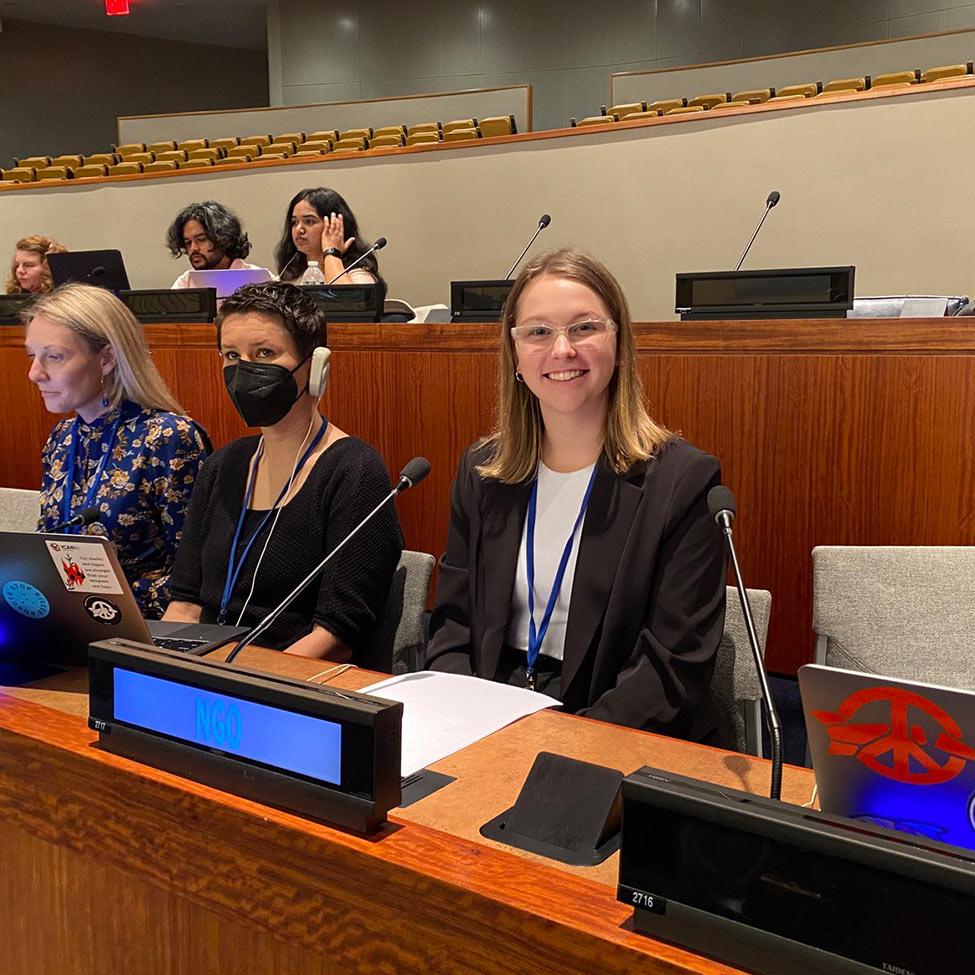
On Thursday, October 13, Molly Rosaaen ’22, Political Science delivered a statement to the United Nations General Assembly First Committee (Disarmament and International Security), calling for “new momentum for disarmament” and “meaningful inclusion of youth—particularly from marginalized communities.”
The statement—written on behalf of 62 supporting organizations including the 1997 Nobel Peace Prize co-laureate, the International Campaign to Ban Landmines—was drafted by Dyson College students Nora Bajor ’26, Political Science, Antje Hipkins ’25, Peace and Justice Studies, Joey Gottlieb ’25, English, Arnold Okyere ’25, Political Science, and Julia Morrison ’26, Political Science, with support from Professor of Political Science, Matthew Bolton, PhD and Associate Professor of Peace and Justice Studies Emily Welty, PhD, the directors of Dyson’s Disarmament Institute. Producing the statement has become an annual Civic Engagement assignment for the Political Science department’s Global Politics of Disarmament and Arms Control class.
This year marks the 40th anniversary of the UN World Disarmament Campaign and the 20th anniversary of the Secretary General’s study of disarmament education. The statement urged stakeholders to consider matters of diversity, equity, and inclusion in disarmament education and facilitate youth access to multilateral forums.

From studying disease at the molecular level to exploring the ecosystems in our own backyards, two Pace University professors are helping undergraduate students turn curiosity into meaningful research. Meet the 2026 Faculty Undergraduate Research Mentor Award recipients.

How much freedom are we willing to sacrifice in the name of security? As facial recognition and AI-powered surveillance expand worldwide, Political Science Professor and Chair Amy Freedman, PhD, examines what the rise of digital monitoring in Southeast Asia reveals about democracy, individual rights, and the growing power of governments to watch and control their citizens.

Decades of research at Pace’s Haskins Labs helped pave the way for a lifesaving treatment for sleeping sickness with far-reaching global impact.