Image

In Fall 2026, the doors of One Pace Plaza East will reopen after an extended renovation. Students will once again fill its classrooms, rehearsal spaces, and studios—studying, performing, and creating in the heart of Lower Manhattan. The renovated building will house new facilities for the Sands College of Performing Arts along with humanities instructional spaces designed to serve students from across the University. For the many students, faculty, and staff eagerly awaiting its return, the reopening will mark the beginning of a new chapter in Pace’s story.
Fittingly, as Pace celebrates its 120th anniversary, the reopening of One Pace Plaza East also marks a return to where that story began.
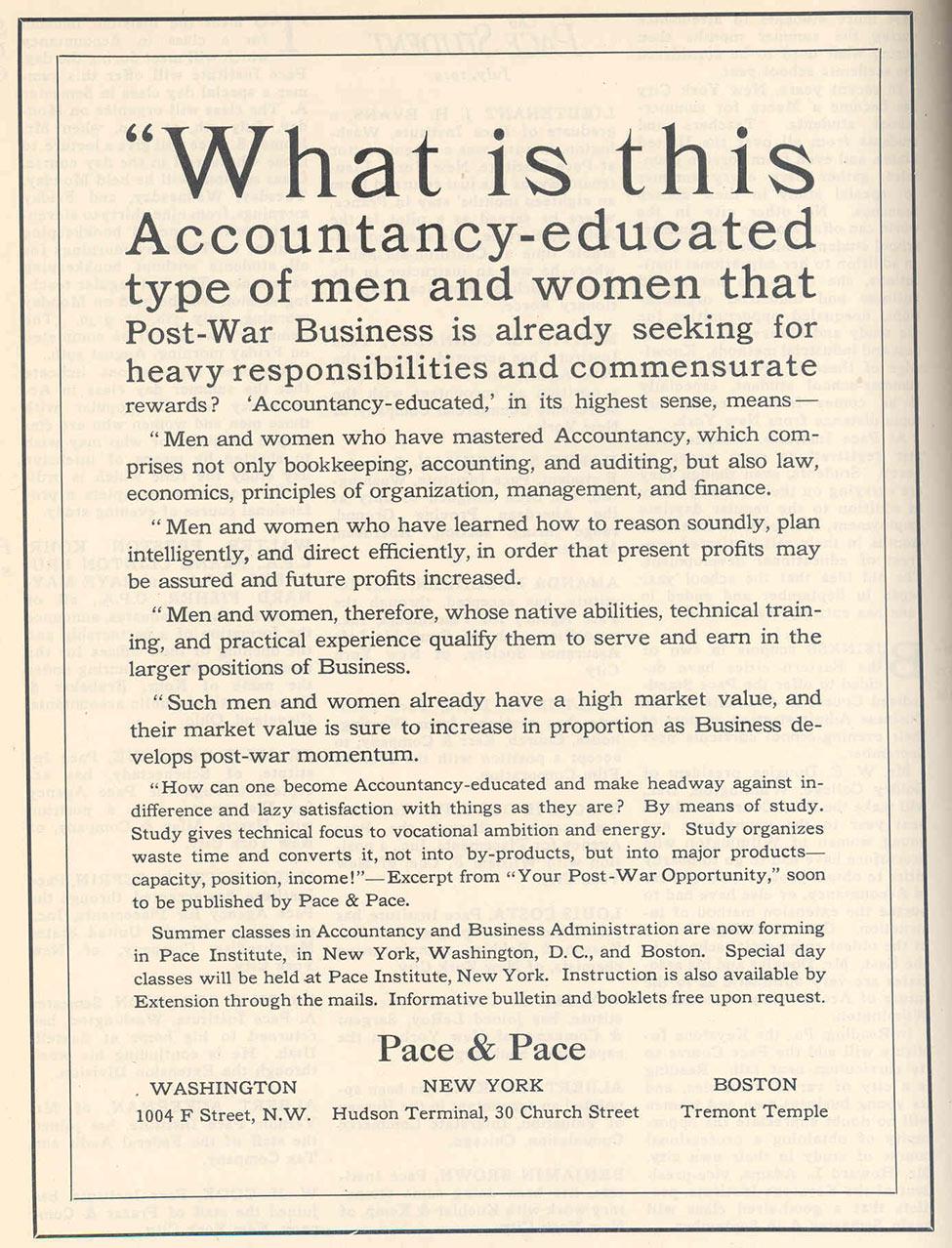
In 1906, educator and entrepreneur Homer St. Clair Pace rented a space in the New York Tribune Building on this same site, just steps from the financial institutions shaping the modern economy. With a $600 loan, Pace launched his first class as an experiment in higher education: an institution designed to prepare students for the emerging accounting profession while also equipping them with the broader intellectual tools needed to succeed in a rapidly changing world.
From that first course in a rented classroom, Pace has grown into a comprehensive university serving students across campuses in Lower Manhattan, Pleasantville, and White Plains. Yet the institution continues to pursue the simple but powerful idea on which it was founded: education should unite intellectual inquiry with real-world experience, drawing on the opportunities of the city and empowering students to shape the professions, communities, and institutions of their time. In other words, Pace has long practiced what might be called education as agency—an approach to learning that prepares students not only to understand the world but to participate in shaping it.
At the beginning of the twentieth century, American universities had not yet fully adapted to the changing demands of the modern economy. Traditional curricula remained largely centered on classical study, preparing students for established professions such as law, medicine, and the ministry. Meanwhile, rapidly growing cities like New York were generating new professions, including accounting. As financial markets expanded and businesses grew more complex, accounting required formal training and professional standards. Yet few universities offered programs designed to prepare students for this work. Homer Pace recognized both a need and an opportunity: to create an institution that would connect higher education more directly with the realities of modern professional life.
Pace also experimented with new ways to expand access to professional education. In addition to classes offered in Lower Manhattan, accounting courses were soon taught through YMCA programs across the country, as well as through correspondence courses for students unable to attend in person. These initiatives extended professional education to working students who might not otherwise have had access to professional training.
Pace did not view professional education as purely technical training. He believed that success in business and public life required broader intellectual preparation. From the beginning, students studied not only accounting and business law but also English, public speaking, and psychology—fields that helped cultivate the judgment, communication skills, and intellectual curiosity needed for leadership in a complex world. Decades later, a Pace course catalog would describe this philosophy clearly, noting that “the effectiveness of any undergraduate program in business administration is greatly dependent on the students’ understanding of the humanities, behavioral sciences, social sciences, and natural sciences.”
Supporting this educational philosophy was the belief that students should also learn from those actively working in the professions they hoped to enter. From its earliest years, Pace emphasized practitioners as teachers—accountants, lawyers, and business leaders who brought real-world experience into the classroom. Many faculty members also served as mentors to students, a tradition that remains central to the University today.
In this way, Pace advanced an educational model that was unusual for its time: bringing together rigorous professional preparation, mentorship from faculty and experienced practitioners, and the broader habits of inquiry associated with the liberal arts.
From its earliest years, Pace expanded access to emerging professions at a time when many institutions restricted educational opportunity. It is notable that, from its earliest classes, women studied accounting and business alongside men. Students from diverse backgrounds came to Lower Manhattan seeking preparation for careers in finance, law, advertising, and other growing fields.
Civic engagement also formed part of the University’s culture from its earliest years. During World War I, Homer Pace was asked to serve as Commissioner of Internal Revenue following the introduction of the federal income tax in 1913. Viewing the role as a civic responsibility during wartime, he agreed to serve. At the same time, his wife, Mabel Pace, worked with the National League for Women’s Service to organize classes in business and accountancy so that women could fill positions left vacant as men went to war. A similar effort took place during World War II, when Pace established expanded business education courses for women in coordination with the federal government.
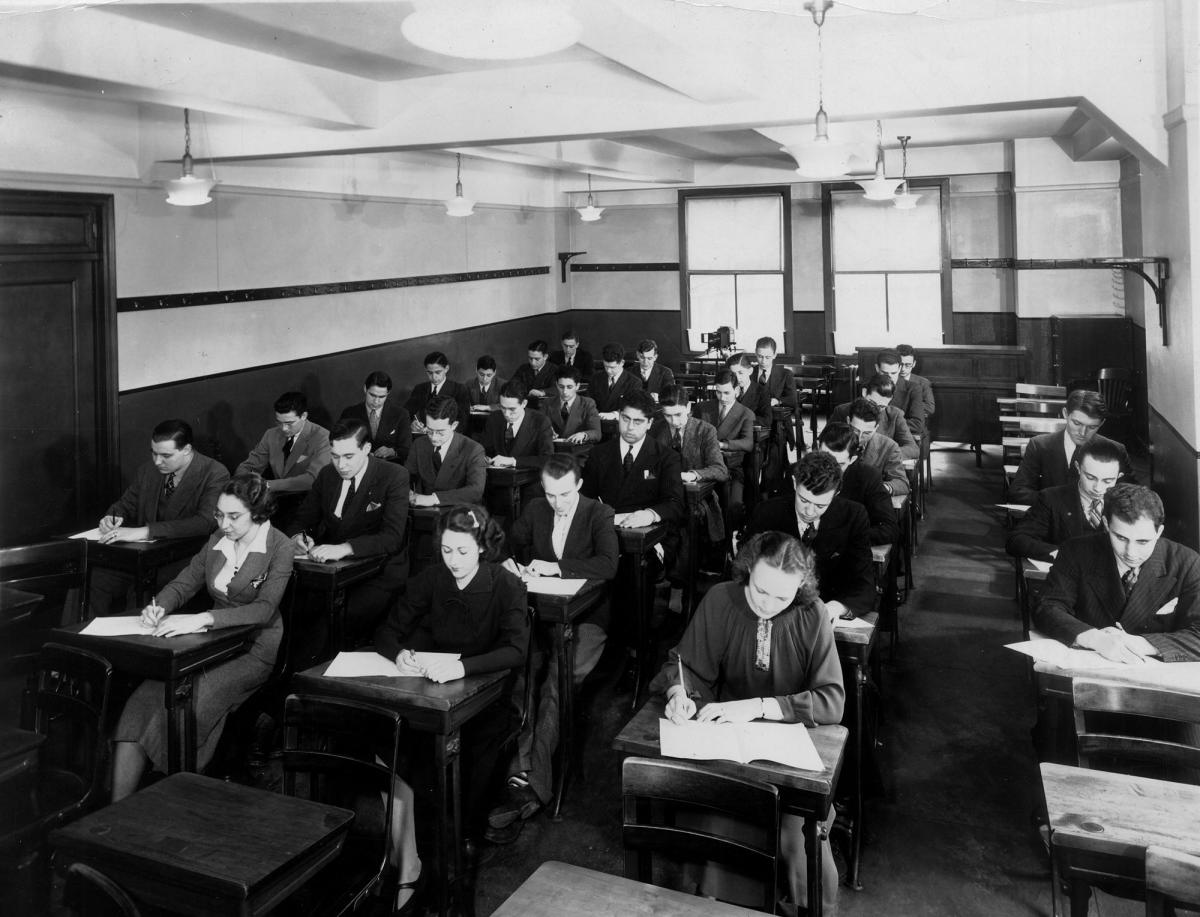
As New York City evolved into one of the world’s leading economic and cultural centers, Pace grew alongside it. The institution transitioned from a for-profit school to a nonprofit educational institution in 1935, expanded its academic offerings after World War II, and began awarding bachelor’s degrees in the 1950s. Over time, what began as the Pace Institute developed into a comprehensive university with programs spanning the arts and sciences, business, computer science and information systems, law, education, health professions, and the performing arts.
Throughout these changes, the relationship between Pace and the city has remained central to its identity. Located in the heart of Lower Manhattan and later expanding into Westchester County, the University continued to draw on the intellectual, professional, and civic life of the region as part of the educational experience.
Opportunity at Pace was never simply an abstract promise. It was created through education that connected students with the institutions, industries, and communities of the city around them.
Over time, this philosophy evolved into what Pace today describes as experiential learning—an approach that connects classroom study with research, internships, and community engagement. At Pace, experiential learning has always meant more than practical experience alone. It reflects a broader goal: helping students develop the intellectual independence to investigate new problems and apply their knowledge to the world around them.
This idea has deep roots in the University’s educational philosophy. As a Pace course catalog from the 1980s explained, “the university experience must not merely include the subject matter of specific courses but must also train students to attack previously unexplored subjects and to apply their resources in examining and assessing these subjects effectively.”
In other words, the purpose of a Pace education has never been simply to prepare students for existing careers. It is to equip them with the curiosity, judgment, and creativity needed to confront problems that do not yet have clear answers.
Today this tradition continues through faculty-mentored research, internships across the New York metropolitan region, community-engaged learning, and partnerships with industry and civic organizations—extending the classroom into the city itself. Pace has also been recognized for its leadership in civic engagement, including its role as a founding member of Project Pericles, its inclusion on the President’s Higher Education Community Service Honor Roll, and its Carnegie Classification for Community Engagement.
Taken together, these efforts reflect a philosophy that might be described as inquiry in action—learning that connects intellectual curiosity with the real challenges of the world students are preparing to shape.
As Pace marks 120 years since its founding at a transformative moment in early twentieth-century education, higher education once again finds itself at a turning point. Rapid advances in technology, shifting expectations about the value of a degree, and the growing complexity of social and economic challenges are reshaping what universities are asked to provide.
In response, Pace is advancing an academic plan focused on areas where its distinctive approach to education can make the greatest impact: health and behavioral health; civic leadership, law, and public service; innovative technology and business; and the humanities and performing arts.
Across these fields, Pace’s longstanding commitment to inquiry in action takes many forms. Students in health and behavioral health programs engage in clinical training and community-based care while studying the social and ethical dimensions of health. Those preparing for careers in law and public service work alongside community organizations, advocacy groups, and public agencies through internships, research, and policy initiatives. In technology and business programs, students explore emerging fields such as cybersecurity, artificial intelligence (AI), and data science while examining their economic and societal implications. And across the humanities and performing arts—including the programs that will soon occupy the renovated spaces at One Pace Plaza East—students combine creative practice with critical inquiry, developing the skills needed to interpret and produce culture, communicate ideas, lead media innovation, and imagine new possibilities for the future.
In an era when AI can increasingly generate information, the deeper purpose of education becomes clearer than ever. Universities must help students develop the intellectual agency to ask new questions, interpret complex problems, and apply knowledge creatively and responsibly. These are precisely the capacities Pace has sought to cultivate for more than a century.
The University has faced moments like our current one before. During the economic turmoil of the 1930s, Pace made a defining choice: transforming itself from a for-profit school into a nonprofit university and placing its future squarely in the hands of education rather than profit. In a time of uncertainty, Pace reaffirmed a simple conviction that the purpose of the university is not merely to respond to economic change, but to prepare students to be innovative thinkers and active problem solvers.
For 120 years, that conviction has guided Pace as it has grown from a rented classroom on Park Row to a university serving students across the globe. The idea remains the same: education should empower students not only to understand the world as it exists, but to imagine—and shape—the world that comes next.

Some institutions wait for the future to arrive. Pace has spent 120 years going after it—preparing lawyers, nurses, technologists, and artists not for the world that was, but for the one taking shape now. This isn’t ambition or luck. It’s 120 years of deliberate evolution.

What began as quiet farmland in Pleasantville has grown into a vibrant hub of learning, partnership, and possibility. As Pace celebrates 120 years, the institution’s presence in Westchester tells a remarkable story—of community impact, student opportunity, and the power of place. Discover how Pace’s roots in Westchester continue to shape its future.

Not just dates and milestones, but momentum. This timeline traces the defining moments that shaped Pace University, from its founding in 1906 to the institution it is today.