Image

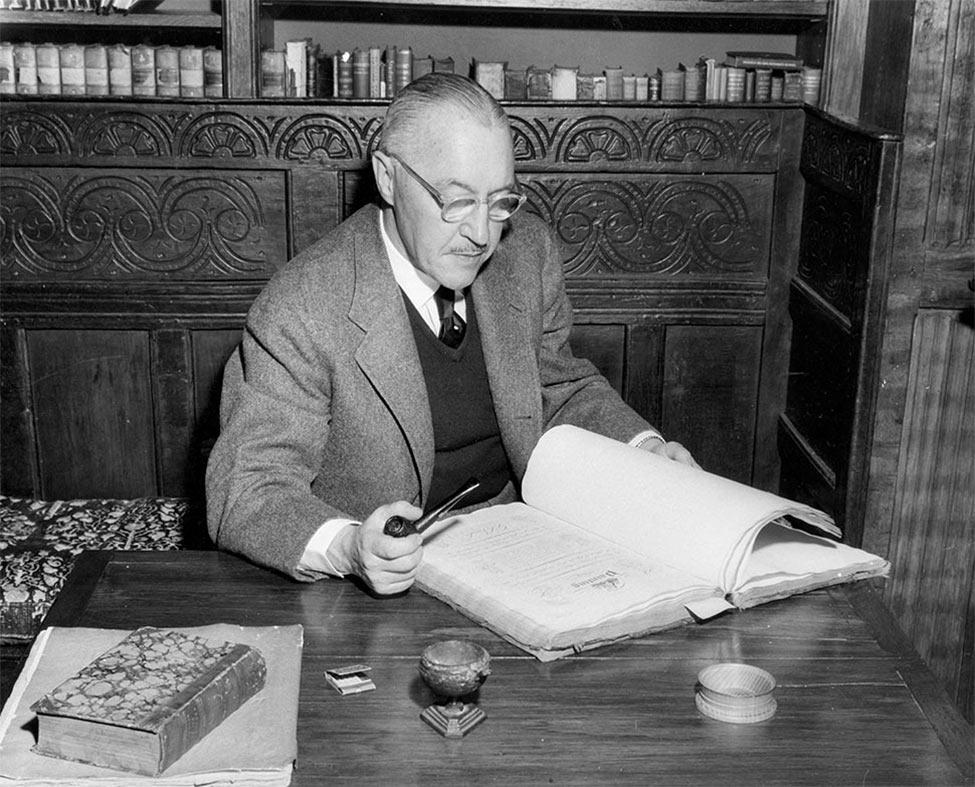
Nestled on a bookshelf in the Pace Study at 41 Park Row, 16 floors above New York City, are clues to the evolution of language.
Yellowed pages from John Higgins’s 1572 edition of Huleot’s Dictionarie—a trilingual guide for Elizabethan learners—peek from the pile. A 1708 second edition of John Harris’s Lexicon Technicum, the world’s first technical dictionary, is perched nearby.
Together, the volumes—personally collected by the University’s co-founder, Homer Pace—form more than a rare archive. They reflect the idea that knowledge is always evolving and never finished, a concept that Pace educators have spent more than a century putting into practice.
For 120 years, adaptability has been Pace’s guiding star. From humble origins as a one-room school of accountancy, to a three-campus powerhouse with thousands of students, Pace has constantly evolved to meet the moment in higher education and to train the workforce of today.
“Our success is a result of the fact that we have a great deal of flexibility,” Edward J. Mortola, Pace's third president, told The New York Times in 1978. “We are able to act quickly when opportunity presents itself and have an ability to innovate.”
That flexibility is again being called upon, as economic pressures and demographic shifts push many universities to retrench. In the face of these challenges, Pace is refocusing on strengths, and in the process, redefining education for the 21st century and beyond.
At the center of these innovations is experiential learning; not just the belief that careers begin long before graduation, but the practice of it. Across the University, Pace students—lawyers, actors, writers, health care workers, technologists, and business leaders in training—go beyond the classroom to gain real-world experience through fieldwork, internships, and immersive learning and working experiences.
“At Pace, we empower students to learn by doing,” said Kelley Kreitz, PhD, director of Experiential Learning and associate professor of English at the Dyson College of Arts and Sciences. “This is a shift away from the historical model of universities of a one-way flow of information.”
To solidify Pace’s leadership in experiential learning and ensure its programs keep pace with a changing world, the University recently completed a comprehensive review of its academic portfolio. Four areas of focus emerged.
First, Pace will remain committed to the liberal arts through programs like Communications and Media Studies, and to the creative disciplines that shape culture, inspire innovation and develop well-rounded, forward-thinking graduates. The Sands College of Performing Arts and the soon-to-open One Pace Plaza East give Pace a national platform from which to lead.
Just as importantly, with nationally recognized programs in nursing, clinical psychology, and mental health counseling, Pace will lead in training the professionals who will meet society’s most urgent health needs.
"At Pace, we empower students to learn by doing."—Kreitz
Beyond health, civic leadership, law and public service will be prioritized. From the Elisabeth Haub School of Law’s top-ranked environmental law program to Dyson’s public administration and criminal justice degrees, Pace will prepare students to lead.
And in a rapidly digitizing economy, Pace will leverage strengths in data science, cybersecurity, AI, finance, and accounting, fields where demand is growing and where Pace has a strong track record of success.
By focusing on these four areas, Pace will become more than another university in a crowded field—it will emerge as New York’s dream school for a new generation of learners. These priorities are grounded in 120 years of proven impact, reflected in the programs, partnerships, and graduates that show Pace can compete, lead, and endure through disruption. The portfolio review didn’t create these strengths, it simply brought them into focus.
That commitment is visible in Pace’s humanities and performing arts curriculum. For Dean of the Sands College of Performing Arts Jennifer Holmes, PhD, artistic expression is an inseparable part of the liberal arts experience. One can’t exist without the other.
“Great artists draw constantly on history, philosophy, literature, politics, economics, science and the study of human behavior,” said Holmes. “The liberal arts cultivate the habits of mind—curiosity, critical thinking, cultural awareness—that allow artists to interpret the world and contribute to it thoughtfully.”
“In that sense,” she added, “the performing arts are not separate from the academic mission of the University, they are one of its most powerful expressions.”
"Great artists draw constantly on history, philosophy, literature, politics, economics, science and the study of human behavior."—Holmes
Established in 2014 within Dyson, the Pace Performing Arts—later earning college status and the Sands name in recognition of a $25 million gift from Pamela and Rob Sands, JD ’84—has quickly become a top contender in the performing arts education world, with current students and alumni regularly working in film, television, and theater.
Sands College is future-focused, preparing students to lead in a rapidly evolving industry. Students train with new technologies, build props and choreograph dance for stage and screen, develop voice work across audiobooks and podcasts, and gain fluency in film production and editing.
They study bi-coastally in Los Angeles and globally in Sitges, Spain, with the Institute of the Arts Barcelona. They devise new work and collaborate with leading artists, producers, and creative entrepreneurs, while building industry-facing skills such as script supervision and pitching.
Students are expected to engage professionally throughout their training, developing the relationships and experience that translate directly to careers.
"...the performing arts are not separate from the academic mission of the University, they are one of its most powerful expressions.”—Holmes
Beyond the stage, Pace’s humanities ecosystem, particularly within Dyson, includes programs in writing, publishing, communications, and digital media. These fields of study demonstrate the University’s continued commitment to the Core Curriculum and applied liberal arts, ensuring that graduates not only master technical and professional skills but also understand culture, communicate effectively, and contribute meaningfully to society.
Together with Pace’s strengths in other areas, the humanities and performing arts help form a university that is interdisciplinary, applied and deeply aligned with modern challenges.
If the humanities shape how we understand the world, Pace’s commitment to health and well-being is focused on improving it.
For Tyler McShane ’26, a Psychology BA/Mental Health Counseling MS student in Pleasantville, a healthy world starts with strong human connection. Pace's investment in health and behavioral health isn't new, but the scale and urgency of that commitment has never been greater. As part of his work as vice president of the campus’s psychology club, McShane recently created a social event designed to help young couples—romantic and platonic alike—bond with each other in meaningful ways.
During a recent iteration, more than 50 students and their partners attended, including many off-campus guests. The result was a novel on-campus event that mixed psychology, honest conversation, and for some a little romance.
“I think that level of intimacy and bonding our event explored was something new and exciting that people wanted to try out. It’s an opportunity for openness that is not typically presented at other events,” McShane said.
“...our purpose [has remained] constant: to prepare students, undergraduate and graduate alike, with the knowledge, real-world experience, and habits of mind to realize their full potential.”—Krislov
At Pace, student wellbeing isn’t an afterthought. It’s built into the experience. Pace is among the top 30 colleges in the country for its exceptional commitment to supporting mental health, and programs like RADical Health, a nationally recognized, peer-led wellness initiative, help to ensure that Pace graduates are resilient, confident and grounded.
Pace is also contributing to a stronger regional healthcare workforce.
One step in this direction is the recent launch of the College of Health Professions’ Pathways to Practice Initiative, supported by more than $3 million from the New York State Department of Health. The program will expand opportunities for underrepresented students and enhance preparation for careers in high-demand clinical fields.
Pace is also broadening access to healthcare careers through financial support. In 2025, more than $4 million in full-tuition scholarships were awarded to more than 200 College of Health Professions students through the New York State Department of Health Career Pathways Training program. Student recipients commit to working for three years with a New York State employer where at least 30% of the patient population is Medicaid supported or uninsured.
At Pace, student wellbeing isn’t an afterthought. It’s built into the experience.
As Pace looks ahead, University leadership is focused on aligning its expanding health programs with its recognized commitment to student wellbeing—strengthening advanced clinical training in fields such as nursing, clinical psychology, school psychology, and mental health counseling.
The goal, said College of Health Professions Dean Brian Goldstein, PhD, is to “align with workforce demands, to expand interprofessional education, and to develop strong teaching, scholarship, and clinical and practice partnerships that benefit students, faculty, and the communities we serve.”
A similar commitment guides Pace’s approach to legal education, civic engagement, and community partnerships.
At the heart of this work is the Elisabeth Haub School of Law, which houses the nation’s top environmental law program. For more than four decades, Pace’s school of law has built a distinctive model of legal education that emphasizes learning beyond the classroom through experiential opportunities, policy advocacy, and public service.
Evidence of this hybrid approach is everywhere.
One example: a new partnership between Pace’s Animal Policy Project and the New York State Wildlife Rehabilitation Council brings together environmental scholars and wildlife experts to collect data, educate communities, and inform policies that protect wildlife across the state.
In these efforts, legal students don’t only craft briefs; they play a central role in the wildlife rehabilitation and release efforts at Pace’s Suburban Biodiversity Conservation Center.
For more than four decades, Pace’s school of law has built a distinctive model of legal education that emphasizes learning beyond the classroom through experiential opportunities, policy advocacy, and public service.
Civic engagement at Pace extends well beyond the law school. The Center for Community Action and Research (CCAR) connects students with opportunities for service, advocacy, and democratic participation. In 2025 alone, Pace students contributed more than 62,000 service hours through civic engagement courses and programs, representing more than $2 million in value for community partners.
Faculty leadership further strengthens Pace’s commitment to public service. Professors Emily Welty, PhD, and Matthew Bolton, PhD, were members of the ICAN—the International Campaign to Abolish Nuclear Weapons—a global coalition that was awarded the 2017 Nobel Peace Prize for its work advancing international disarmament efforts.
Together, these programs reflect Pace’s broader vision: to prepare graduates who combine professional expertise with a deep commitment to civic responsibility, public leadership, and meaningful social impact.
This philosophy, that the world needs civic-minded graduates, has roots in Pace’s founding. When Pace was established as a for-profit training center in 1906, its first focus was accounting. But Homer Pace quickly realized that success in business requires more than being good with numbers.
The best business leaders, he reasoned, needed to be trained in English, public speaking, and even psychology to manage employees and sell services. It was a whole-person approach to accounting that set Pace apart.
It’s a similar system of training that drives Li-Chiou Chen, PhD, interim Dean of the Seidenberg School of Computer Science and Information Systems. As a school for computer science embedded in a liberal arts college, Seidenberg trains technologists who are also humanists.
"Our students are the technologists who connect to the human side of society.”—Chen
“We’re not a traditional coding school,” said Chen. “We train computer scientists who are critical thinkers, creators, problem solvers, collaborators, and technology entrepreneurs. Our students are the technologists who connect to the human side of society.”
Chen said this idea is integrated into Pace’s approach to technology education, in part because the future demands it. As innovations like artificial intelligence (AI), machine learning, and quantum computing accelerate discoveries and power change, critical thinkers will be needed across disciplines to ask the right questions and interrogate the answers.
The approach has helped build a diverse student body. Lauren DeMaio ’24 was a dancer before coming to Pace, where she found herself drawn to computing. Stephanie Sicilian ‘26, a graduate student in information systems, was an athlete on Pace’s volleyball team; she stayed at Pace to pursue her interest in AI. Brennan Moores ’26, a game developer before applying to college, wanted a school where creative experimentation thrives. He found it in spades at Seidenberg.
"We train computer scientists who are critical thinkers, creators, problem solvers, collaborators, and technology entrepreneurs."—Chen
Emboldened by students like these, and committed to staying ahead of workforce needs, Pace is expanding programs in cybersecurity, AI, data science, and high-demand business disciplines.
Cybersecurity stands as one of the University’s flagship strengths. Pace’s MS in Cybersecurity is housed within a National Security Agency and Department of Homeland Security-designated Center of Academic Excellence in Cyber Defense Education, reflecting the rigor and national recognition of its programs. Students develop practical expertise through hands-on training environments such as the Cyber Range and the Cybersecurity Education and Research Lab.
Pace is also expanding its leadership in AI. It has launched new degrees programs—including the first undergraduate AI degree in Westchester County. In 2024, the University launched the Pace Artificial Intelligence Lab, an interdisciplinary hub for research, experimentation, and collaboration. The lab brings together faculty and students from across the University to explore emerging technologies and their applications in fields ranging from business analytics to healthcare and public policy.
Data science and advanced analytics further strengthen Pace’s technology ecosystem. The MS in Data Science emphasizes applied learning through work with real-world datasets and cutting-edge analytical tools.
Industry and government partnerships reinforce these academic strengths. Pace has signed an Education Partnership Agreement with the National Security Agency to expand opportunities for collaboration in cybersecurity education and research, helping create a pipeline of highly trained professionals.
This philosophy is reflected across the University, shaping programs within the Lubin School of Business as well.
“These initiatives reflect Pace’s commitment to adaptive innovation,” said Dean of the Lubin School of Business Ajay Khorana, PhD.“By linking technology with business education, Pace will develop adaptive, resilient leaders who thrive in disruption and change; are fluent in innovation, AI, and emerging technologies; and are empowered through experiential learning.”
"By linking technology with business education, Pace will develop adaptive, resilient leaders who thrive in disruption and change.”—Khorana
Like language itself, Pace has always evolved, building on the past to strengthen the future for its students and the communities it serves.
In 1917, as World War I raged, Pace—just over a decade old—offered its students a promise reflective of the times. “Pace training prepares for war-time service now and peace-time opportunities later,” vowed an ad in the Pace Student, the school’s first newsletter. It was, said Pace archivist and historian Ellen Sowchek, an appeal to women to enter a field vacated by men headed to the frontlines.
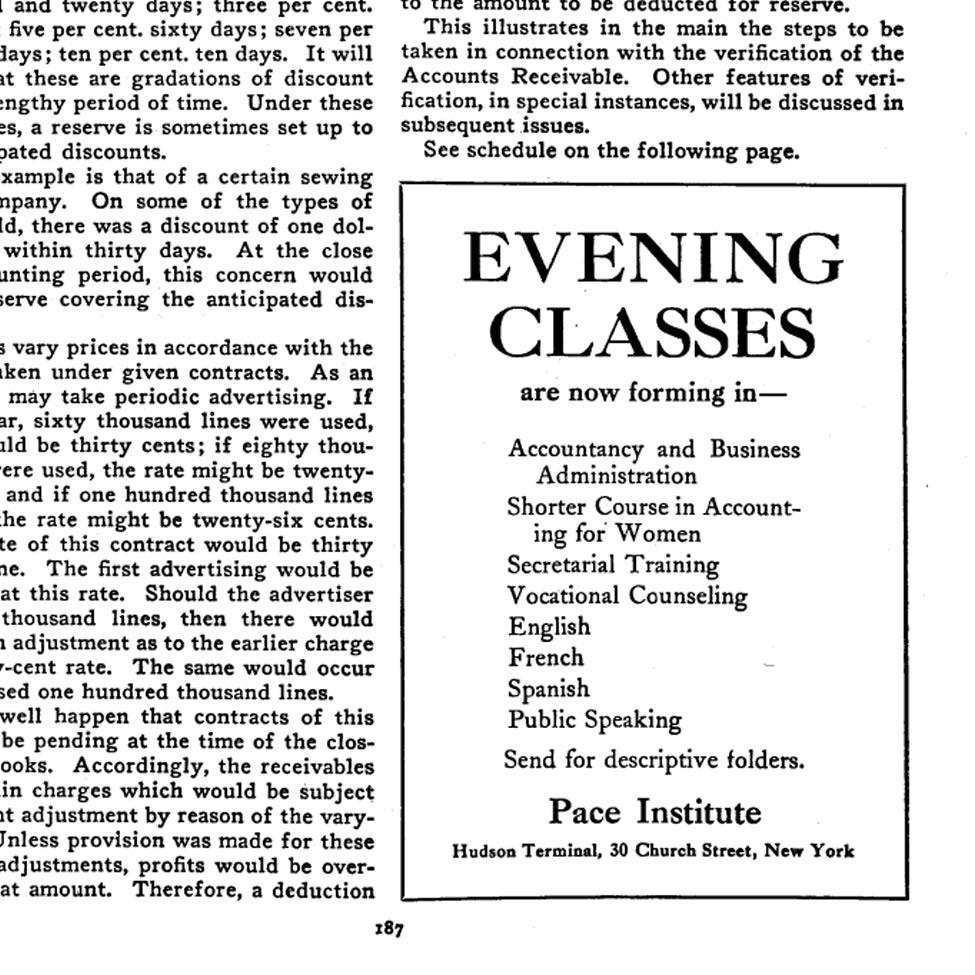
During these early years, the Pace brand expanded through affiliate schools and franchises across the country, and with a training program offered by mail. But in 1922, Pace retrenched to renew its focus on New York City. By 1929, as the stock market crashed and the Great Depression loomed, Pace’s decision to trim was vindicated.
As economic conditions improved, Pace sensed its moment. In 1935, Pace, which began as a proprietary for-profit business, was incorporated as a non-profit institution of higher education and officially became a college in 1948. Between 1960 and 1984, Pace’s third president, Edward J. Mortola, led a transformation that saw Pace mushroom from a tiny footprint and an enrollment of 400 into an educational powerhouse with eight schools, three campuses, and more than 26,000 students.
Pace is smaller today, but no less rigorous in its pursuit of academic relevance, said Marvin Krislov, Pace’s eighth, and current, president.
“Over the decades, we’ve grown across disciplines, campuses, and generations,” he said in its 2026 State of the University address. “But our purpose [has remained] constant: to prepare students, undergraduate and graduate alike, with the knowledge, real-world experience, and habits of mind to realize their full potential.”
The pattern is consistent enough to be called a strategy. In 1922, Pace pulled back from national expansion to recommit to New York—and thrived. In the 1960s, it expanded boldly when conditions allowed and built something lasting. Today's refocusing on core strengths isn't a retreat. It's the same institutional instinct, applied to a new moment. Pace has done this before. The record suggests it will work again.
Flip to page 4,130 in The Century Dictionary and Cyclopedia—a Pace Study showpiece and one of America’s greatest contributions to the field of dictionaries—and the entry for “opportunist” helps illuminate Pace University’s approach to keeping education relevant.
“In general,” the definition reads, an opportunist is “one who makes the best of circumstances as they arise.” The entry continues by invoking Anthony John Mundella, a famed British Liberal politician and major figure in 19th-century educational reform.
“Mr. Mundella,” the entry reads, “made a happy address before the conference, in which he styled himself an opportunist in education…a man who has to do the best he can under the circumstance.”
One hundred and twenty years after Pace’s founding, it’s forefathers would no doubt approve of the University’s continued commitment to that ideal.

Not just dates and milestones, but momentum. This timeline traces the defining moments that shaped Pace University, from its founding in 1906 to the institution it is today.

What began as quiet farmland in Pleasantville has grown into a vibrant hub of learning, partnership, and possibility. As Pace celebrates 120 years, the institution’s presence in Westchester tells a remarkable story—of community impact, student opportunity, and the power of place. Discover how Pace’s roots in Westchester continue to shape its future.

Pace has changed over the years, but some things never leave you. From long-gone campuses to unforgettable traditions, these are just some of the moments that define what it means to be Pace.