Image

Bennett Gershman, a law professor at Pace University in New York, said he had seen that kind of workload only on misdemeanor or lesser felony cases, which take far less time to clear. “It’s insane,” he said. “How can you handle a criminal justice system with integrity when you have one lawyer with so many cases that it’s almost impossible to navigate and manage in a fair, responsible, professional way?”
Elisabeth Haub School of Law Dean Horace Anderson has a Q&A with Westchester Lawyer.

It is a busy time for news at Pace University. This morning we’re announcing our speakers for Commencement 2023; yesterday we announced the formal appointment of our new Provost; and now, in the latest issue of Pace Now, we're sharing more faculty success, some amazing go-getters, and so much more.

It is a busy time for news at Pace University.
This morning we’re announcing our speakers for Commencement 2023. Telfar Clemens ’08, the Lubin grad and world-recognized fashion designer who’s as well known for his commitment to access and inclusion as he is for his must-have bags, will address all of our graduates and their guests at the main ceremony. At the Haub Law ceremony, Sen. Elizabeth Warren will be the featured speaker, and she’ll be joined by her husband, Harvard Law Prof. Bruce H. Mann. And at the ceremony for the Seidenberg School and the College of Health Professions, Trustee Ivan Seidenberg will speak to mark the 40th anniversary of his namesake school of computer science and information systems. It’s an impressive lineup that speaks to the breadth and ambition of Pace and our Class of 2023 graduates—and it’s just a small part of what I know will be a truly extraordinary day of celebration at the USTA Billie Jean King National Tennis Center on Monday, May 15.
But that’s just our latest news. Yesterday afternoon, the Board of Trustees appointed Prof. Joseph R. Franco as our new provost. Dr. Franco has been serving as interim provost since last summer, and he is doing an extraordinary job. A faculty member since 1987, he is a full professor in the Psychology and Mental Health Counseling Department on the Pleasantville Campus with a deep well of respect across the University. I am excited to continue working with him, as I know so many of us are.
There’s a lot of other news in this edition of Pace Now, from the highly prestigious National Science Foundation grant recently won by Seidenberg Prof. Zhan Zhang to an intercontinental experiential education success story to the little-known story of a tiny Pace library that makes a big impact.
And don’t forget all of the news in my State of the University speech, delivered just a few weeks ago: Our big plans to renovate the east side of One Pace Plaza, the nearly complete 15 Beekman Street, and academic innovations and investments like the Pace Entrepreneurship Studio, the expansion and upgrade of CHP’s simulation labs in Pleasantville, Seidenberg’s forthcoming Cyber Range on that campus, where cybersecurity students will be able to practice defending against the latest threats.
There’s a lot going on, and there’s more to come.
Let’s go get it.
Commencement 2023 just got 5x more exciting! This May, the Class of 2023 will celebrate with a creative genius and fashion entrepreneur, an intrepid US Senator, a renowned legal scholar, a former CEO of the largest telcom company in the US, and a nonprofit leader dedicated to justice and equality.


On Monday, May 15, the Class of 2023 will celebrate with a creative genius and fashion entrepreneur, an intrepid US Senator, a renowned legal scholar, a former CEO of the largest telcom company in the US, and a nonprofit leader dedicated to justice and equality.
The moment we’ve all been waiting for is finally here. We’re proud to announce that this year’s Honorary Degree Recipients, speakers, and honorees, who come to us with a diverse range of accomplishments and experiences and continue to push boundaries in their respective fields.
Liberian-American Fashion Designer
Honorary Degree Recipient and Speaker at the Main Ceremony
Telfar Clemens was born in 1985 to Liberian parents in Queens; his father had earned an MBA at Pace University a few years earlier. When Clemens arrived at Pace in the fall of 2003, he had already begun deconstructing garments and inventing his own creations. While he focused on his schoolwork in the Lubin School of Business, he also dove into the downtown worlds of music, culture, and fashion. In the classic model of countless Pace generations before him, he hustled: He got up early to go to his classes, he spent his afternoons working on his collection, and he DJ’ed at night to earn money. In 2005, while still a student, he founded his label, producing accessible, unisex items built on the principles of fluidity and inclusivity.
Just a few years later, he graduated from Pace with a degree in business management. He established himself as an insider’s designer, worn by people who worked in the industry if not quite breaking through to the wider culture. Then, in 2017, he won the coveted CFDA/Vogue Fashion Fund Award, and its prize of $400,000. He invested that money in production of the Telfar Shopping Bag—now lovingly known as “the Bushwick Birkin” for its status as an accessible icon.
The Telfar brand’s tagline is “Not for you, for everyone.” Even as the bags have become higher and higher profile—Oprah named them one of her favorite things; Beyonce has been spotted carrying one, and so has AOC—their price tops out at $257. As the label has grown and expanded, it has stayed true to its roots.

US Senator from Massachusetts
Honorary Degree Recipient and Speaker at the Haub Law Ceremony
Elizabeth Warren, a fearless consumer advocate who has made her life's work the fight for middle class families, was elected to the United States Senate on November 6, 2012, by the people of Massachusetts. She is widely credited for the original thinking, political courage, and relentless persistence that led to the creation of the Consumer Financial Protection Bureau. President Obama asked her to set up the new agency to hold Wall Street banks and other financial institutions accountable, and to protect consumers from financial tricks and traps often hidden in mortgages, credit cards, and other financial products.
In the aftermath of the 2008 financial crisis, Sen. Warren served as Chair of the Congressional Oversight Panel for the Troubled Asset Relief Program (TARP). Her independent and tireless efforts to protect taxpayers, to hold Wall Street accountable, and to ensure tough oversight of both the Bush and Obama Administrations won praise from both sides of the aisle. Senator Warren was a law professor for more than 30 years, including nearly 20 years as the Leo Gottlieb Professor of Law at Harvard Law School. The graduating class at Harvard twice recognized her with the Sacks-Freund Award for excellence in teaching. She taught courses on commercial law, contracts, and bankruptcy and wrote more than a hundred articles and ten books, including three national best-sellers, A Fighting Chance, The Two-Income Trap, and All Your Worth.
National Law Journal named her one of the Most Influential Lawyers of the Decade, TIME Magazine has named her one of the 100 most influential people in the world four times, and she has been honored by the Massachusetts Women's Bar Association with the Lelia J. Robinson Award.

Legal Scholar and Professor of Law at Harvard Law School
Honorary Degree Recipient at the Haub Law Ceremony
Professor Bruce Hartling Mann is an American legal scholar and legal historian who has been teaching at Harvard Law School since 2006, where he is the Carl F. Schipper, Jr. Professor of Law. He teaches courses in American Legal History and Property. His research focuses on the relationship among legal, social, and economic change in the American Revolutionary era. Mann holds five teaching awards—one at Washington University and four at Penn, this includes the university-wide Christian R. and Mary F. Lindback Foundation Award for Distinguished Teaching.
He is the author of Neighbors and Strangers: Law and Community in Early Connecticut (2001). He has co-edited a volume of essays entitled The Many Legalities of Early America and wrote a variety of articles and essays in various history journals and law reviews. His most recent book, Republic of Debtors: Bankruptcy in the Age of American Independence (2009) received the SHEAR Book Prize from the Society for Historians of the Early American Republic, Littleton-Griswold Prize from the American Historical Association, and the J. Willard Hurst Prize from the Law and Society Association.
He is currently a Fellow of the Massachusetts Historical Society, he is an elected Member of the American Antiquarian Society, and from 2011–2013, served as the President of the American Society for Legal History. Mann is married to Elizabeth Warren, the senior United States senator from Massachusetts and a former law professor. Warren proposed to Mann after she observed one of his Property classes.

President, One Hundred Black Men
Opportunitas in Action Award Winner and Speaker at the Lubin Ceremony
Aldrin Enis was elected the 11th president of the founding chapter of One Hundred Black Men (OHBM) at the end of 2020. With this being a pivotal year nationwide due to the COVID-19 pandemic, Enis was faced with challenges unique to any other president of OHBM. With many different aspects of community driven service to address in 2020 and 2021, he continued to hold the Junior One Hundred Legacy program and their partnership with Pace University in high priority. He approved the continuation of the program and partnership in 2021. Enis participated virtually in the Orientations and other sessions to stay engaged with the BIPOC male high school student participants. He never forgets to speak to Pace’s longstanding partnership with OHBM and the importance of seeking opportunity and post-secondary education.
In providing programming as part of this partnership, Pace University has a key opportunity to show all the Pace Community has to offer to its students from different areas of the University. Enis’ priorities as president include scaling up OHBM’s youth and adolescent programs while heightening awareness around mental health for these age groups. He has encouraged the OHBM staff working on the Junior One Hundred Legacy program to further engage with Pace University and to take an intentional approach in planning the program’s content. The 2023 program was approved to be held in-person for the first time since the COVID-19 pandemic.

Retired Chairman and CEO of Verizon
Speaker at the Seidenberg Ceremony
Ivan Seidenberg’s telecommunications career began more than 50 years ago when he joined New York Telephone as a cable splicer and linesman. Several decades and mergers later, he led its successor company, Verizon, to become the largest telecommunications company in the United States by building a nationwide wireless network, deploying high-speed fiber broadband direct to homes, and expanding its global Internet backbone network around the world. Seidenberg retired as Verizon’s chairman and CEO in 2011. Over the course of his accomplished career, Seidenberg was and continues to be involved in many business development, advisory, and philanthropic efforts.
In 2007, Pace University dedicated the Ivan G. Seidenberg School of Computer Science and Information Systems in recognition of his gift of $15 million to the University. In 2007, President George W. Bush named Seidenberg to the National Security Telecommunications Advisory Committee.
From 2009 to 2011, Seidenberg chaired the Business Roundtable, an association of the CEOs of the largest US corporations, and he currently he serves on the boards of trustees of Pace University and NewYork-Presbyterian Hospital and on the board of directors of BlackRock, the world’s largest asset manager. He is also an advisory partner for Perella Weinberg Partners, an investment bank. In 2000, he addressed the Pace Commencement ceremony and was awarded an honorary doctor of humane letters degree, honoris causa.
Stay tuned to the Commencement website for important information about deadlines (application to graduate, ticket ordering, and caps and gowns), the full schedule of events for May 15, and more. Can’t wait to see you on the big day!

“I’ve become the person that I am today because I came to New York City and Pace University.” International student Chinmay Bonde reflects on how his pro bono work with nonprofits in India, his professors at Pace, and his time in New York City have given him well-rounded, real-world education in his field.

Pace’s best kept secret is also New York’s smallest library. Pace’s Zine Library is under 100 square feet but what it lacks in size it makes up for in unique literary sources, student-created research, and pedagogical resources for faculty looking to change things up in the classroom.

“If we create technology that helps emergency care personnel make better, faster decisions, we can literally save lives.” Professor Zhan Zhang would know—he’s spent almost a decade doing research in emergency care technology. At Pace, he’s empowering ambitious young innovators to improve life through novel tech solutions.
Pace University alumnus Telfar Clemens ’08, a celebrated fashion designer and founder of the label Telfar, will address Pace University’s Commencement 2023 and receive an honorary doctorate. U.S. Sen. Elizabeth Warren will address the Elisabeth Haub School of Law graduating class. In addition, Sen. Warren and Harvard Law Professor and legal historian Bruce H. Mann will both receive honorary degrees. Trustee and alumnus Ivan G. Seidenberg ’81, retired chairman and CEO of Verizon Communications, will address graduates of Pace’s Seidenberg School of Computer Science and Information Systems to mark the school’s 40th anniversary.

For the second year, Pace will hold a combined ceremony for graduates of its three campuses at USTA Billie Jean King National Tennis Center in Queens
Pace University alumnus Telfar Clemens ’08, a celebrated fashion designer and founder of the label Telfar, will address Pace University’s Commencement 2023 and receive an honorary doctorate. U.S. Sen. Elizabeth Warren will address the Elisabeth Haub School of Law graduating class. In addition, Sen. Warren and Harvard Law Professor and legal historian Bruce H. Mann will both receive honorary degrees. Trustee and alumnus Ivan G. Seidenberg ’81, retired chairman and CEO of Verizon Communications, will address graduates of Pace’s Seidenberg School of Computer Science and Information Systems to mark the school’s 40th anniversary.
The university’s commencement will be held on May 15, 2023, at the USTA Billie Jean King National Tennis Center in Queens. This year’s commencement marks the second consecutive year that Pace will hold a combined ceremony for graduates of its campuses in New York City and Pleasantville, N.Y., and its Elisabeth Haub School of Law in White Plains, N.Y. The university will honor the entire Class of 2023 at its main ceremony, highlighted by Clemens’ remarks, and graduating students will cross the stage at their individual school and college ceremonies.
At Commencement each year, Pace also honors community members who exemplify the Pace motto of Opportunitas. This year’s Opportunitas in Action winner is Aldrin Enis, president of One Hundred Black Men of New York, a community service organization and longtime Pace partner that helps to create educational and career opportunities for Black youth in New York City.
“This remarkable group of honorees speaks to the many accomplishments and wide-ranging interests
of the Class of 2023 and the Pace University community,” said Pace President Marvin Krislov. “I’m pleased that we will once again be celebrating all of our graduates together in one in-person celebration, and I’m even happier that we’ll have such an impressive group of role models to help us mark this momentous occasion.”
Clemens will receive a Doctor of Humane Letters degree, honoris causa, at the 12:15 p.m. main ceremony, and he will address the graduates and their guests. Clemens is a wildly successful entrepreneur. He spent his time at Pace deconstructing garments and inventing his own creations; he later established himself as a fashion force to be reckoned with. In 2017, he won the coveted CFDA/Vogue Fashion Fund Award and its $400,000 prize. He invested that money in production of the Telfar Shopping Bag—now lovingly known as “the Bushwick Birkin” for its status as an accessible icon.
Sen. Warren will address graduates of the Elisabeth Haub School of Law in their morning ceremony. Warren, a consumer advocate who has made her life’s work the fight for middle class families, was elected by voters in Massachusetts to the U.S. Senate on November 6, 2012. A former candidate for the Democratic presidential nomination, she is recognized as one of the nation's top experts on bankruptcy, and the Boston Globe has called her “the plainspoken voice of people getting crushed by so many predatory lenders and under regulated banks.”
Sen. Warren and her husband, Harvard Law Professor and legal historian Bruce H. Mann, will also receive Doctor of Laws, honoris causa, the highest honor conferred by the Law School -- recognizing their lifelong contributions to public service and the legal profession -- at the law school ceremony. Mann is an American legal scholar who has taught at Harvard Law School, where he is the Carl F. Schipper Jr. Professor of Law, since 2006, teaching American Legal History and Property. His research focuses on the relationship among legal, social, and economic change in the American Revolutionary era.
Ivan G. Seidenberg ’81 will address the joint afternoon ceremony for the Seidenberg School of Computer Science and Information Systems and the College of Health Professions. Seidenberg earned a master’s degree in business administration and marketing at Pace. His telecommunications career began more than 50 years ago when he joined New York Telephone; he retired as chairman and CEO of its successor company, Verizon Communications. He is a tireless advocate for both diversity and academic excellence, and Pace awarded him an honorary doctorate in 2000. The Seidenberg School of Computer Science and Information Systems was named in his honor in 2006 after he donated what was then the largest gift ever received by Pace University.
Since 1906, Pace University has been transforming the lives of its diverse students—academically, professionally, and socioeconomically. With campuses in New York City and Westchester County, Pace offers bachelor, master, and doctoral degree programs to 13,600 students in its College of Health Professions, Dyson College of Arts and Sciences, Elisabeth Haub School of Law, Lubin School of Business, School of Education, and Seidenberg School of Computer Science and Information Systems.

The Madness of March returns to Pace University once again: For the first time in school history the Pace University Men's Basketball team earns back-to-back NCAA championship berths as the Setters heard their name called in Sunday night's Selection Show on NCAA.com. Pace received the No. 5 seed in the East Region and will face No. 4 seed and fellow Northeast-10 Conference foe University of New Haven.


The Pace University Men’s Basketball Team earned an at-large berth to the NCAA Championship for the second-straight year.
The Madness of March returns to Pace University once again: For the first time in school history the Pace University Men's Basketball team earns back-to-back NCAA championship berths as the Setters heard their name called in Sunday night's Selection Show on NCAA.com. Pace received the No. 5 seed in the East Region and will face No. 4 seed and fellow Northeast-10 Conference foe University of New Haven.
The first-round games will be played on Saturday, March 11 at Saint Anselm, the No. 1 seed in the East Region. Game time between the Pace and New Haven is set for 7:30 p.m. Fans can watch the game live.
The Setters (20-10) and Chargers (20-8) met once this season with New Haven besting Pace by just six points, 56-50, on January 21 in New Haven, Conn. New Haven was runner-up in the NE10 Championship.
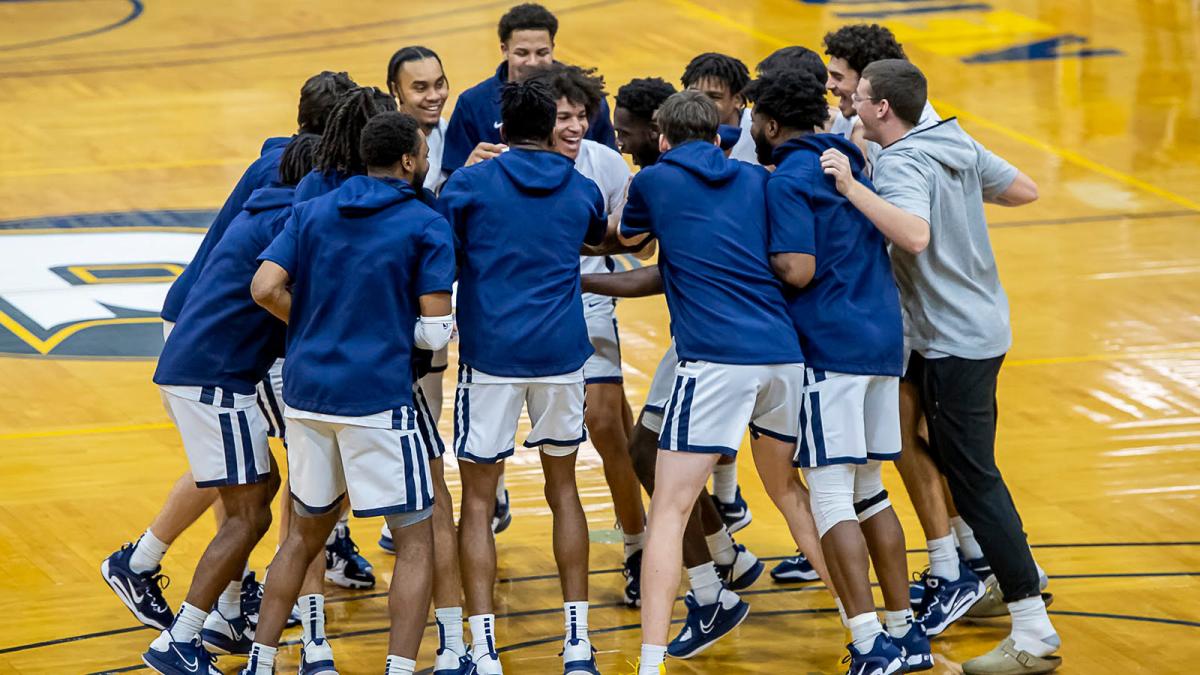
Head coach Matt Healing and the Setters have had another tremendous season, earning 20-plus wins for the second consecutive year. Healing's squads have boasted winning records in the last four seasons. The last time Pace recorded back-to-back 20-win seasons was 1989-1992.
Pace ranked second in the NE10 in field goal percentage defense (40.4) which ranked 18th nationally. In scoring defense, the Setters ranked 26th nationally (65.5), third in the NE10. The Blue and Gold finished seventh in the NE10 with an 11-9 record. In the conference championships, the Setters defeated No. 10 seed Adelphi, 72-51; but lost on the road at No. 2 seed Saint Anselm, 78-70.
The Pace men's basketball program has appeared in the NCAA championship just five times prior: 1992, 1999, 2002, 2007 and 2022.
Last season, the Setters earned the fifth seed in the East Regional and defeated fourth-seeded Dominican 77-64. It was the first NCAA win since 2002.
With a win on Saturday, Pace will advance to the NCAA Regional Semifinals which is slated for 7:30 p.m. on Sunday, March 12. A win in the semifinals will send the Setters to the regional championship, set for 7:00 p.m. on Tuesday, March 14.
Click here for all the NCAA Regional Information.
Pace University Athletics is a member of NCAA Division II, competing within the Northeast-10 Conference (NE10). Pace Athletics sponsors 15 intercollegiate sports, along with cheer and dance teams and a Pep Band. Known as the Setters, Pace’s official mascot is known as T-Bone. In 2021-22, Pace student-athletes posted a cumulative grade point average of 3.33. Additionally, a total of 562 Setters were selected to the NE10’s Academic Honor Roll with 69 student-athletes earning Academic Excellence with 4.0 semester GPAs. Twenty two student-athletes earned NE10 President’s Award for Academic Excellence, recognizing graduating student-athletes who have attained Magna Cum Laude at their institution, have participated in at least two seasons of NE10 competition and are current student-athletes at the time of graduation.
Pace’s best kept secret is also New York’s smallest library. Pace’s Zine Library is under 100 square feet but what it lacks in size it makes up for in unique literary sources, student-created research, and pedagogical resources for faculty looking to change things up in the classroom.

One of New York City’s smallest libraries can be found right here at Pace.
Clocking in at 97.92 square feet, Pace’s Zine library at 161 William Street is a reminder of how even the smallest things can have a big impact.
Instructional Services Librarian at Birnbaum Library Susan Thomas and Associate Professor Kelley Kreitz co-founded the library, and they both recently spoke passionately of the power of zines at a workshop sponsored by the Faculty Center. The workshop, Teaching and Learning with Zines Across the Disciplines, opened with a presentation by co-director Professor Derek Stroup in which he explained the unique elements at play when working with zines, accompanied by photos of some of the libraries’ eclectic offerings.
Stroup’s introduction reveals an eclectic variety of pieces. At Pace’s Zine library, you can find acclaimed historical zines from the 1970s next to zines created by students. Full-color magazines with huge budgets sit on the shelf next to flimsy, photocopied zines originally given out for free on the subway. This kind of variety presented on equal ground can spark conversations about where good art comes from, and who creates it. With a lower barrier to entry than traditional publishing, authors with smaller (or virtually no) budgets can share their perspective and create their own unique work using zines.
We are on the outside, we are in the underneath of publication.
—Derek Stroup
“We are on the outside, we are in the underneath of publication,” Stroup said. Many of these zines are unique and cannot be found for elsewhere—not even on Amazon.
But Pace’s Zine Library isn’t just an interesting curiosity. This particular workshop was sponsored by the Faculty Center, so much of the time was dedicated to exploring how faculty can best utilize the library. Many faculty, including Professor Steve Bookman, have brought their classes to the library, included zines in course materials, and even assigned zines as projects. According to him, students are big fans. “The multi-media aspect the students love because they don’t see it as an essay. It is an essay, but it’s more fun and creative for them,” said Bookman. “They have to be able to put something into fewer words which is something they are going to take into the real world.”
"We work together to provide this exciting, unique resource for the students."
—Susan Thomas
“Students play an important role, too,” says Thomas. “They select zines and related publications for the collection; donate their own zines; intern on a collaboration between the Zine Library and the Pace University Art Gallery and the Chinatown Art Brigade exhibition; and volunteer in the Zine Library as student catalogers.” Their contributions are made possible by the collaboration between Pace librarians and faculty, who work together to explore how zines and zine pedagogy can be utilized in the classroom. According to Thomas, "We work together to provide this exciting, unique resource for the students."
With a wide variety of topics—from sexuality and gender to racial justice; visual arts to history; skateboarding, nutrition, punk music, and more—zines can be utilized as primary texts across many disciplines to explore course content. Faculty trying to reinvent how their own material is taught and learned can utilize pedagogy resources that explain how to create their own zines or find zine lesson plans. And for faculty who don’t feel the course materials are represented in the library, the library wants to hear from you. Early collaborator to the library and zine-enthusiast Associate Professor Kelley Kreitz, PhD, recommended during the workshop, “We can use faculty needs to direct where the collection goes to some degree.”
It puts the idea of publishing and authorship within reach.
—Derek Stroup
For students who have big ideas but limited resources, zines create opportunity. “A student can’t create a book on economic change in Manhattan in a semester. But here’s something within reach, they can probably create an eight-page zine,” Stroup explained. “It puts the idea of publishing and authorship within reach.” Whether a zine is created for a school project or for extracurricular interests and passions, zines can empower students to become published authors and get real-world experience expressing their ideas and research.
Whether you want to use the zines as primary texts, task students with creating their zines for research projects, or use resources to create zines of your own, Pace’s Zine Library is ready to support Pace Community members in the ever-forward push for innovating the way students learn.
Access and browse the Zine Library Collection online. To plan a visit or learn more, visit Pace’s Zine Library website.


Pace University’s Lubin School of Business, in collaboration with AnD Ventures, recently launched the Pace Entrepreneurship Studio (PES) with the mission to support Pace students, faculty, staff and alumni in taking their compelling business ideas or ventures from concept to company.

Pace University’s Lubin School of Business, in collaboration with AnD Ventures, recently launched the Pace Entrepreneurship Studio (PES) with the mission to support Pace students, faculty, staff and alumni in taking their compelling business ideas or ventures from concept to company.
PES will position the University as a leading institution for cultivating entrepreneurship and innovation in the tri-state area.
“For more than a century, Pace and the Lubin School have been at the forefront of business education,” said Pace President Marvin Krislov. “Today, the Pace Entrepreneurship Studio is a unique and cutting-edge opportunity for ambitious and innovative Pace students to gain access to some of the best minds in business and tech. I couldn’t be happier that three student-led projects are already well on their way to success.”
AnD Ventures, an Israeli venture capital firm, has collaborated with Pace on this exciting endeavor to teach the "how" and to support the "what" of providing students, faculty, and alumni with a complete blueprint for establishing successful businesses.
Presently, three startups have been selected from a pool of twenty-three to undergo PES’ “Studio Process,” which entails passing a due diligence review with AnD Ventures’ investment team and key experts from a variety of sectors. During the due diligence process the PES team identifies the main challenges for each company and develops a tailor-made roadmap for accelerating its growth. Each startup has its own process and key performance indicators for the purpose of raising funds and developing a strategy for international expansion.
“With equal amounts of fascination and pride, I am excited that PES is serving as a launchpad and support infrastructure for business ideas and ventures created by members of our community,” said Lawrence G. Singleton, dean of the Lubin School of Business. “Fostering and cultivating an entrepreneurial spirit in our students is one of Lubin’s strengths. Pace’s contribution to the entrepreneurial ecosystem positions the university to nurture the growth of businesses providing solutions to a variety of challenges consumers are experiencing today.”
The onboarded startups are:
These three startups are already in the marketplace providing goods and services and delivering results. PES is providing guidance and resources so that these successful ventures may build even more momentum.
With an aptly-fitting name reflective of the ambition, drive, and grit embodied by members of the community, Pace “Go-Getters” with compelling business ideas or startups are encouraged to apply to the PES program. PES is the university’s motto of Opportunitas at work!
Pace University has a proud history of preparing its diverse student body for a lifetime of professional success because of its unique programs that combine immersive academics and real-world experiences. Pace is ranked the #1 private, four-year college in the nation for upward economic mobility by Harvard University’s Opportunity Insights, evidence of the transformative education the University provides.
Globally recognized and prestigiously accredited, the Lubin School of Business integrates New York City’s business world into the experienced-based education of its students at Pace’s suburban and downtown campuses, implemented by one of the region’s largest co-op programs, team-based learning, and customized career guidance. Its programs are designed to launch success-oriented graduates toward upwardly mobile careers.
Located at Pace University, the Pace Entrepreneurship Studio (PES) elevates promising entrepreneurs with the assistance of international leaders and professionals. PES supports new startups, from ideation to funding—from conception to operation, with the mission to teach the "how" and to support the "what"—providing students, faculty, and alumni with a complete blueprint for establishing successful businesses.
AnD Ventures is an Israeli venture capital firm that invests in pioneering early-stage startups and builds them into companies that make a difference. The team consists of founders, sophisticated investors, corporates, and VCs. Together, they work in concert with experts from Fortune 500 companies, serial entrepreneurs, innovators, and experts across a vast array of industries and experiences.
“I’ve become the person that I am today because I came to New York City and Pace University.” International student Chinmay Bonde reflects on how his pro bono work with nonprofits in India, his professors at Pace, and his time in New York City have given him well-rounded, real-world education in his field.

Chinmay Bonde ’23 already had a wealth of marketing knowledge before he left India to pursue an MS degree in marketing analytics as a Pace graduate student. But before he arrived in New York City, he gained experience that shifted the way he thought about how companies did business and emphasized the importance of building his own skills.
While still in India, Chinmay worked for California-based IT company Cloudalyze. During the pandemic, Chinmay’s company asked that employees donate one percent of their work hours toward voluntary work for nonprofits. “Organizations that donated their expertise to nonprofits could earn the Impact Partner certification, which is the highest tier of the Salesforce platform in the nonprofit industry,” he explained.
His experience in system development, graphic design, and customer success came together as he worked with nonprofits across different industries—from healthcare, education, energy, and beyond. Throughout his pro bono work, he felt there were three major takeaways. “First, my organization received a high achievement tier within Salesforce, which is huge because everyone uses Salesforces,” he explains. “Second, it was a bonus for me on a personal level by enhancing my skillset, and it’s great to have the experience on my resume. And the third thing is that the nonprofits were able to save a lot of money and time they would have had to invest in a paid consulting firm if we hadn’t stepped in.”
I found really amazing professors at Pace with such great experience.
Chinmay estimated the pro bono work he did saved nearly $100,000 for nonprofits during a difficult financial time. “Many were so impressed and so happy with the work done, they were ready to pay us back and enroll in full-time support,” Chinmay says. His company even created new cost-effective support plans specifically aimed at nonprofits as a result of their work together. To sum it up, “Everybody wins.”
Now, Chinmay is further expanding his skill toolbox at Pace as a graduate student. When he was choosing schools in the US, he focused his research on faculty, looking for professors who had industry experience that resonated with the work he wanted to do. “I found really amazing professors at Pace with such great experience,” he says. “I’m on my last semester and my marketing knowledge and skills have really been enhanced to a level it wouldn’t have otherwise, especially because of those amazing professors.”
I have become the boss of my own life just by living over here, and Pace University is the reason I have been able to achieve all of that.
Chinmay prides himself on his market research, and he noticed something especially interesting about Pace. “I looked at nearly sixty colleges before I made my decisions and had a few offer letters.” According to him, “Pace seemed to be the only college program with a STEM-designated MS in social media and mobile marketing which is a huge thing in today’s time. Especially for international students who want to come to America.” Even though he didn’t enroll in that program, it was one more thing that impressed him about his future school.
As an international student, moving to New York City was a daunting prospect but has proved to be one of the most beneficial aspects of his time at Pace. “It’s such a vast, overwhelming, fast-paced city,” he admits. “But I made the best decision of my life. I’ve become the person that I am today because I came to New York City and Pace University. Not just from just a career and knowledge perspective—I think it’s entirely changed me as a human being.”
From nonprofit work in India to the classroom in New York City, Chinmay’s journey emphasizes how education comes in all forms, whether it’s on-the-job, in school, or through new experiences. “I have become the boss of my own life just by living over here, and Pace University is the reason I have been able to achieve all of that,” he says. “It’s changed my life in such a short amount of time.”