Image
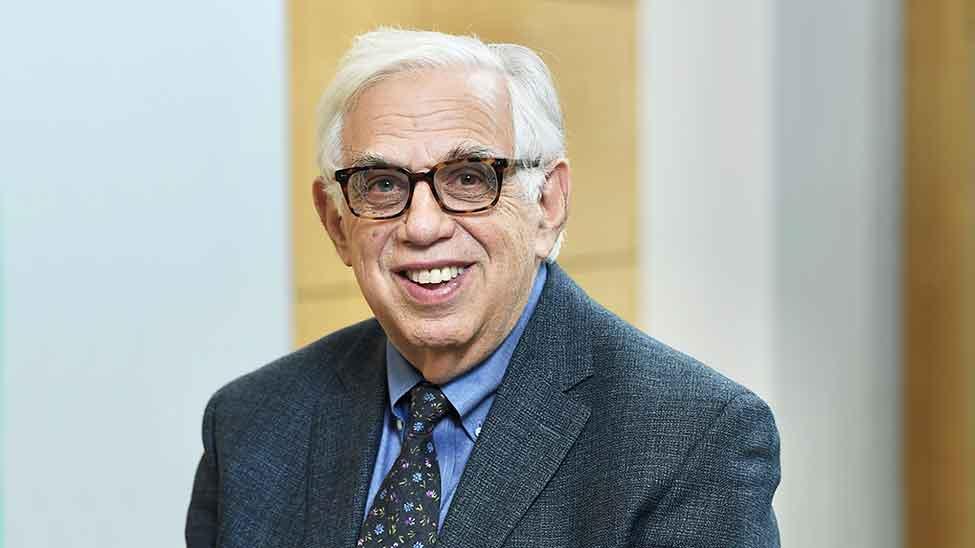
Pace University appoints Li-Chiou Chen as dean of the Seidenberg School, effective July 16, 2026.


Pace University has appointed Li-Chiou Chen, PhD, as dean of the Seidenberg School of Computer Science and Information Systems following a thorough internal search conducted in accordance with the Faculty Handbook. Her five-year term begins on July 16, 2026.
Since stepping into the role of interim dean nearly two years ago, Chen has provided thoughtful, steady leadership during an important period of transformation for Seidenberg. She has built on the school's strengths while advancing a vision centered on academic excellence, innovation, student success, and strategic investment in the future of computing and technology education.
The appointment comes after a thoughtful internal search led by Seidenberg's Faculty Council. Throughout the process, Chen distinguished herself through her record of collaborative leadership, strategic vision, and deep commitment to the school's mission. Her ability to guide Seidenberg through a period of meaningful change while fostering academic excellence, strengthening partnerships, and supporting students made her the clear choice to lead the school into its next chapter.
Over the past two years, Chen has brought people together around a shared vision for Seidenberg's future while advancing initiatives that strengthen academic programs, expand research opportunities, and enhance the student experience. Under her leadership, the school has secured more than $10 million in external grant funding, strengthened its research enterprise, and advanced priorities that improve program quality and expand opportunities for students.
Among Chen's priorities has been ensuring that Seidenberg continues to evolve alongside the rapidly changing technology landscape. Under her leadership, the school will launch three new artificial intelligence degree programs in fall 2026: a Bachelor of Science in Artificial Intelligence, a Master of Science in Artificial Intelligence, and a Master of Science in Applied Artificial Intelligence.
With the introduction of the bachelor's program, Seidenberg will become the first school in Westchester County to offer a dedicated undergraduate degree in artificial intelligence. These new programs reflect Seidenberg's commitment to preparing students with the technical expertise, ethical foundation, and practical experience needed to lead in one of today's fastest-evolving fields.
These accomplishments reflect Chen's collaborative leadership and her commitment to preparing students for success in rapidly evolving fields. Together, they reinforce Seidenberg's reputation as a leader in computing, cybersecurity, artificial intelligence, and emerging technologies while positioning the school for continued growth and innovation.
As dean, Chen will continue to build on Seidenberg's strong trajectory while advancing the school's mission of educating the next generation of technology leaders and innovators. Under her leadership, Seidenberg will continue expanding its academic offerings, strengthening research, and creating transformative opportunities for students.
What happens after the sentence is handed down? For professor emeritus Michael Mushlin, JD, that question has defined a career. Now, a first-in-the-nation New York reform he helped shape will require judges to step inside prisons and jails, bringing the realities of incarceration into clearer view.


‘We do not see and we do not hear those who suffer, and what is terrible in life goes on somewhere behind the scenes."
Anton Chekhov made this observation in his novella Ward No. 6, one of his many works that explored how society treats people once they fall out of public view. His perspective was informed in part by three months spent in a Russian penal colony where he interviewed thousands of convicts and witnessed the realities of incarceration firsthand.
More than a century after Chekhov wrote Ward No. 6, Michael Mushlin, JD, professor emeritus at the Elisabeth Haub School of Law at Pace University, still finds himself returning to the writer’s observations. For Mushlin, Chekhov’s central insight remains urgently relevant: society devotes enormous attention to determining guilt or innocence, but too often stops looking once a person is sentenced. His own career has been a sustained effort to challenge that silence—to bring prisons, and the people inside them, back into public and judicial view.
“But we should care,” Mushlin insists.
That idea—that we should care— has defined Mushlin's career as a lawyer, scholar, and advocate. As a civil rights lawyer, legal scholar, and prison reform advocate, he has spent decades pushing courts, lawmakers, and the public to pay closer attention to what happens after a prison sentence begins. His work has included major civil rights litigation, a four-volume treatise on prisoners' rights, and leadership roles in some of New York's most influential prison reform organizations.
Most recently, Mushlin chaired the Subcommittee on Judicial Visits to Prisons and Jails. After four years of study and planning, the group's proposal was adopted by New York State, making it the first state in the nation to require judges with sentencing or detention responsibilities to make annual, meaningful visits to prisons and jails.
It seems to me that people should be treated humanely.
Prisoners' rights appealed to Mushlin early in his legal career because, unlike many areas of law, the moral question felt clear. “It seems to me that people should be treated humanely,” he said. “When you’re a prisoners’ rights lawyer, we’re not saying this person shouldn’t be punished. We’re not saying this person didn’t do something bad. What we’re saying is that it’s in everybody’s interest that this person be treated with humanity. It’s in the interest of victims, the interest of the prisoner, of society, of safety. It’s in the interest of the well-being of the American people and our values.”
“The bulk of my career has been spent as a teacher and an academic at Pace, so I consider Pace my home.”
While fighting for reform, Mushlin was also educating the next generation of lawyers, judges, and policymakers at the Elisabeth Haub School of Law. Though he initially worried academia would pull him away from his advocacy work, Pace allowed him to bring the two together. “I'm very grateful to Pace for giving me the opportunity to continue doing that work while also being a professor,” he said.

One of the clearest examples was a prisoners' rights course he developed for Haub Law, where students studied the law, heard from guest speakers, and visited prisons. Though such courses are rare at law schools, Pace welcomed the addition. According to Mushlin, the course was embraced by faculty and remains part of the curriculum today. One alumna even told him recently it was the best class she took in law school.
Looking back, Mushlin sees no divide between his work as an educator and his work as an advocate. “I didn't feel like I was leaving behind my role as an activist by going into academia.”
During his time at Pace, Mushlin taught students that understanding the justice system required looking beyond convictions and courtrooms. Soon, he would begin making the same case to New York's judiciary.
In 2022, Mushlin was asked to chair a newly formed subcommittee of the Chief Administrative Judge's Advisory Committee on Criminal Law and Procedure. The group's charge was simple: determine whether judges should visit prisons and jails and, if so, what those visits should look like.
Over the next four years, Mushlin worked with judges, corrections experts, and legal professionals to develop what would become a first-in-the-nation effort to bring judges inside correctional facilities. "Prisons are the most cut-off places that we have," Mushlin said. "There are not only walls in prisons, but also an intellectual barrier."
Prisons are the most cut-off places that we have.
New York judges already conducted prison visits, but they were often brief and perfunctory. Mushlin and the subcommittee wanted something more meaningful—visits that would give judges a better understanding of the realities of incarceration.
“The idea is that you should really see every area of the prison,” he said. The proposal requires judges to make annual, day-long visits to correctional facilities, touring housing units, medical and educational areas, solitary confinement, dining halls, and visitor spaces. Judges also have the option to speak directly with incarcerated people and correctional staff to gain a deeper understanding of life inside prison walls.
“The idea is to essentially spend a good part of a day immersing oneself in this place,” Mushlin said. “If you're going to visit a prison, you should really do it.”
After four years of work, the subcommittee's proposal was adopted by New York State, making it the first state in the nation to require judges with sentencing or detention responsibilities to make annual, meaningful visits to prisons and jails.
For Mushlin, the significance of the rule extends far beyond the visits themselves, identifying three key benefits. “One benefit is that judges are able to perform their very important sentencing function better, more realistically, and with some real notion of what the consequences of the prison sentence is,” he said.
Having judges go into prisons signals to people who have been imprisoned that they are not forgotten.
“The second benefit is that makes more visible and connected the prison system to the criminal justice system,” he continues. According to Mushlin, policing and adjudication receive more visibility, leaving corrections often in an “out of sight, out of mind” position.
The third benefit is perhaps the most human. “Having judges go into prisons signals to people who have been imprisoned that they are not forgotten,” Mushlin said. “That's a really important message.”
The proposal took four years to develop as the subcommittee worked to balance ambitious goals with the realities of cost, coordination, training, and implementation. Although the rule has now been adopted, significant planning remains before it takes effect in January 2028.
For Mushlin, the milestone is both a culmination and a beginning. While it represents one of the most significant achievements of his career, he knows the work of reform is never finished. Lasting change depends not only on policy, but on the people who will shape the future of the legal profession. That's why he believes legal education plays such a critical role.
Lawyers have a critical role to play in making our country a better place.
“In law school you train your mind to think rigorously, carefully, and logically about a problem,” he said. “Lawyers have a critical role to play in making our country a better place.”
As New York prepares to implement a first-in-the-nation judicial visitation program, Mushlin hopes future generations of lawyers will continue the work of reform. More than a century after Chekhov warned of the callousness that can come with habit and distance, Mushlin’s work offers a practical response: shorten the distance. Step inside. Look closely. And remember that justice depends not only on the sentence imposed, but on the humanity preserved afterward.
Want to learn more? Register to attend the inaugural Morris E. Lasker Lecture on Correctional Justice where Mushlin will present on this imitative and prison reform.

Through research, teaching, and interdisciplinary collaboration, Pace faculty from Dyson College and the College of Health Professions are helping students understand human trafficking as a complex human rights issue—one that demands knowledge, compassion, and care.

From virtual patients to real-world readiness, students are training in high-stakes scenarios before they ever enter a clinic. Nancy Owen reveals how AI is reshaping that experience at Pace’s Center for Excellence in Healthcare Simulation.

In a world where everyone can share the news, who decides what's true? Drawing on more than a decade of research, associate professor Mirjana Pantic explores how readers can participate responsibly in the news while separating fact from fiction in her book, Digital News Literacy and Participatory Journalism.
Inside the newly revitalized One Pace Plaza East, Pace University’s Commercial Dance students got their first glimpse of a space built for the way they move, create, and collaborate. What began as a social media shoot became a live lesson in experiential learning, as Sands students choreographed, directed, and performed original movement in minutes—offering a joyful preview of Pace’s next chapter in the performing arts.


For Pace University’s Commercial Dance students, stepping into the newly revitalized spaces at One Pace Plaza East was more than a first look. It was a first feeling.
The mirrors. The scale. The studios. The theaters. The sense that, at last, this was a place built with them in mind.
“My first impression of the new One Pace Plaza East space was WOW,” said Naomi Bowen ’26. “Almost too good to be true, the state-of-the-art design and technology we have.”
Opening in Fall 2026, One Pace Plaza East marks a bold new chapter for Pace University’s New York City Campus and for Sands College of Performing Arts. The transformation will create a dynamic home for learning, performance, creativity, and community, including state-of-the-art classrooms, creative arts and collaboration spaces, student housing in Maria’s Tower, and a new Performing Arts Center with three theater venues, including a reimagined 430-seat Schimmel Theater.
But on one spring day, just before graduation, the future of the space came alive in a very Pace way: through students.
A group of Sands Commercial Dance students entered the building for a social media shoot meant to capture their first impressions. What happened next became something bigger. Given a new space, a guerrilla camera crew, and very little time, the students began creating. Within about 20 minutes, they had choreographed and blocked original performances in the new spaces, adjusting in real time, directing one another, and transforming the shoot into a showcase of what Pace students do best.
They made something from nothing.
For Bowen, the approach was simple: “YES, AND.”
That spirit of collaboration, flexibility, and fearless experimentation is central to the Commercial Dance experience at Pace. Students are trained not only to perform, but to think like working professionals—to understand the camera, the audience, the product, the room, and the moment.
Bowen said the experience immediately brought her back to the program’s Los Angeles semester, led by Mandy Moore, one of the industry’s leading choreographers. In a course called Choreography for the Camera, students were often asked to create quickly and intentionally.
“It taught me that in these fast-paced environments, you have to be adaptable. And honestly, after performing shirtless on SNL with Harry Styles, nothing seems too scary anymore!”
“Our teachers Mandy and Jillian Meyers, assisted by the wonderful Claire, would do warm-up exercises at the top of class where we only had five minutes to create, forcing us to be quick on our feet,” Bowen said. “When we had longer work sessions, we focused on questions such as, ‘How do we motivate the camera?’ ‘What is the product?’ and ‘Who is the audience?’ That is what guided us throughout this little shoot.”
Aiden Powers ’26 saw the same training come to life. During the shoot, Powers helped direct the group while keeping the energy creative, focused, and fast-moving.
“In Commercial Dance, we go to LA for our junior spring under the direction of Mandy Moore,” Powers said. “In our Choreography for the Camera course, Mandy and Jillian frequently gave us complex tasks with limited parameters and a short amount of time. Collaboration was crucial to make those projects successful.”
That preparation showed. The students moved through the space with the confidence of performers and the instincts of creators, quickly shaping ideas, testing angles, and making decisions.
“I think the biggest thing I’ve learned is a successful leader is decisive and doesn’t waste five minutes deciding if something works or not,” Powers said. “Making those quick decisions creates an efficient environment.”
For Powers, the shoot is also connected to recent professional experiences, including performing on Saturday Night Live with Harry Styles and with the cast of Dancing with the Stars. Those moments reinforced the importance of adapting quickly when movement meets the camera.
“We would get rehearsal footage back and they would immediately change numerous things to fit the camera better, almost like how we were adjusting choreography based on different takes with T-bone,” Powers said. “It taught me that in these fast-paced environments, you have to be adaptable. And honestly, after performing shirtless on SNL with Harry Styles, nothing seems too scary anymore!”
That mix of discipline, humor, skill, and confidence helped make the video resonate. The first social media post from the shoot quickly amassed more than 40,000 views, offering the Pace Community—and future performers—a glimpse of what is coming.
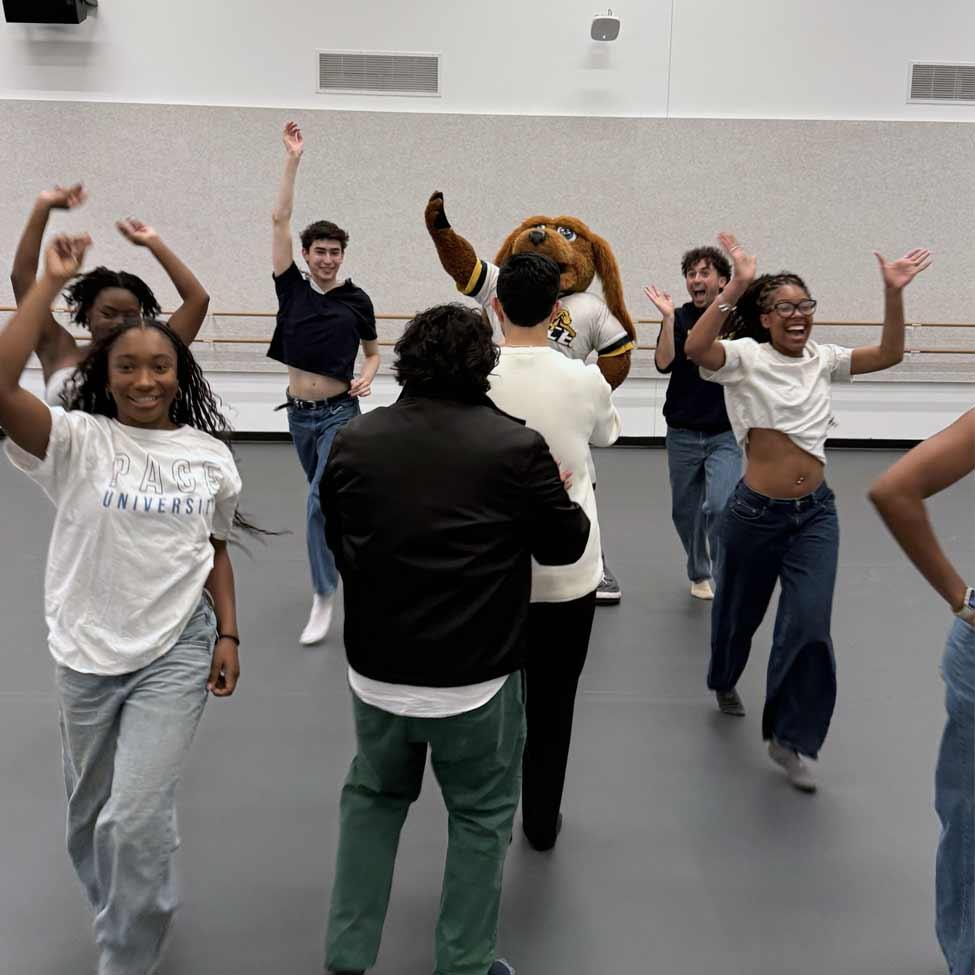
For Holly Evans, program head of the BFA Commercial Dance Department, the day captured exactly what the new space represents.
“Having a dedicated space to celebrate the performing arts and arts education is transformative for our Sands programs,” Evans said. “It shows the University’s commitment to the arts and the amazing artists we train at Pace. NYC is the heartbeat for the performing arts, and our new building is right in the center of this energy.”
Watching students experience the studios for the first time, Evans said, felt like seeing the future of the program unfold in real time.
“As I watched my students walk into the new dance space, I immediately saw the future flash in front of my eyes,” she said. “They were so excited to be in the space and immediately wanted to share it with their peers who hadn’t seen it yet.”
The moment also reflected the culture of the Commercial Dance program: collaborative, generous, ambitious, and deeply connected.
“The culture of our program is a family and that was clear that day,” Evans said. “The oldest students immediately took leadership roles setting up the video concepts and blocking. The younger students collaborated but also respected the vision of our seniors. They all wanted what is best for each other and the program as a whole.”
“It felt like damn, I think I am ready,” Bowen said. “All the knowledge and tools I have accumulated over the years will be put to great use.”
For the graduating seniors, the experience carried an added meaning. They were standing inside a space that future Pace performers will soon call home, while also preparing to step into their own professional futures.
“It felt like damn, I think I am ready,” Bowen said. “All the knowledge and tools I have accumulated over the years will be put to great use.”
Powers felt that readiness, too—especially in the challenge of communicating movement to dancers, camera operators, managers, and even T-bone.
“This impromptu directing experience made me realize just how much I’ve learned, and how much I love directing,” he said.
For the Pace Community, One Pace Plaza East is not just a new building. It is momentum. It is a place where students can rehearse, create, perform, collaborate, and lead in an environment designed to match the caliber of their training.
“Sands has been able to produce great artists with limited resources,” Evans said. “I can only imagine what we will be able to do now. The future for Sands is limitless.”
And for the students who danced through the studios before the doors officially open, the message was clear: this space is ready for them.
Soon, it will be ready for everyone else.

From a 390-foot crane to thousands of new light fixtures, the transformation of One Pace Plaza East is a story told in big numbers, bold spaces, and behind-the-scenes precision. Go inside the construction of Pace’s future-facing downtown campus hub—one seat, studio, stage, and catwalk at a time.

What can dogs teach us about ourselves? Through the Dog Lab, Dyson College assistant professor Molly Byrne, PhD, is using innovative virtual research to uncover new insights into canine and human behavior alike.

From celebrating 120 years of Pace pride to earning national recognition, launching new centers, advancing sustainability, and empowering students to lead, this semester offered 10 inspiring reminders of Pace’s momentum—and the community driving it forward.
From celebrating 120 years of Pace pride to earning national recognition, launching new centers, advancing sustainability, and empowering students to lead, this semester offered 10 inspiring reminders of Pace’s momentum—and the community driving it forward.

This semester, Pace’s 120-year legacy came alive in bold new ways—from milestone celebrations and national rankings to groundbreaking research, student advocacy, career momentum, sustainability honors, and standout recognition for our performing arts, law, nursing, technology, and healthcare programs. Across our campuses and far beyond them, Pace students, faculty, alumni, and friends continued to prove what has always defined this University: ambition in action, purpose in motion, and a community built to meet the future.

Pace celebrated its 120th anniversary with campus birthday parties on April 13 in Pleasantville, New York City, and at the Elisabeth Haub School of Law in White Plains, honoring co-founder Homer St. Clair Pace with food, fun, prizes, and commemorative giveaways. The celebration continued on June 11, when Pace lit up New York City’s famed Helmsley Building in honor of Alumni Reunion during our milestone 120th year. Want to learn more? Check out our Deep Dive into the history of Pace University.
Pace University has continued its rise in the national spotlight, earning multiple Top 100 placements in the 2026 U.S. News & World Report rankings—including the #1 Environmental Law program in the country, Top 50 rankings in law and nursing, and three programs among the top 20 percent nationally. From law and nursing to business and technology, Pace has demonstrated growing momentum across career-focused fields that prepare students for meaningful, in-demand work.
PaceDocs released its latest film, Stories Come Together, following a successful premiere at the Jacob Burns Film Center that reunited students, alumni, faculty, and supporters to celebrate the program’s legacy of connection and storytelling. Featuring interviews with more than 30 alumni and faculty members, the documentary honored Professor Emeritus Maria Luskay, EdD, and reflected on a program that has produced 24 documentaries across 14 countries and earned more than 30 awards over 24 years.
Only months after its launch, the Gale Epstein Center for Technology, Policy and the Environment at Pace University is already emerging as a hub for civic innovation, experiential learning, and environmental advocacy. Housed within the Seidenberg School of Computer Science and Information Systems and made possible by a transformative gift from philanthropist and business leader Gale Epstein, the Center is advancing Pace’s leadership in environmental technology, policy innovation, and public health. Guided by Executive Director John Cronin, the Center is empowering students to tackle real-world challenges in water quality, environmental justice, and the public’s right to know about the water they drink—while expanding its impact through award-winning student projects, sustainability initiatives, youth-led environmental engagement, and Cronin’s appointment to the Millennium Campus Network’s global Civic Learning Council, which advances the UN Sustainable Development Goals.

Sands College of Performing Arts at Pace University was named one of The Hollywood Reporter’s 25 Best Drama Schools in the World, spotlighting Pace’s growing global reputation for performing arts education. With a new performing arts center opening this fall, alumni like Cooper Koch and Christopher Briney making waves, and a groundbreaking artist-in-residence program with Deaf West, Sands showed the world that this was only the beginning.
Hundreds of Pace students packed the Spring 2026 Job and Internship Career Fair to connect with 100+ employers—including EY, KPMG, FUJIFILM, and Northwell Health—building networks and exploring career paths with top recruiters. It’s one more example of Pace’s career power: the Class of 2024 achieved a 92% employment or continuing education rate within six months of graduation.
After hosting its Actionable AI Conference earlier this spring, Pace had continued the momentum with a second major AI conference: Intelligent Futures: The Role of Artificial Intelligence in Shaping Universities and Higher Education, presented with O.P. Jindal Global University at Pace’s downtown NYC Campus. The event had brought together leaders from Pace, JGU, Columbia, Drexel, Fordham, Hunter, Manhattanville, Marist, and more to explore how AI had been reshaping teaching and learning, the humanities, governance, and ethics in higher education.
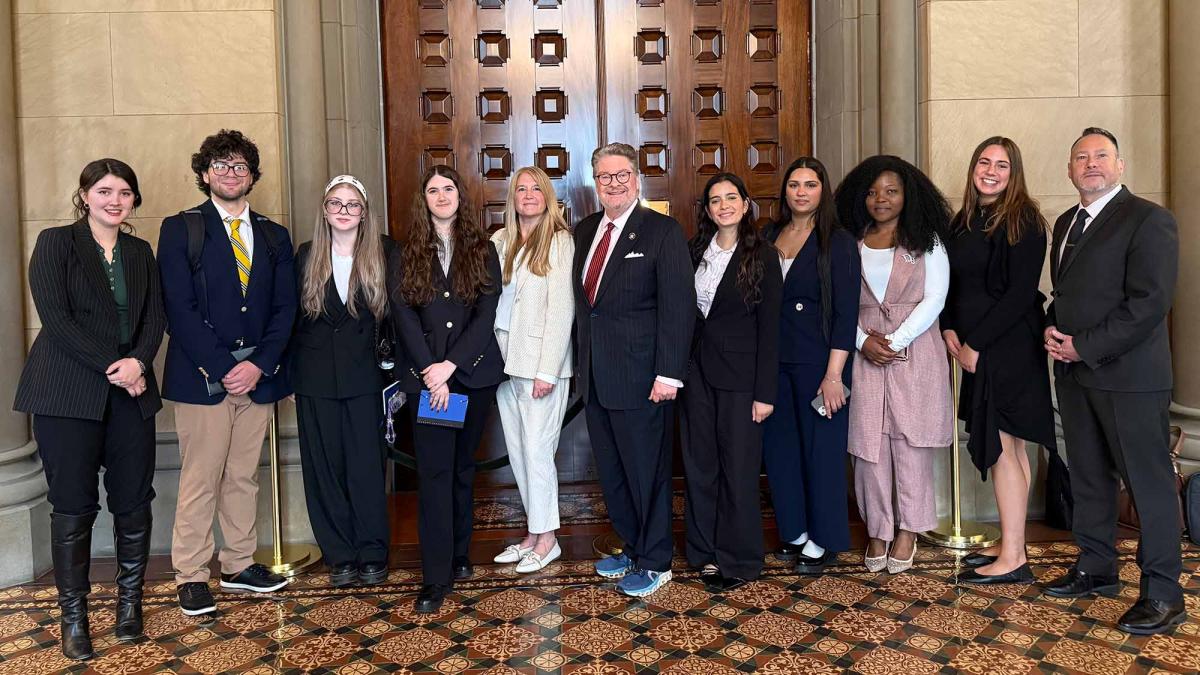
After three years of student-led research and advocacy, Pace University students in the Animal Advocacy Clinic had helped bring the RAPTORS Act before New York lawmakers, targeting rodenticides linked to the deaths of wildlife and pets. Introduced by Senator Pete Harckham and Assemblymember Chris Burdick, the bill had built on Pace research highlighting the urgent risks these poisons posed to hawks, birds of prey, companion animals, and the broader environment.
Pace University has received a 2026 U.S. Department of Energy Better Project Award for its transformative energy retrofit initiatives at One Pace Plaza, the University’s flagship campus building in Lower Manhattan. The award recognized Pace’s comprehensive modernization of One Pace Plaza East, which combined innovative sustainability strategies with major infrastructure improvements to reduce energy consumption, enhance the student experience, and strengthen long-term operational reliability.
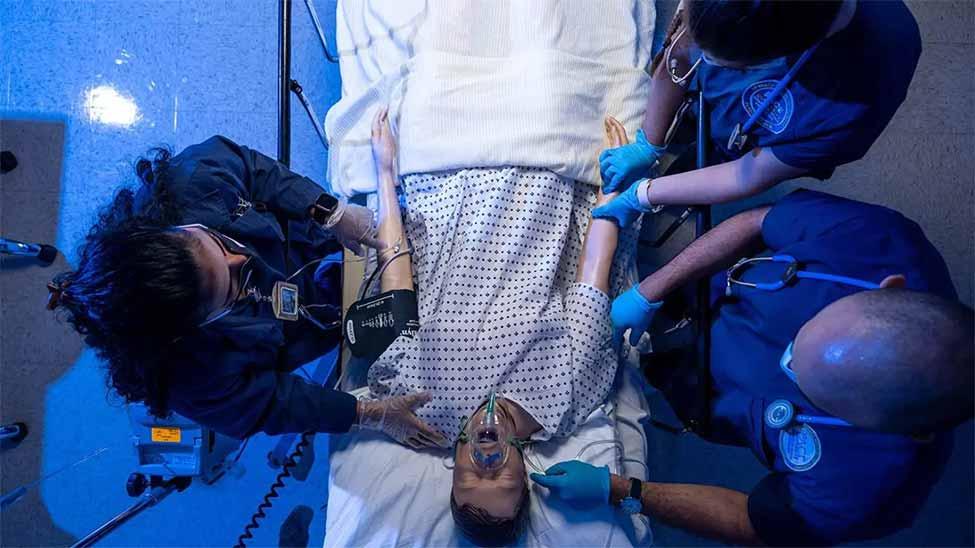
Pace University received $2.175 million in funding from New York State Senate Majority Leader (and Pace alumna!) Andrea Stewart-Cousins '86, '08 to support capital improvements and technology upgrades at its Center of Excellence in Healthcare Simulation in Pleasantville. The investment expanded hands-on training for students in high-demand health programs, helping Pace prepare the next generation of nurses and clinicians through state-of-the-art simulation experiences.
What happens after the sentence is handed down? For professor emeritus Michael Mushlin, JD, that question has defined a career. Now, a first-in-the-nation New York reform he helped shape will require judges to step inside prisons and jails, bringing the realities of incarceration into clearer view.
Inside the newly revitalized One Pace Plaza East, Pace University’s Commercial Dance students got their first glimpse of a space built for the way they move, create, and collaborate. What began as a social media shoot became a live lesson in experiential learning, as Sands students choreographed, directed, and performed original movement in minutes—offering a joyful preview of Pace’s next chapter in the performing arts.
From a 390-foot crane to thousands of new light fixtures, the transformation of One Pace Plaza East is a story told in big numbers, bold spaces, and behind-the-scenes precision. Go inside the construction of Pace’s future-facing downtown campus hub—one seat, studio, stage, and catwalk at a time.
Two accomplished leaders. Two deep Pace connections. Meet Lisa Agdern and Lynda J. Hullstrung ’89, the newest members of Pace University’s Board of Trustees, whose experience in philanthropy, business, alumni engagement, and student support will help shape what’s next for the Pace Community.



Pace University has elected Lisa Agdern and Lynda J. Hullstrung ’89 to its Board of Trustees, welcoming two accomplished leaders with deep connections to the University and a shared commitment to expanding opportunity for Pace students.
Agdern serves as executive director of the Seidenberg Family Foundation, where she oversees grantmaking aligned with the family’s philanthropic goals and values. Her connection to Pace reflects a remarkable family legacy: her father, Ivan G. Seidenberg ’81, served on Pace’s Board of Trustees for more than three decades and is now a Trustee Emeritus. The Seidenberg family’s generosity helped name Pace’s Seidenberg School of Computer Science and Information Systems and has supported the Seidenberg Scholars Program, advancing opportunities for talented students in technology and computing.
Agdern joined the Seidenberg Advisory Board in 2024 and brings to Pace a strong commitment to philanthropy, education, and mission-driven leadership. She is also active in nonprofit work supporting a variety of healthcare fields and community organizations.
“Pace has a long history of preparing students to succeed, and I’m excited to work alongside such a dedicated and talented Board of Trustees to help build on that legacy,” said Agdern. “As higher education continues to evolve, I look forward to helping identify new opportunities that strengthen the University and ensure students continue to graduate with the education, experiences, and support they need to thrive.”

Hullstrung, a proud Pace alumna, graduated summa cum laude from the Lubin School of Business with a BBA in Public Accounting before joining Deloitte & Touche LLP, where she is now an audit and assurance partner. Over the course of her career, she has held significant leadership roles in accounting, auditing, risk management, professional practice, and client service, including work with major public companies and SEC registrants.
Her service to Pace has been extensive. Hullstrung currently chairs the Lubin School of Business Advisory Board and previously served as president and board member of the Lubin School of Business Alumni Association. Through her professional expertise, alumni leadership, and philanthropic support, she has helped strengthen opportunities for future business leaders.
“As both an alumna and a longtime member of the Lubin School of Business Advisory Board, Pace has been an important part of my professional journey,” said Hullstrung. “I’m excited to bring those experiences, along with my career in public accounting, to the Board of Trustees to help guide the University through a rapidly changing higher education landscape and position Pace for continued success.”
Together, Agdern and Hullstrung bring experience in philanthropy, finance, education, alumni engagement, and institutional service to Pace’s Board of Trustees. Their election reflects Pace’s continued commitment to leadership grounded in service, opportunity, and student success.

As another academic year comes to a close, we're pleased to share the Summer 2026 edition of Pace Magazine. Looking back over the past year, we've celebrated 120 years of Pace University while continuing to focus on what has always defined us: preparing students to meet the opportunities and challenges of a changing world.
Inside the newly revitalized One Pace Plaza East, Pace University’s Commercial Dance students got their first glimpse of a space built for the way they move, create, and collaborate. What began as a social media shoot became a live lesson in experiential learning, as Sands students choreographed, directed, and performed original movement in minutes—offering a joyful preview of Pace’s next chapter in the performing arts.
What happens after the sentence is handed down? For professor emeritus Michael Mushlin, JD, that question has defined a career. Now, a first-in-the-nation New York reform he helped shape will require judges to step inside prisons and jails, bringing the realities of incarceration into clearer view.
New York's championship parade transformed Lower Manhattan into a sea of orange and blue—and Pace found itself at the center of the celebration. Take a look back at the unforgettable day.


This summer, New York City turned orange and blue.
After the New York Knicks captured their first NBA championship in 53 years, hundreds of thousands of fans packed Lower Manhattan for a ticker-tape parade through the Canyon of Heroes.
The celebration spilled onto Pace's doorstep, with crowds packing the sidewalks around One Pace Plaza and 41 Park Row. Fans climbed street signs, perched atop statues, and squeezed into every available vantage point to catch the festivities unfolding across the street at City Hall, where the team was officially honored.
For a few hours, Pace's downtown campus became part of one of New York's biggest celebrations.
The celebration wasn't Pace's only link to the Knicks. Seven Pace alumni are members of the Knicks City Dancers, bringing a little Setter spirit to Madison Square Garden throughout the team's championship run.
From packed sidewalks in Lower Manhattan to performances at Madison Square Garden, Pace was part of the Knicks' championship season from start to finish.
The confetti has been swept away, but these snapshots capture the excitement, energy, and unforgettable moments of a historic day in Lower Manhattan.


Inside the newly revitalized One Pace Plaza East, Pace University’s Commercial Dance students got their first glimpse of a space built for the way they move, create, and collaborate. What began as a social media shoot became a live lesson in experiential learning, as Sands students choreographed, directed, and performed original movement in minutes—offering a joyful preview of Pace’s next chapter in the performing arts.
From celebrating 120 years of Pace pride to earning national recognition, launching new centers, advancing sustainability, and empowering students to lead, this semester offered 10 inspiring reminders of Pace’s momentum—and the community driving it forward.
From a 390-foot crane to thousands of new light fixtures, the transformation of One Pace Plaza East is a story told in big numbers, bold spaces, and behind-the-scenes precision. Go inside the construction of Pace’s future-facing downtown campus hub—one seat, studio, stage, and catwalk at a time.
As another academic year comes to a close, we're pleased to share the Summer 2026 edition of Pace Magazine. Looking back over the past year, we've celebrated 120 years of Pace University while continuing to focus on what has always defined us: preparing students to meet the opportunities and challenges of a changing world.

As another academic year comes to a close, we're pleased to share the Summer 2026 edition of Pace Magazine. Looking back over the past year, we've celebrated 120 years of Pace University while continuing to focus on what has always defined us: preparing students to meet the opportunities and challenges of a changing world.
That commitment is reflected throughout this issue.
You'll meet students in the Sands College of Performing Arts as they experience their new home at One Pace Plaza for the first time. Purpose-built studios and performance spaces are giving dancers an environment designed for creativity, collaboration, and growth. You'll also read about faculty whose research is advancing conversations in healthcare, criminal justice, journalism, environmental policy, and artificial intelligence. Across every discipline, our students and faculty are asking important questions and pursuing solutions that extend well beyond the classroom.
This issue also highlights how Pace continues to invest in the future. New academic spaces, expanded research initiatives, enhanced healthcare simulation, and innovative learning environments are creating new opportunities for students to develop the knowledge and experience they'll carry into their careers. At the same time, national recognition for our academic programs and faculty reflects the excellence that defines our University.
While we're proud of these accomplishments, we're even more excited about what lies ahead. Every investment, every discovery, and every student success story strengthens the foundation for the future of Pace and the people we serve.
As we reflect on a year that included the celebration of our 120th anniversary, we're grateful for the alumni, faculty, staff, students, donors, and friends who make this community so extraordinary. Your support continues to create opportunities for today's students while opening doors for future generations.
Thank you for being part of the Pace Community. We hope the stories in this issue leave you with the same sense of optimism we feel every day as we look toward the future of Pace University.
Warmly,
Marvin Krislov
President
Rob Sands, JD ’84
Chair, Board of Trustees
From celebrating 120 years of Pace pride to earning national recognition, launching new centers, advancing sustainability, and empowering students to lead, this semester offered 10 inspiring reminders of Pace’s momentum—and the community driving it forward.
Inside the newly revitalized One Pace Plaza East, Pace University’s Commercial Dance students got their first glimpse of a space built for the way they move, create, and collaborate. What began as a social media shoot became a live lesson in experiential learning, as Sands students choreographed, directed, and performed original movement in minutes—offering a joyful preview of Pace’s next chapter in the performing arts.
What happens after the sentence is handed down? For professor emeritus Michael Mushlin, JD, that question has defined a career. Now, a first-in-the-nation New York reform he helped shape will require judges to step inside prisons and jails, bringing the realities of incarceration into clearer view.
Remembering members of the Pace Community whose lives, work, and presence left a lasting mark on our University.


Each semester, Pace University pauses to remember members of our community who have passed away. As students, faculty, staff, alumni, mentors, colleagues, and friends, they contributed to the life of the University in meaningful and lasting ways. We honor their memories, celebrate their legacies, and extend our deepest condolences to their families, friends, and all who knew and loved them.

Barbara Farrell, EdD, CPA, was a longtime professor in Pace University’s Lubin School of Business and a dedicated educator whose career at Pace spanned more than four decades. A certified public accountant, she brought extensive professional experience in public accounting, private industry, auditing, accounting information systems, forensic accounting, and internal auditing to generations of students.
Professor Farrell earned both her BBA and MBA in Public Accounting from Pace University and later earned her EdD from Columbia University. She began teaching at Pace as an adjunct professor in 1980 and became a full-time faculty member in 1984. Beyond the classroom, she served as faculty advisor to the Robert S. Pace Accounting Society, contributed to key University committees, supported scholarship initiatives, and helped expand opportunities for accounting students. In 2024, she received Pace’s Presidential Lifetime Achievement Award in recognition of her dedication to teaching, service, scholarship, and the University community.
Professor Farrell is remembered as a generous mentor who helped students succeed in their careers and personal lives. She was also devoted to her family and to animal rescue causes. We extend our heartfelt condolences to her son, Brandon Downing, her family, friends, colleagues, former students, and all who benefited from her wisdom, kindness, and guidance.

Richard L. Ottinger, JD, dean emeritus of the Elisabeth Haub School of Law at Pace University, was a public servant, environmental pioneer, and transformative figure in the life of the University. A cofounder of the Peace Corps and a 16-year member of Congress, he devoted his life to expanding opportunity, advancing environmental protection, and strengthening responsible governance.
At Pace, Dean Emeritus Ottinger served as dean of Pace Law School from 1994 to 1999 and founded what is now the Pace Energy and Climate Center. Through his vision and leadership, Haub Law earned national and international recognition in environmental law and climate advocacy. Generations of students, alumni, faculty, and colleagues carry forward his commitment to justice, public service, and environmental stewardship.
We extend our deepest condolences to his wife, June, his children and grandchildren, and all who were mentored, inspired, and touched by his remarkable life.
Steviemarie “Stevie” DeLuca ’27 was a Criminal Justice major in the Dyson College of Arts and Sciences and a student in the Honors College on Pace University’s Pleasantville Campus. She was also a dedicated member of the Pace cheerleading team and a soror of Delta Phi Epsilon.
Stevie is remembered by coaches, classmates, colleagues, and friends as a bright light who was always smiling, positive, and kind to those around her. Her loss is deeply felt across the Pace Community. We extend our heartfelt condolences to Stevie’s family, friends, teammates, sorority sisters, and all who knew her.

Stephen Brodsky, JD, was a longtime general counsel for Pace University, known across decades of service for his dedication, judgment, and deep commitment to the University community.
Born in Brooklyn, New York, Stephen built a life marked by devotion to family, meaningful work, and creative expression. Beyond his legal career, he was a photographer, singer-songwriter, and storyteller who brought joy and inspiration to those around him. We extend our heartfelt condolences to his wife, Mary, his daughter, Katherine, his family, friends, colleagues, and all who knew him.
Florence L. Denmark, PhD, Robert Scott Pace Distinguished Professor of Psychology and former chair of Pace University’s Department of Psychology, was a pioneering psychologist, scholar, teacher, and advocate. Her work helped shape the fields of social psychology, the psychology of women, and human rights.
A past president of the American Psychological Association, Professor Denmark was widely recognized for her leadership, scholarship, and commitment to advancing equity in psychology and beyond. She joined Pace in 1988 and had a profound impact on the University community, her students, and her colleagues. We extend our deepest condolences to her family, friends, former students, colleagues, and all who were touched by her life and work.

Ruis Woertendyke, former Chair of Theatre at Pace School of Performing Arts, was a visionary educator, mentor, and leader whose influence helped shape the performing arts programs that would become Pace University’s Sands College of Performing Arts.
For more than three decades, Ruis dedicated his career to educating artists, mentoring faculty, and building a culture of artistic excellence at Pace. During his tenure, he recruited a new generation of faculty, many of whom remain part of the Sands community today, and oversaw the creation and evolution of several signature programs, including Musical Theater, Commercial Dance, BFA Acting, and BA Acting and Directing.
Ruis also helped expand Pace’s place in the broader performing arts community. He established Pace’s first collaboration with La MaMa, launching repertory seasons featuring one-act plays by celebrated playwrights, and was instrumental in founding Methods: A Journal of Acting Pedagogy, an important forum for scholarship and dialogue on the craft and teaching of acting. In 2017, he received the Kenan Award for Teaching Excellence in recognition of his outstanding teaching, dedication to students, and intellectual leadership.
Those who knew Ruis remember him not only as an accomplished educator and administrator, but also as a generous mentor who nurtured artists with curiosity, rigor, and care. His legacy lives on in the countless students, alumni, faculty, and colleagues he inspired, and in the vibrant artistic community he helped create at Pace. We extend our heartfelt condolences to his family, friends, former students, colleagues, and all who were touched by his life and work.
From celebrating 120 years of Pace pride to earning national recognition, launching new centers, advancing sustainability, and empowering students to lead, this semester offered 10 inspiring reminders of Pace’s momentum—and the community driving it forward.

For Brenda Latham-Sadler, MD, ’78, Pace was more than a place to earn a degree—it was the foundation for a remarkable career in medicine and service. As she celebrates retirement after decades as a physician and professor, Brenda reflects on the close-knit biology program, supportive faculty, and lasting friendships that helped shape her journey.

At Pace, you’ve got an entire team in your corner. These are the top 10 people (and offices!) every new student—and their families—should know, right from the start.
In a world where everyone can share the news, who decides what's true? Drawing on more than a decade of research, associate professor Mirjana Pantic explores how readers can participate responsibly in the news while separating fact from fiction in her book, Digital News Literacy and Participatory Journalism.


News no longer belongs solely to journalists. Every day, eyewitnesses upload videos of breaking events, social media users share information in real time, and audiences help shape the stories that spread online. But as more voices enter the conversation, distinguishing trustworthy reporting from misinformation has become increasingly difficult.
That's the challenge Mirjana Pantic, PhD, associate professor at the Dyson College of Arts and Sciences, has spent more than a decade studying. Her book, Digital News Literacy and Participatory Journalism, draws on years of research into participatory journalism and explores how readers can make sense of today's news ecosystem.
Pantic's interest in participatory journalism began while she was editor in chief of a news website in Serbia. “I noticed was that we started interacting with audiences more than ever before.” Freed from the space constraints of print and broadcast media, digital news can accommodate more voices, allowing organizations to enable comments and even create sections dedicated to stories written by members of the public.
Participatory journalism can take many forms—from reader comments and tips to citizens documenting breaking events as they unfold. "When breaking news events happen, it is not likely that you're going to have a journalist right there when it happens,” she explains. “That's why we rely a lot on citizens to contribute photographs, videos, and information."
We can share whatever we want online, but news organizations carry much more accountability.
Citizen journalism has helped document natural disasters, terrorist attacks, and moments that have shaped public discourse. Pantic points to the police killing of George Floyd as one example. "Without a citizen journalist, we wouldn't be able to see what actually happened. This is why citizen journalism is important."
However, the rise of misinformation has complicated participatory journalism. "When I started doing research on participatory journalism, it was flourishing," says Pantic. "But now it appears as if it is dying." Shrinking newsrooms have fewer resources to moderate comment sections and verify user-generated content, prompting many organizations to scale back reader participation. "Many news organizations simply decided to kill those sections," she explains.
That caution stems from the high stakes of getting it wrong. "They can be sued for what they publish, but they also carry accountability in terms of losing their audiences if what they share turns out to be fake,” Pantic says. “We can share whatever we want online, but news organizations carry much more accountability.”
Pantic explains that not all false content is spread with malicious intent, as misinformation, for instance, is spread unknowingly. According to her, "People see something, they react emotionally, they reshare it right away, and they don't even understand how severe the consequences of that one small act could be.” Rumors spread faster than journalists can verify them, creating a cycle of mistrust. When major news organizations don't immediately report a story, some assume a conspiracy. Pantic states the explanation is usually simpler: “They're not reporting on it because it didn't happen, or they don't have enough evidence to say that things are the way they are.”
That burden of verification, however, is what gives news organizations their value. Pantic recalls a friend who practiced participatory journalism during the Taliban's takeover of Kabul by changing her Tinder location to Afghanistan and speaking with people on the ground through the app. Even as she gathered firsthand accounts ahead of official reports, Pantic recalls, “She didn't believe [what she heard] until the major news organizations began reporting on it.” Even in an age of instant information, people still turn to trusted news organizations to separate fact from fiction.
People see something, they react emotionally, they reshare it right away, and they don't even understand how severe the consequences of that one small act could be.
Digital News Literacy and Participatory Journalism helps readers navigate today’s news landscape with practical strategies, from checking a website's "About Us" page to scanning its coverage for recurring themes. Pantic’s book also explores the left- and right-leaning perspectives of American news outlets, showing readers how to recognize bias rather than avoid it, saying, "You can consult multiple sources and decide what you want to believe."
Pantic's work doesn't end with her book. This fall, she'll launch a new course at Pace based on Digital News Literacy and Participatory Journalism and she is also sharing videos related to digital news literacy on her YouTube channel. The book also introduces the growing role of artificial intelligence in journalism, laying the foundation for future research into how AI is reshaping the field.
As the boundaries between journalists and audiences continue to blur, Pantic hopes her book will empower readers to participate in the news responsibly, recognizing that everyone has a role to play in how news is created, shared, and understood.
From virtual patients to real-world readiness, students are training in high-stakes scenarios before they ever enter a clinic. Nancy Owen reveals how AI is reshaping that experience at Pace’s Center for Excellence in Healthcare Simulation.
Inside the newly revitalized One Pace Plaza East, Pace University’s Commercial Dance students got their first glimpse of a space built for the way they move, create, and collaborate. What began as a social media shoot became a live lesson in experiential learning, as Sands students choreographed, directed, and performed original movement in minutes—offering a joyful preview of Pace’s next chapter in the performing arts.
What can dogs teach us about ourselves? Through the Dog Lab, Dyson College assistant professor Molly Byrne, PhD, is using innovative virtual research to uncover new insights into canine and human behavior alike.