Image

At the Pace University Dog Lab, we study how dogs think, learn and interact with their world. Our research is non-invasive, play-based, and designed to be fun for our canine participants.
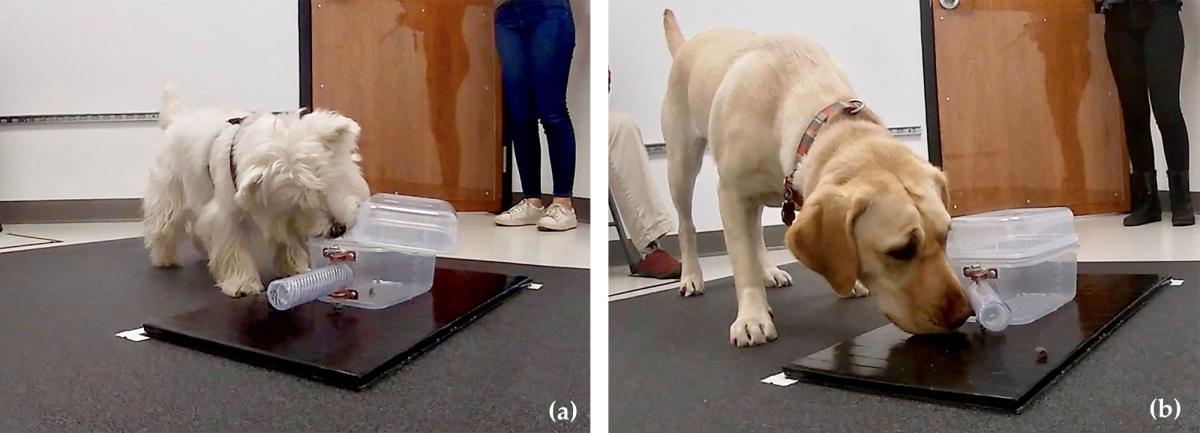
How do dogs learn from humans? We investigate the cognitive mechanisms underlying how dogs acquire new skills and information. By showing dogs demonstrations or puzzle boxes we are able to compare their learning strategies to those of human children and other animals.
Unlike human children who often copy every action a demonstrator makes—even unnecessary ones—we’ve found that dogs are highly practical. They quickly refine their process to only use the necessary steps to get their reward!
Dogs have evolved alongside humans for thousands of years, developing unique social skills to communicate with us. We explore how domestication has shaped their cognitive abilities, allowing them to read human social cues better than almost any other species.
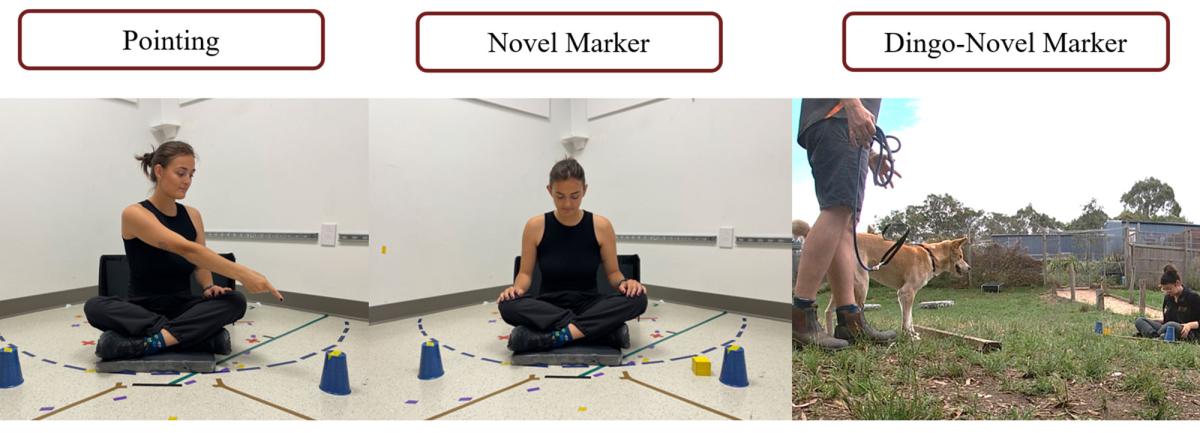
How well do dogs understand when humans intend to communicate? In this game, we test dogs’ ability to follow human social cues they have seen before and some that are brand new to find hidden treats. This helps us map the boundaries of their communicative abilities.
What do dogs think about the minds of others? Do they have expectations about how humans act, and are they interested in working together with us? We investigate our interspecies bond and look for behavioral signatures of theory of mind and cooperative intent.
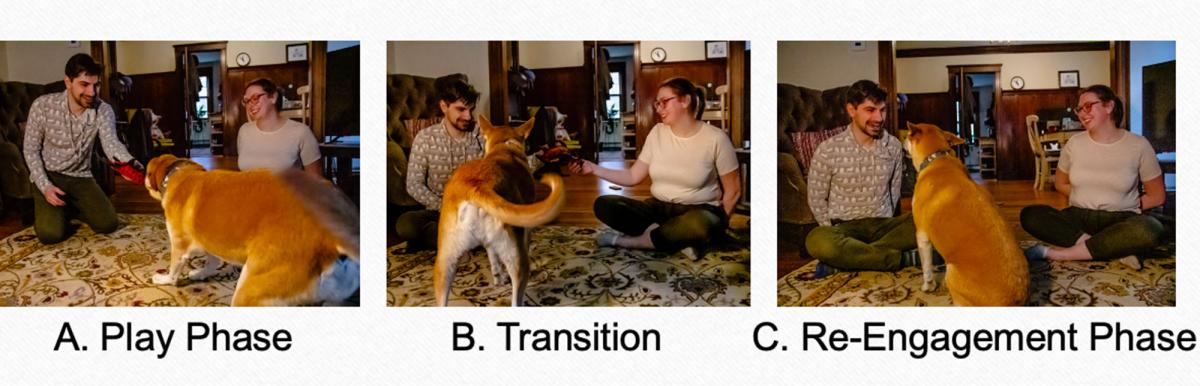
We investigate what happens when human interaction suddenly stops. Do they expect us to behave a certain way and do they want to re-engage us in the task we were doing together? This experiment compares dogs’ responses to experiments done with human children.
We are always looking for canine volunteers! Our studies are short, fun, and you get to stay with your dog the entire time.
**Fisher, C. F., Byrne, M. & Johnston, A.M. (2025). Dogs (Canis familiaris) refine their process where children (Homo sapiens) overimitate. Journal of Comparative Psychology.
Byrne, M., *Sawyer, K. & Johnston, A. M. (2024). Still Face in pet dogs (Canis familiaris). Journal of Comparative Psychology.
Pelgrim, M. H., *Tidd, Z., Byrne, M., Johnston, A. M. & Buchsbaum, D. (2024). Synchronous Citizen Science with Dogs. Animal Cognition.
Byrne, M., Horschler, D. J., *Schmitt, M. & Johnston, A. M. (2023). Pet dogs re-engage after joint activity with a human. Animal Cognition, 1-6.
ManyDogs Project, Espinosa, J., Bray, E. E., Buchsbaum, D., Byosiere, S.E., Byrne, M., Freeman, M. S., Gnanadesikan, G. E., Alexandrina Guran, C.-N., Horschler, D., J., Jiner, L., Johnston, A. M., MacLean, E. L., Pelgrim, M. H., Santos, L., Silver, Z. A., Stevens, J. R., Völter, C. J., Zipperling, L. (2023). ManyDogs 1: A Multi-Lab Replication Study of Dogs’ Pointing Comprehension. Animal Behavior and Cognition.
Horschler, D. J., Bray, E. E., Gnanadesikan, G. E., Byrne, M., Levy, K. M., Kennedy, B. S. & MacLean, E. L. (2022). Dogs re-engage human partners when joint social play is interrupted: A behavioural signature of shared intentionality? Animal Behaviour, 183, 159-168.
Byrne, M., Bray, E., MacLean, E. & Johnston, A. M. (2020). Evidence for win-stay-lose-shift in puppies and adult dogs. Cognitive Science Society Conference Proceedings.
Johnston, A. M., Byrne, M., & Santos, L. R. (2017). Is shared reality unique? Insights from a new species. Comparative Opinions in Psychology, 23, 30-33.